
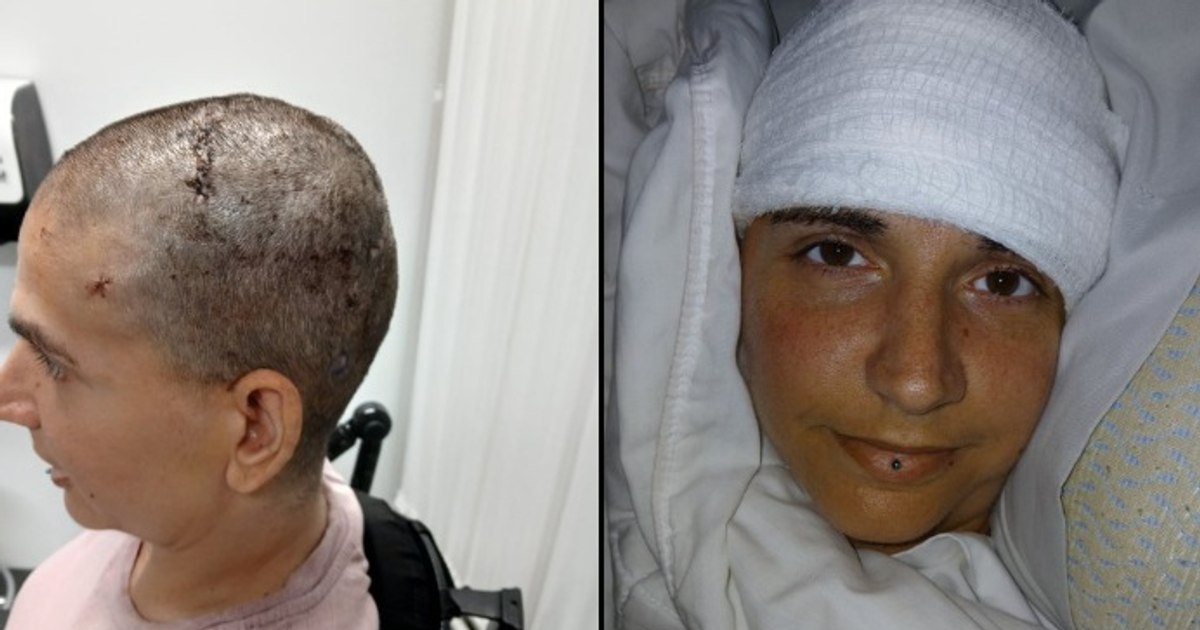
A woman, who has been completely paralyzed over the past 20 years, has regained her ability to use a computer, marking a world premiere for Neuralink, Elon Musk’s company.
Patient I was implanted in the brain Neural Link Photo: Audrey Crews/X
Due to this revolutionary implant, Audrey Crews in Louisiana, which is paralyzed since the age of 16, after being seriously injured in a car accident, revealed on the X platform as she managed to write her name on the computer screen.
“I tried to write my name for the first time in 20 years. I’m working on that“, Audrey posted on X.
Using the brain-computer interface (BCI), the beneficiary of the implant chose a purple cursor to write the name “Audrey” on the screen with cursive letters, according to the Daily Mail.
It suffered, following the car accident, injuries to the C4 and C5 vertebrae, which left it tetraplegic, without sensitivity to the arms and legs.
In July, the Neuralink procedure implanted a small device in July, in the size of a coin, in the patient’s motor cortex, allowing it to control a computer with the help of the mind.
In his posts on X after the operation, Audrey revealed how he managed to draw, write words, scroll with the mouse and use the keyboard, all through the power of his mind.
By responding to the positive feedback she received on social networks, she said she feels “released” and even began to receive requests about what to draw next, because the drawings are an exercise for it while using the implant.
The first woman in the world to suffer this procedure
Musk, the Spacex and Tesla CEO, co-founded Neuralink in 2016 together with a group of experts in the fields of neuroscience, engineering and robotics. Their goal was to combine human intelligence with artificial intelligence, treat brain disorders and, possibly, improve human capabilities in the future.
In 2019, Musk presented the N1 implant, a small device that is placed on the brain to read and translate electrical signals into shares, such as the cursor movement on the computer screen.
Audrey Crews became the ninth person who has undergone this revolutionary procedure, who allowed patients with severe paralysis or neurological disorders, such as amyotrophic lateral sclerosis (SLA), to control electronic devices by telepathy.
“I am the first woman in the world to do this“She added on X.
“Imagine your index finger is left click, and the cursor (movement) is with the wrist, without doing this physically. Just a normal day using telepathy“, This said.
The patient managed to draw hearts, flowers, rainbow and even a few faces, while moving the cursor with the help of thoughts transmitted to the implant N1.
The implant is fed by a battery
Crews’ operation at the Health Center of the University of Miami involved perforating the skull, so that the surgeons could introduce 128 threads, thinner than a human hair in the motor cortex. The wires contained over 1,000 electrodes that detect electrical signals, or neuronal impulses, produced by brain cells when a person is thinking of moving. Each thought creates a unique model of brain activity.
The implant is powered by a small battery that charges wirelessly. It sends neuronal impulses to a computer or smartphone running Neuralink’s software via Bluetooth, which are then translated into computer orders, according to the quoted source.
Asked by one person X if he ever thought he could do something like this again, Audrey replied: “Nor in my boldest dreams but the future is here”.
Musk: “She controls her computer only by thinking”
Also, Elon Musk responded to a post about the story of Crews: “She controls her computer only by thinking. Most people do not realize that this is possible”.
Neuralink patient mentioned that this will not play the ability to go again or regain the movement of the limbs, but hopes that this discovery will allow her to write a book about her journey. “I am paralyzed from the age of 16, so I have a lot to tell“She said.
The implant N1 is still in the initial testing phase, and its long -term safety and efficacy are being evaluated.
Noland Arbaugh, the first person to use the N1 implant, noted that the wires connected to the motor cortex have withdrawn, which required the device adjustment by Neuralink to maintain the connection with the tetraplegic patient brain.
