
Lake Vidraru will be emptied for the first time after six decades after the establishment and could reveal remains of the former Cumpăna settlement, a place marked by disturbing stories.
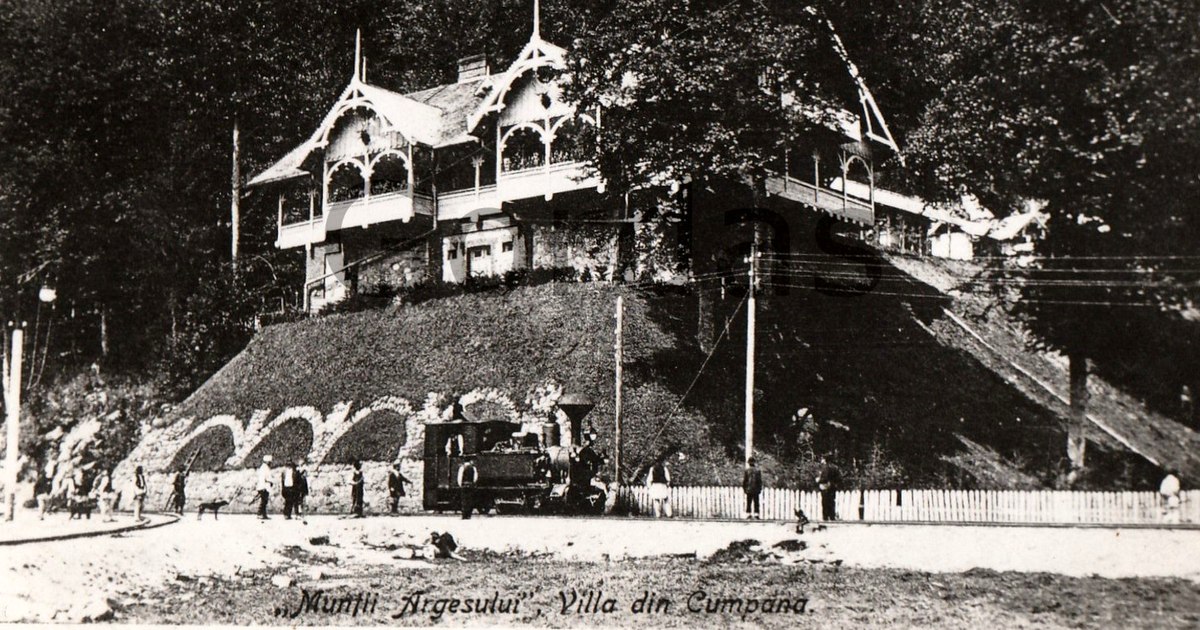
The former house of the Brătianu family. Interwar illustrated. Source: delcampe.net
From August 1, the controlled drain process of the Vidraru accumulation lake, for the first time since its arrangement, began, six decades ago.
Emptying the lake after six decades
The procedure is performed by Hidroelectrica, in several successive stages, the completion being estimated for the end of February 2026.
“This operation is necessary to carry out the technical interventions on the hydromechanical equipment of the dam, aiming to secure the entire hydropower and ensure its functioning for a new life cycle”, transmitted the City Hall of Curtea de Argeș.
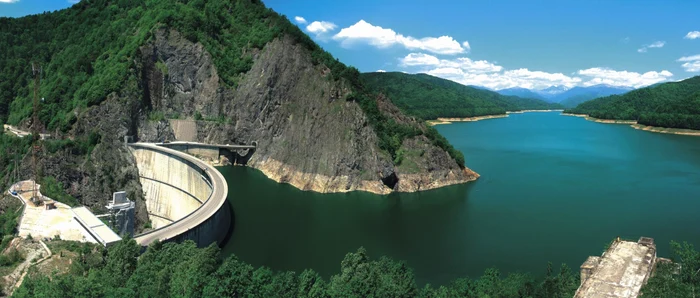
Vidraru. Photo: Hidroelectrica
The emptying of the lake is necessary for the technical teams to be able to intervene on the dam equipment, thus ensuring its safety and operation for the coming years. The process will be done, initially, by turbine, then by evacuation through the dams of the dam, taking place in several successive stages.
In the final stages, the debts will be evacuated downstream, in the river Argeș river, with values between 20 and 47 cubic me/s. The Vidraru hydropower will be re-technologized by an investment of 188.3 million euros, excluding VAT.
In the next few months, with the emptying of the lake, the Romanians who reach Vidraru will be able to see what remained on its bottom of the legendary village, swallowed by water.
What is hiding on the bottom of Lake Vidraru
Vidraru Hydrocentral, from Argeș county, with an installed power of 220 MW and the accumulation lake stretched on almost 1,000 hectares, were established in the 1960s. The Vidraru dam, on the Argeș Valley, remained one of the most spectacular in Europe. At the time of his inauguration, in 1966, the height of 167 meters and the length of over 300 meters in the fifth place, in size, in Europe. However, the local legends gave the project a gloomy connotation.
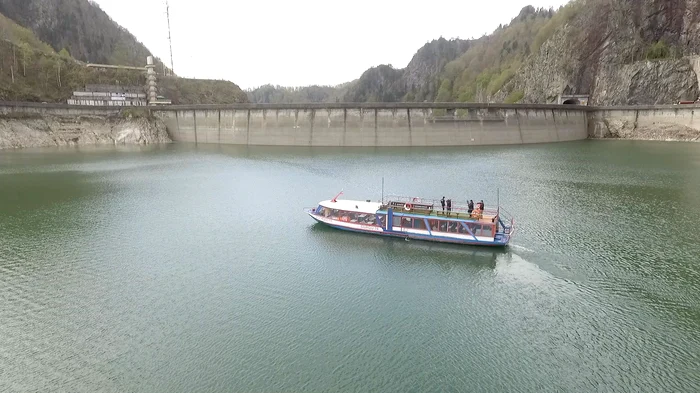
Vidraru dam. Photo: Education at height
It is said that many people have lost their lives on the dams of the dam, and a legend states that some of the inhabitants of Cumpăna village, swallowed by water, would have preferred to die than to leave their glass. In fact, the duration of the lake was over a year, enough for the authorities to convince the locals to leave the settlement. Instead, work accidents made victims.
“The accidents were, because the Vidraru Dam was a colossal construction. At the millions of cubic meters of rock, at the drilling and dynamites, there were also accidents, as now, on any site. But they were not talking and not today, it is not known how many people have been to the hospital. The former deputy mayor of Arefu commune, Gheorghe Buzoiu, who worked for more than four decades at the Vidraru hydroelectric power station.
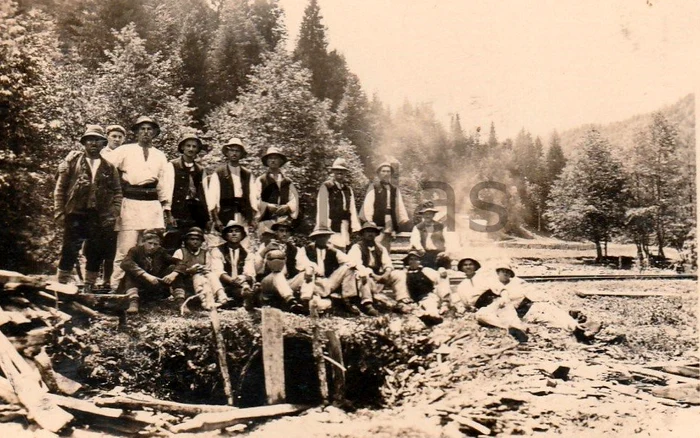
Forest workers at Cumpăna. Source: delcampe.net
Located on the Argeș Valley, Cumpăna was a colony of forest workers, with several forest cottages and a former villa of the family of Ionel (Ion IC) Brătianu (1864-1927), one of the most influential politicians in the modern history of Romania.
“In Cumpăna was appropriated Ionel Brătianu with 20 hectares, on which a beautiful Romanian villa and a wonderful park, in which, by planting, the entire Carpathian flora was built here.”informed the newspaper Universe in 1937.
The Villa of the Brazilians had reached the comparison before the filling of the lake, according to the testimonies of the time, and its memory is kept in a few illustrations. In the early 1960s, the working colonies for thousands of people who worked at the dam were installed in Cumpăna. The place at the end of a forest railway had become both an area of workers and locals, as well as one explored by tourists, proposed in the 1930s as a future resort. Also from the 1930s dates the first plans for the arrangement of Lake Vidraru.
“Before moving to the filling of the lake, it proceeded to dismantle the constructions that could be saved, including the railway that reached Cumpăna was opened piece by piece. Some constructions were even relocated, and from others only the materials were recovered. Then it was filled with water all the valley, after which a deep silence would be laid.” The story Gheorghe Buzoiu. The locals from Cumpăna were evacuated and compensated, but the legends about those who died swallowed by water, refusing to leave their glass, continued to feed the imagination of Romanians.
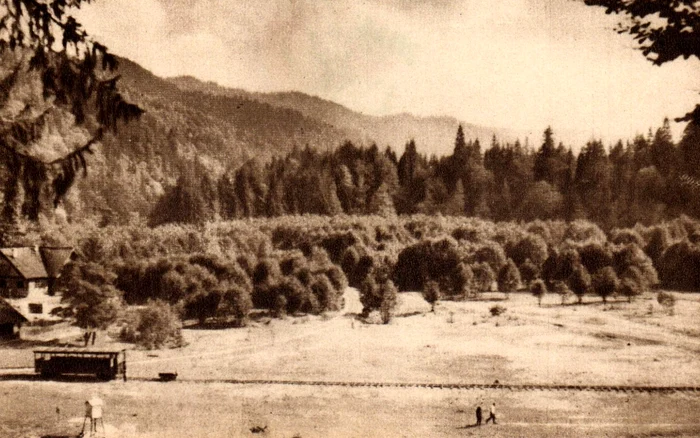
COMPANA. Photo: Delcampe. net, illustrated
The old forest resort where the logs brought from the mountains were loaded, however, kept some disturbing stories, more credible than that of the locals swallowed by water.
“At the invasion of the Germans through the staircase, to the north of Cumpăna, there were given in these places, and after the war there was a great cemetery of the heroes. At that time, Mrs. Pia Brătianu (no of Ic Brătianu’s wife), with the bag in the back, wrapped the coconuts of the mountains and gathered the heroes, the heroes. Team of students for the forest brigadies from the school in Brăneşti-who do in Pumpăna-, accompanied by the engineer Manolescu, the head of the resort, rolling the leaf deposited among beech and fir trees, not far from Cumpăna, at the point of Gruu-Căpăina, at the hive, they discovered, under the layers of the leaf, Bionet and, in a metal wallet, next to, a silver coin of a Romanian lion, before the war, and a 5 money nickel coin; inform the newspaper Universul, in 1937.
The bones of the soldier were gathered and handed over to the head of gendarmes, to be sent to the Heroes Cemetery, and the cartridges, bayonets and coins were sent to the school in Brăneşti, to be exhibited in the school museum.
“In order to be meant and preserved as a place of pious and sweet memory, the engineer Manolescu planted, in the form of a cross, with the beech in the middle of the hero, the fir trees,” informed the inter -war newspaper.
Hydroenergetic arrangement, planned in the 1930s
In the years of the war, the Cumpăna colony, at the end of a forest line that climbed on the Argeș Valley included the offices of the Forest District, two cottages, a restaurant, an electric plant, an artificial lake and a small hotel, informed the press.
From Cumpăna several roads and paths that were leading to the highest peaks, to the lakes in the mountains, and some passed into Transylvania. The area was favorable to a hydro -energy arrangement, the specialists noted.
“From keys to Cumpăna, the valley has the shape of a lighean with an opening: the keys of Argeş. By closing the keys, you can fill the valley with water, forming a level of 80 meters, which could put in motion a hydraulic turbine. respectively, but it has not been implemented (the project dates from 1936). inform the newspaper of science and travel in 1943.
The place near the springs of Argeș, Cumpăniţa, Capra and Buda, was then viewed as a future resort
“Being sheltered by the wind, having a picturesque position and being on the road that leads to the highest mountains of Romania, Cumpăna would have reached a climatic resort of the first rank, if it had not been a breaking of clouds on July 11-12, 1942. This cloud break lasted a few hours, but it was enough to turn the river. It was taken by water, the washed terrace, and the houses on the destroyed valley. inform the publication.
The railway line was repaired in the following years, but its route was then swallowed by the waters of Lake Vidraru.
