
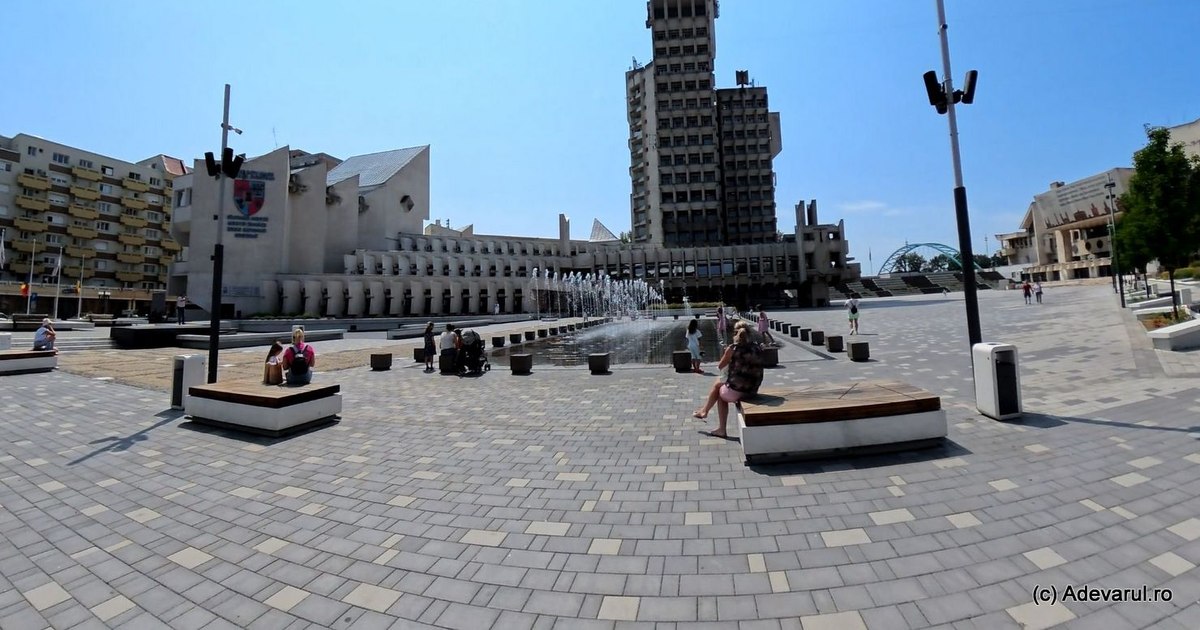
The tallest building in Transylvania rises to almost 100 meters and is the landmark of the city of Satu Mare. The architecture of the Administrative Palace has aroused numerous controversies, but some specialists have considered it one of the most successful constructions.
The Civic Center in Satu Mare. Photo: Daniel Guță. TRUTH
Located near the borders of Romania with Hungary and Ukraine, Satu Mare is among the most appreciated cities by tourists in the northwest of the country, despite the fact that it is located over 150 kilometers from the Romanian highway network.
The emblems of the city of Satu Mare
The “Highway of the North” (DEX 14), a high-speed road to connect the northwestern border of Romania and the cities of Satu Mare and Baia Mare de Suceava and the historical region of Bukovina, has been planned by the Romanian state for over a decade. But her route, almost 400 kilometers, remained at the project stage.
According to the plans, the express road called the “North Highway” would be built on the OAR route (the border with Hungary)-Satu Mare-Baia Mare-Dej-Bistrița-Vatra Dornei-Suceava, ensuring a better connection to the counties Satu Mare, Sălaj, Maramureș, Bistrița-Năsăud, Suceava, Suceava
Satu Mare welcomes his travelers with one of the most spectacular buildings in Romania, located in the center of the municipality, but visible from tens of kilometers away. For seven decades, the Administrative Palace in Satu Mare remains the landmark of the city that became a residence of Satu Mare county, in 1968.
In the early 1970s, Satu Mare went through the largest urban transformations in its history, determined by the new administrative status, but also by the need for restoration after the devastating floods of 1970. A new civic center was built between 1974 and 1987, in the immediate vicinity of the old city center, dominated by the spectacular Roman Catholic, and adorned with several other historical buildings from the 18th -19th centuries, which surround a recently modernized park.
The new civic center was designed by the architect Nicolae Porumbescu-Vaida and included a culture house with 800 seats, an outdoor amphitheater, commercial spaces and new blocks with over 1,000 apartments. In its center there was a building with 15 floors, whose peak reached 97 meters – the “political -administrative headquarters” of the county, currently called the Administrative Palace.
Nicolae Porumbescu’s masterpiece
The skyscraper block in Satu Mare was inaugurated in 1986, following a visit by Nicolae Ceausescu, and the press of the time described him as “a metaphor for the pride and dignity of all the inhabitants of this part of the country”, a community that included Romanians, but also Hungarians, Germans, Jews, Ukrainians (Roma).
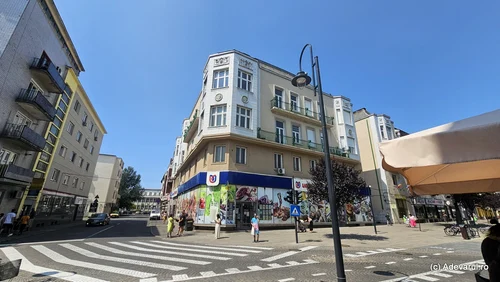
Image 1/15:
Satu Mare Photo Daniel Guță Adevărul (56) JPG
The architect described his achievement in a plastic way.
“I had to” plague “the surrounding space, to think in metaphors, to calculate its voids, which they must inevitably contain, in order to be filled with future. Life should not be wasted, the profession of architect is a continuous plea for efficiency and form. The man must stand upright, not bend to him and nothing. Then come the vertical of the construction, the vertical of the hammer. In the past, I would like to nest his Ciocârlia up, on the city tower. I reserved a small place there, would you see it? ”, said Nicolae Porumbescu Vaida, in 1986.
After 1990, the architectural ensemble had the fate of many emblematic buildings, associated with the Ceausescu regime: ironized, allowed to degrade and even vandalized. However, some specialists consider the works of Nicolae Porumbescu-Vaida to be true masterpieces towards the gray blocks, typical of the communist regime.
Among the most appreciated were the Culture House in Suceava (1965-1969), the Administrative Palace in Botosani (1968-1970), the Culture House in Baia Mare (1971) and the City Center from Satu Mare (1974-1987).
The last of them was perhaps the most successful urban architectural complex in the communist period, the note Constantin Hostiuc, a doctor in the history of art.
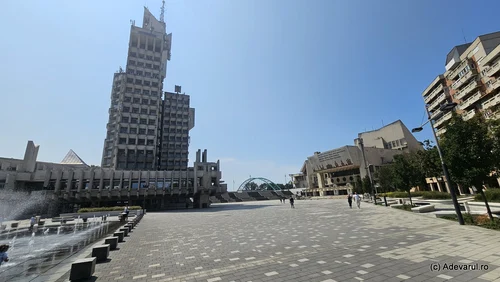
Image 1/15:
Satu Mare Photo Daniel Guță Adevărul (38) JPG
“First of all, it seems to be about the scale of intervention in the city. We are talking about intelligent and well-mastered implants, self-awakening, who sought to aggress as little as possible by volumetry. Valued the chosen place, surrounded by other spaces, buildings and textures that enter into an interesting and complex resonant dialogue.
The art critic noted that the volume of buildings was “tanned” by the natural color and using warm colors on their surfaces, and the presence of large windows creates the natural impression.
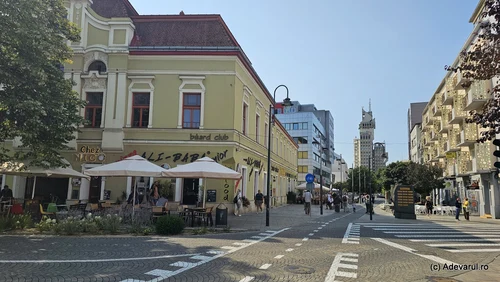
Image 1/10:
Satu Mare Photo Daniel Guță Adevărul (2) JPG
The reason for the Romanian torso forces inspired the architect Nicolae Porumbescu Vaida in his projects, being used as a connection element of simple people with the imposing constructions that appeared in their cities.
“Finally, it was almost impossible not to identify, with all its stylization, the omnipresent motif of the peasant torso force-a brand of a pastoral society, certainly” peel-element “with a unifying potential, concrete binder between the high thinking of the great architecture and the psychological attachment to the house. Cultural declaration of authority ”, the art critic showed.
