
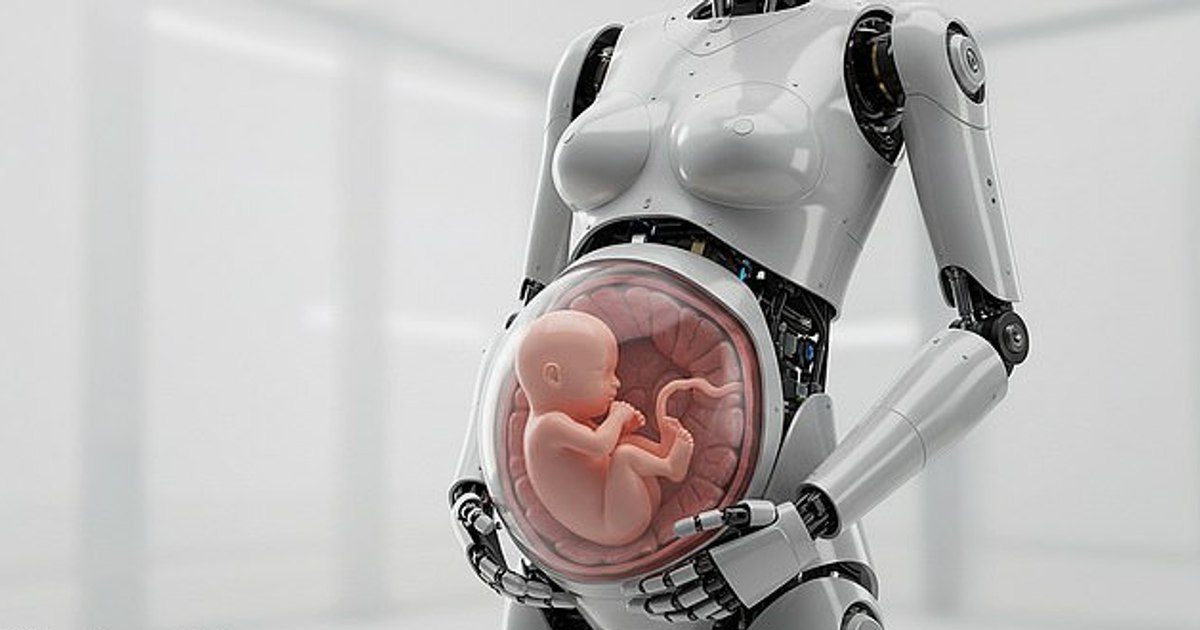
China scientists are working on the first robot capable of carrying out a task to time and born a living child. A prototype could be released next year.
China develops the first humanoid robot capable of receiving a photo child: x
An idea that until now seemed only from SF movies could become a reality. China scientists work on the first “pregnant robot“Able to carry a task to the term and give birth to a living child.
The robot will be equipped with an artificial uterus that receives nutrients through a tube, experts said. The prototype is expected to be launched next year, with an estimated price of about 100,000 yuans (about 11,500 euros).
Dr. Zhang Qifeng, the founder of Kaiwa Technology, runs the project. According to the Asian press, the device will not only be an incubator, but a robot capable of reproducing the whole process, from conception to birth. “The artificial uterus technology is already in a “mature phase” and must now be implanted in the robot’s abdomen so a real person and the robot can interact to get the task“Said Dr. Zhang, according to the Daily Mail.
Regarding the ethical and legal aspects, he said: “We organized discussion forums with the authorities in the Guangdong Province and submitted proposals, while discussing policies and legislation.”
No details have been provided about how the egg and sperm will be fertilized and implanted in the artificial uterus. Dr. Zhang made these statements in an interview published on Duoyin, the Chinese version of Tiktok.
Mixed reactions among the public
The news has triggered heated discussions on the social networks in China. Critics believe that technology raises ethical problems and is unnatural. Many have argued that deprivation of the fetus by the maternal connection is cruel and questions were raised about the sources of the eggs needed for the process.
However, some users have supported innovation, seeing it as a way to save women from pregnancy suffering. “Many families spend considerable amounts for artificial insemination, only to fail, so that the development of the pregnant robot contributes to the society“, A user wrote.
Previous experiments and historical context
Previously scientists have managed to keep in life premature for weeks using a “Artificial uterus” which resembled a plastic bag. The device, called “Biobag“He offered the fetus everything he needed to develop, including nutrients rich in nutrients and a protective bag with amniotic fluid. After 28 days in Biobag, the lambs that otherwise died have gained weight and began to increase wool.
Although the biobag works as an incubator, allowing the development of premature in an environment similar to the uterus, scientists hope that pregnant robot will be able to support the fetus from conception to birth.
Ethical and social concerns
The debate on artificial uterus is not new. Since the 1970s, feminist activists such as Andrea Dworkin have resisted firmly, considering they could lead to “The end of women”. In 2012, Dworkin wrote: “Women already have the power to eliminate men and, in their collective wisdom, have decided to keep them. The real question now is: will men want, once the artificial uterus is perfected, to keep women around?“
In 2022, researchers from The Children’s Hospital of Philadelphia, involved in the development of artificial uterus, published an article on ethical implications: “One concern is that it could lead to the impairment or even pathology of pregnancy and reduce the experience of women to find meaning, empowerment and fulfillment in this unique aspect of female biology. ”
However, a recent survey showed that 42% of people between the ages of 18 and 24 would support “Increasing a complete fetus outside a woman’s body ”.
The context of China
The development of the pregnant robot reminds of the 2023 The Pod Generation film, in which a Tech company offers couples the option to use removable artificial uterus to divide the task. In China, technology could help combat increased infertility rates, which have climbed from 11.9% to 18% in 2020. In response, local authorities include artificial insemination and in vitro fertilization to cover infertile couples.
