
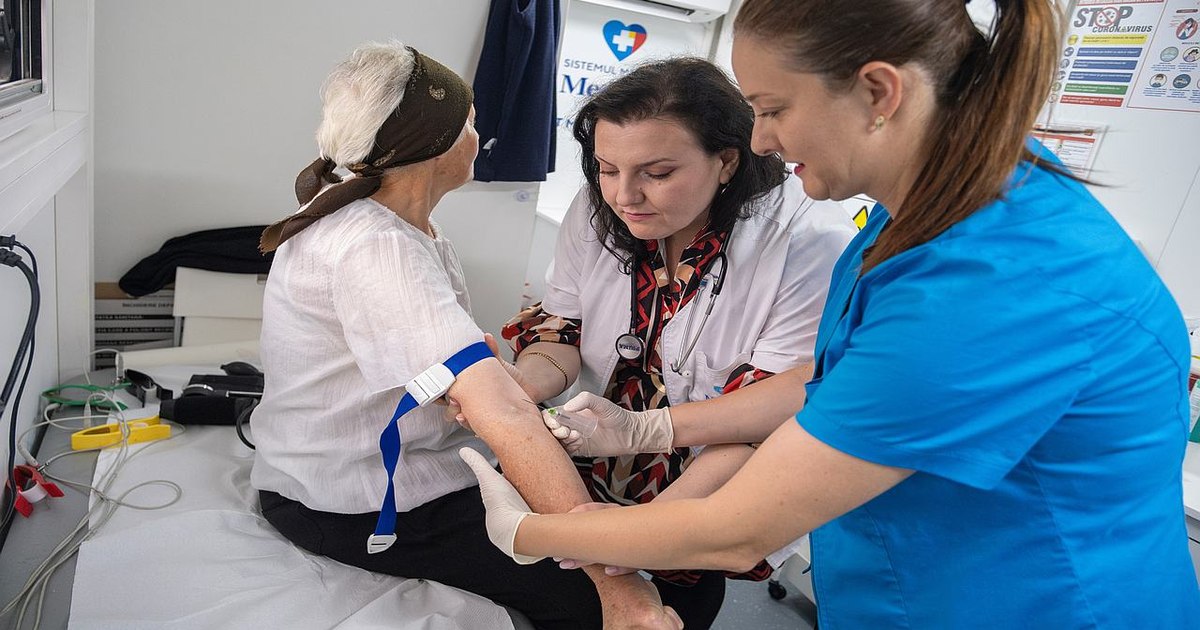
The Minister of Health, Alexandru Rogobete, officially announced the launch of mobile medical caravans, a program that will allow hospitals to provide consultations, investigations and treatments in an outpatient regime, in disadvantaged communities. The expenses would be settled by CNAS.
The Minister of Health promises medical caravans in the isolated photo archive communities
While the public message is an optimistic one, the National House of Health Insurance (CNAS) points out that the implementation depends on normative acts and, above all, money: the institution has a deficit of at least 10 billion lei.
Minister’s promise: “Patients must be in the first place”
In a Facebook post, the Minister of Health, Alexandru Rogobete, explained the reason why he decided to formalize the model of the medical caravans. He started from the hard reality of rural and isolated areas, where access to medical services is almost impossible.
“In Romania, there are still too many places where people do not have easy access to medical services. Communities in isolated or poorly served areas are often forced to wait too long until they reach a doctor, and this means lack of diagnosis and delayed treatments,” the minister wrote.
Rogobete recalled that such caravans have been existing for years, voluntarily organized by dedicated doctors.
“Over the years, many dedicated doctors have gone on their own initiative in such communities through mobile medical caravans, offering consultations, investigations and treatments where the need was urgent. I considered this model of good practice an example of responsibility and involvement for people ”stressed the official.
The new measure assumes that hospitals will have a law to organize such actions in partnership with local associations and organizations, and the services offered: consultations, diagnostic and therapeutic procedures, paraclinical investigations or even day hospitalization, will be settled by the National House of Health Insurance.
“Everything will be granted by specialist doctors, through mobile healthcare, based on the contractual relationship of hospitals with health insurance houses ”,
the minister said.
From theory to practice: CNAS “support the measure”, but the money is missing
If the minister’s public message is an optimistic one, the technical reality is much more complicated. Horațiu Moldovan, vice president of CNAS, said exclusively for the truth that the institution supports the idea of medical caravans, but the implementation depends on clear and financing rules.
“We support the measure and believe that it is a very good opportunity for Romania to provide medical assistance in disadvantaged areas, with difficult access to medical services,” said Moldovan.
However, at present there is no special law regulating these caravans, but only the general framework of the Health Law no. 95/2006. In order for them to work effectively, secondary regulations are needed.
“At the moment, we are at the level of law. The criteria, all the details, will be established by normative acts, by Government Decisions, the Framework Contract and the Norms of application ”explained CNAS Vice President.
When could all these changes come into shape?
“As fast as we can, it depends on the budgetary provisions. We will do all these in -depth analyzes, we want how fast,” said Horațiu Moldovan.
So, in addition to the lack of norms, the major problem is the budget. The National House of Health Insurance already needs about 10 billion lei to close the year 2025, and the new measure involves additional costs.
A deficit of 10 billion lei presses on the CNAS budget
According to official data, the National House of Health Insurance needs at least 10 billion lei to close the year under normal conditions.
During a press conference, which took place last month, at the Victoria Palace, together with the Minister of Health, Alexandru Rogobete, and the president of CNAS, Horațiu Moldovan, Prime Minister Ilie Bolojan acknowledged this problem:
“This year we have a budget allocated of 77 billion lei, in which our colleagues have asked us for a mandatory supplement, so that we can bring the invoices re-updated-because from March we had no financial capacity to fully pay the amounts-and also we can work until the end of the year.
The expenses for the sanitary system, through CNAS, reached 16% of the current revenues of the state budget, compared to about 11% in previous years, which creates additional pressure on financial resources.
The reactions in the online environment: between irony and hope
In the public space, the reactions to the minister’s announcement were divided. Many Romanians applaud the idea, considering it “necessary and urgent”, but others remain skeptical.
A comment on Rogobete’s post expresses frustration towards the lack of basic infrastructure:
“You do not better make cabinets in rural areas? Bun?
Another user directly criticizes the sanitary policy: “Stop right the basil! You left a lot of uninsured people believing they will pay insurance! You took the net, that those people have nothing to pay for, but you are not interested! Do not say you do well to the Romanian people!”
There are also constructive messages that require the completion of caravans with logistical solutions: “It had to be long, this action, but it is not late-only to be implemented-a ‘autofarmaic’ is required, with a record of the locations, to reach the necessary drugs-including interventions for dialysis.”
Medical caravans, in action in Timisoara
To show that “it can”, the minister also announced that on the weekend of August 23-24, such medical caravans arrived at the Oașa Monastery in Timisoara.
“This weekend, such an action takes place at the Oașa Monastery, where a team of doctors from Timisoara consults the people in the area. I thank Prof. Dorel Săndesc, who for over 5 years organizes and coordinates these medical caravans, for the inspiration and example.
I have often participated in such activities and I can say that I miss those moments. They showed me how much the proximity of people matters and how much hope it brings a simple gesture of medical support. Patients must be in first place no matter where they live“is shown on the official Facebook page of the Ministry of Health.
