
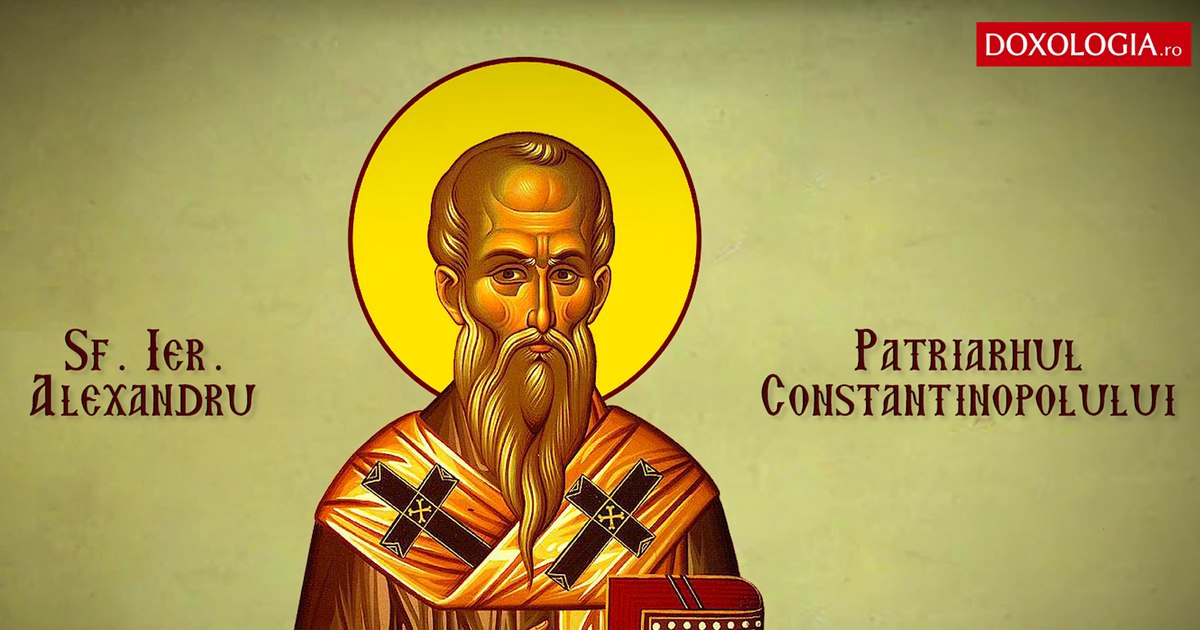
On August 30, Romanians celebrate Saint Alexander’s day, one of the greatest hierarchs and fearless defenders of the Christian faith. Saint Alexander performed unforgettable miracles: miraculous healing, the removal of demons and even the salvation of Constantinople during a violent storm, bringing peace to an era marked by religious disturbances. He remains a model of holiness and devotion, being mentioned either as a patriarch or as a bishop of Constantinople, in the time of Emperor Constantine the Great.
St. Alexander the Patriarch of Constantinople Symbol of Wisdom and Photo Faith Doxology
Each name bears a story, but few are as full of symbolism as Alexander – “The defender of the people”. Every year, thousands of Romanians celebrate on August 30, honoring one of the most respected saints of the Orthodox Calendar.
Next, you will discover who Saint Alexander was really assigned, but also traditionshabits and superstitions that have been preserved to this day. At the same time, you will find out what the name Alexander has and why he is so loved and carried by so many Romanians.
Who was Saint Alexander: The life and deeds of the Patriarch of Constantinople
Saint Alexander, the Patriarch of Constantinople in the fourth century, remains one of the legendary figures of the Church in the first centuries, according to doxologia.ro. The disciple of Saint Mitrofan, he was sent to the Synod of Nicaea and rose as an unfinished defender of the faith against Arie, the one who shakes the unity of Christians. After the death of his teacher, Alexander climbed the patriarchal throne, supported by Constantine the Great himself.
His meetings with pagan philosophers turned into true spectacular confrontations, where, by the power of prayer, a wise wise man and determined to baptize, together with his friends. But the decisive moment of his shepherd was the prayer that turned the course of history: Arie, the heretic who was preparing to enter the church triumphantly, died unexpectedly in a shameful way, before carrying his plan to the end. For Christians, this was the proof that God listened to the tears of the Patriarch.
Arriving at the venerable age of 98, Alexander entrusted his soul to the Lord, leaving behind the image of a brave shepherd, hot prayer and pillar of Orthodoxy. He is mentioned as the Patriarch who defended the church, with the same force with which a general defends his fortress.
Recognized for his courage in the face of the heresies of time, Alexander was noted for his teaching, but also by the active role in protecting the Christian community. In the iconography, it is often represented with the book of the Gospel, a symbol of wisdom and unwavering faith.
The meaning of the name Alexander and the connection with Alexander the Great
The name Alexander comes from the Greek Alexandros, which means “The defender of the people” or “The one who protects people”. No wonder this name was carried by emperors, voivodes and saints – it symbolizes power, protection and wisdom. In the Romanian folk tradition, Alexander is seen as a name that brings luck, protection and health to his bearer.
The popularity of the name is also linked to Alexandru Macedon, nicknamed Alexandru cel Mare, who, at just 33, ruled a huge empire, which stretched from Greece to India.
Saint Alexander’s popularity in Romania: Who celebrates its onomastics on August 30
In Romania, tens of thousands of people bear the name Alexandru, Alexandra or derivatives such as Alex, Alexa, Sandu, Sanda, Lixandru Lixandra, Lisandru, Lisandra, Alexandrina, Alessandro, Alessandra, Alexis, Alexie, Sandra, Andra, Săndel or Newer Sasha/Saşa. All of them celebrate their name day on August 30, bringing joy and bringing together families around the holiday table.
Saint Alexander: Traditions and superstitions of the day of name
This day is not only one of a religious holiday, but also of reflection and kindness. It is said that people have to be milder and more attentive to their neighbor, not to speak evil and show mercy to the wicked. The prayer to Saint Alexander is spoken with the power of believers, demanding health, peace and protection for the family.
Habits kept until today by Saint Alexander
- The holiday table: Households prepare traditional dishes, which they share with the neighbors or those in need.
- Agricultural Habits: In some villages, it is believed that the sowing or the sickle made on this day brings rich fruit and luck.
- Superstitions: If it rains, the year will be old; If it is clear, the holidays will have health and joys.
- Prayers and icons: The believers light candles at the icon of Saint Alexander, demanding blessing and protection.
And of course, the day brings joy to those who bear the name Alexander, Alexandra and their derivatives, being an occasion of the traditional “Happy Birthday!”
Curiosities and aspects less known by Saint Alexander in Romania
In some regions, Saint Alexander’s day coincides with local customs of cleanliness and sanctification, to drive away evil spirits.
Although Saint Alexander is revered throughout the Orthodox world, in Romania it has a special place due to the spread of the name and links with popular traditions.
The derivatives of the name, such as Sandu, Săndel or Alecu, are often used as affectionate forms, making the holiday extremely personal and close to the family.
The importance of Saint Alexander: religious and cultural symbol for Romanians
In addition to its religious role, Saint Alexander is a cultural and identity symbol for Romanians. Its name, carried by thousands of people, evokes wisdom, courage and protection, values cherished by society for centuries. Thus, the feast of Saint Alexander, marked on August 30, becomes not only an opportunity for personal joy, but also a connection between the past, tradition and present.
