
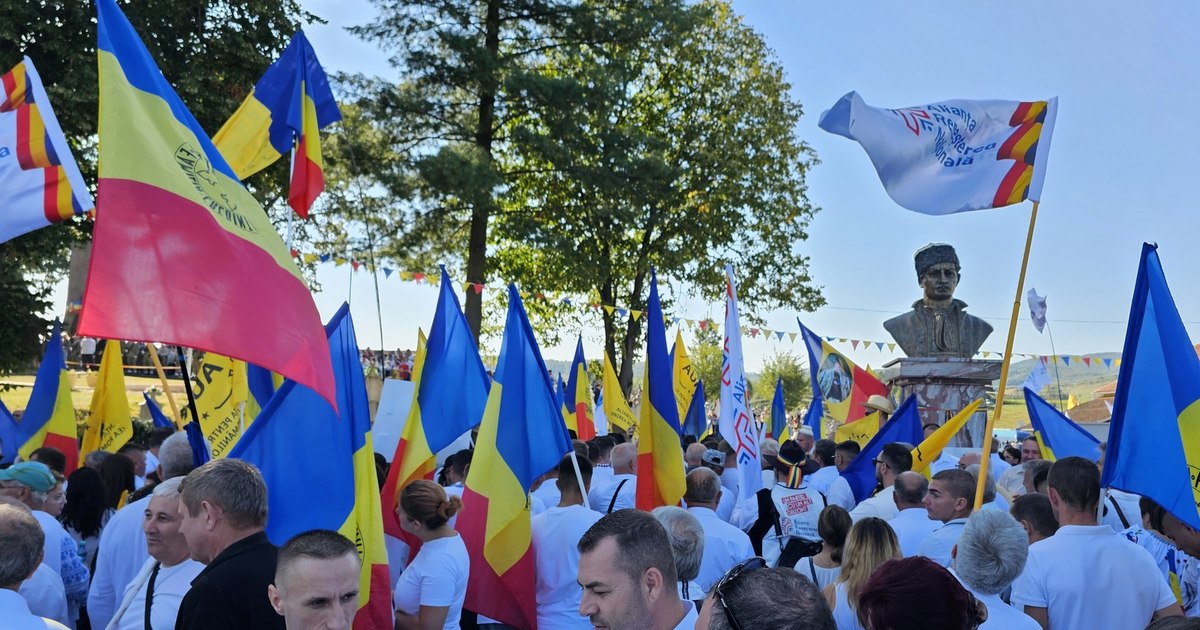
Țebea, the village where there is the place of eternity of Avram Iancu, is animated at the beginning of September, with the national celebrations dedicated to “Crăișorului Mountains”. The rest of the year, there is a place forgotten by tourists and politicians who cram here at the holiday.
Țebea has often become a place of parades with political substrate. Photo: Daniel Guță
At the beginning of September, the town of Ţebea in Hunedoara county (Video, from 2024) It returns to the attention of the Romanians, and the surrounding settlements attract tourists.
This fact is largely due to Avram Iancu (1824–1872), one of the emblematic figures of the Romanians, commemorated annually in Țebea, in the first or second Sunday in September, around the date of his death, September 10th.
On September 7, thousands of Romanians are expected again at the national celebrations in Țebea, organized on the occasion of the 153th anniversary of the death of the nickname “Crăișorul Mountains”.
The program includes, on Sunday morning, a religious service, a military parade, the laying of crowns at its tomb in the courtyard of the Orthodox Church and, subsequently, a folklore show, which will participate, among others, the artists Nicolae Furdui Iancu and Paula Hriscu.
Țebea, the place of the crowd baths
In recent years, the number of participants in these celebrations has been in a continuous decrease, and the manifestation was increasingly marked by the attempts of politicians and party supporters to stand out.
During the religious service and the ceremony of laying the crowns, the place around the tomb is occupied by politicians and officials, and the public is kept at a distance, beyond the fences guarded by the gendarmes, outside the complex from Țebea or in the cemetery.
In 2024, the atmosphere was tense after MEP Diana Şoșoaca caused a controversial incident. A local man argued with those in his suite, accusing him of humming in the church yard.
“You are not allowed to come to the cemetery to swear, the insensitive. Here is a church and the cemetery, the baths of the javre“He shouted.
The politician’s reply was just as aggressive.
“You are slaves. Slaves. Avram Iancu would not have accepted something like that. Shame on you, that you betray your mind. You are you, me?”, Replied Diana Şoșoaca.
In 2023, politicians were again in the foreground. Former Prime Minister Nicolae Ciucă, then president of the Senate, was welcomed with trucks and horns parked near the historical complex, while saying the commemorative message about Avram Iancu. At the same time, George Simion and Diana Şoșoaca were among the many politicians present at the event, as was the case at the 2022 edition.
In 2021 and 2020, the celebrations took place in a narrower setting, due to the Covid-19 pandemic, with fewer guests from the political class and several hundred participants.
“In the past, there was much more people here. Tens of thousands of people came through the 1970s – 80s in Țebea, not only for Avram Iancu, but also to spend at the Cammăneas.he remembers a local.
Țebea, silent and forgotten 364 days a year
The complex from Țebea, a picturesque settlement from the Crișului Alb Valley, which separates the Apuseni Mountains from the Metaliferi Mountains, remains almost deserted during the rest of the year.
The village 7-8 kilometers from Brad municipality, in Baia de Criș commune, is transited by Deva -Leadea Road (DN 76) and, despite its historical importance, few travelers pay attention.
Those who stop at the historical complex in Țebea find here the tomb of Avram Iancu, the Cemetery of Heroes – where Romanian soldiers from the First World War are buried and other participants in historical events in Apuseni -, but also the Gorun of Horea, the secular tree reminiscent of the leader of the Moors during the 1784.
Baia de Criș, Avram Iancu’s shadow
Located in the vicinity of the village of Țebea, Baia de Criș has been an important locality in western Romania for a long time. Until the 19th century, it was the administrative residence of Zarand County, and until the beginning of the 20th century there was a prefecture and a court. Raised in the Middle Ages, the Franciscan Monastery in the center of the town impresses today by its dimensions.
In Baia de Criș there is also the place where Avram Iancu was hosted in the last days of life and where he died, today transformed into a small museum.
“Avram Iancu perishes in 1872 in the tent of a poor house in Baia de Criș, of a donut. From here they brought him, like so many others from Baia de Criș, who did not have a church and a cemetery there, in Țebea. And next to the old oak with the proud trunk,” recalled the historian Nicolae Iorga.
Also here are the historical buildings of the former prefecture and judges, but also houses from the nineteenth century, art monuments and commemorative plaques dedicated to the “Mountains”.
Currently, Baia de Criș, once an administrative and mining center, has lost its importance. His villages count about 2,100 inhabitants, half compared to the past decades, and the train station has reached ruin.
Brad city is glowing through the Gold Museum
Brad municipality has kept the memory of Avram Iancu, but, like most of the localities on the Crișului Valley, it has been affected in recent decades by the economic decline that encompassed the land.
The high school in the locality, founded in the last years of life of Avram Iancu, bears his name and reminds both the Transylvanian hero and Father Arsenie Boca, former student.
Some monuments dedicated to the Crăișor of the mountains adorn the center of Brad, but the main attraction of the city remains the Museum of Gold, unique in Europe.
The rich golden mines in the Bradului area and their factories, brought together in the Barza mining center, were closed in the 2000s, and since then the city with 13,000 inhabitants and the surrounding communes have not recovered on the industrial level.
The railway station in Brad (video), 130 years old, is now deserted, and the spectacular railway Deva -Brad, built between 1939 and 1987, was decommissioned in the 1990s.
In the vicinity of Brad, Crișcior commune, the place of the great gold mines in the Metaliferi Mountains and some of the dramatic events of Horea’s uprising and the Transylvanian Revolution, it remained only a memory of the former Great Mining Center.
Avram Iancu, the tragic hero of the Moors
Avram Iancu (1824-1872) was an emblematic personality of the history of Romanians. In the years of the revolutionary movements in the middle of the 19th century, when Transylvania became the scene of a civil war, the young Romanian lawyer was the man to whom the hopes of the motion, involved in the political actions and in the defense of the Romanian communities. The fate of the nicknamed Crăișorul Mountains was a tragic one.
Just a few years after the conclusion of the revolution of 1848-1849, during which he noticed as a energetic leader, but uncomfortable for the Habsburg and Hungarian authorities, Iancu withdrew from public life. In recent years, a deep depression affected him, some historians say, and the disease he suffered haste in the end, at just 48 years old.
At the beginning of 1872, his state of health worsened. He was admitted to the hospital in Baia de Criș, where he spent the last weeks of his life. Avram Iancu was found dead on the morning of September 10, 1872, on the porch of the house of a local from Baia de Criș, Lieber, the baker he had overnight.
On him were found a nipple, a cherry wood whistle and a moss to Emperor Franz Joseph, anointed and mototolite, which he never sent. In the letter, Avram Iancu complained that he had become a man “completely broken, in a worthy state of being called miserable.”
The priest recorded on the death certificate the name “Avram Iancu, the hero of the Romanians”, the age of 48 and the mention “natural death”.
Avram Iancu was buried in Țebea, in the Orthodox Cemetery, near Horea’s Gorun.
