
The first magnetic fields that appeared after the Big Bang were much weaker than it was believed, comparable to the electrical activity of the human brain, shows a new study based on hundreds of thousands of computer simulations.
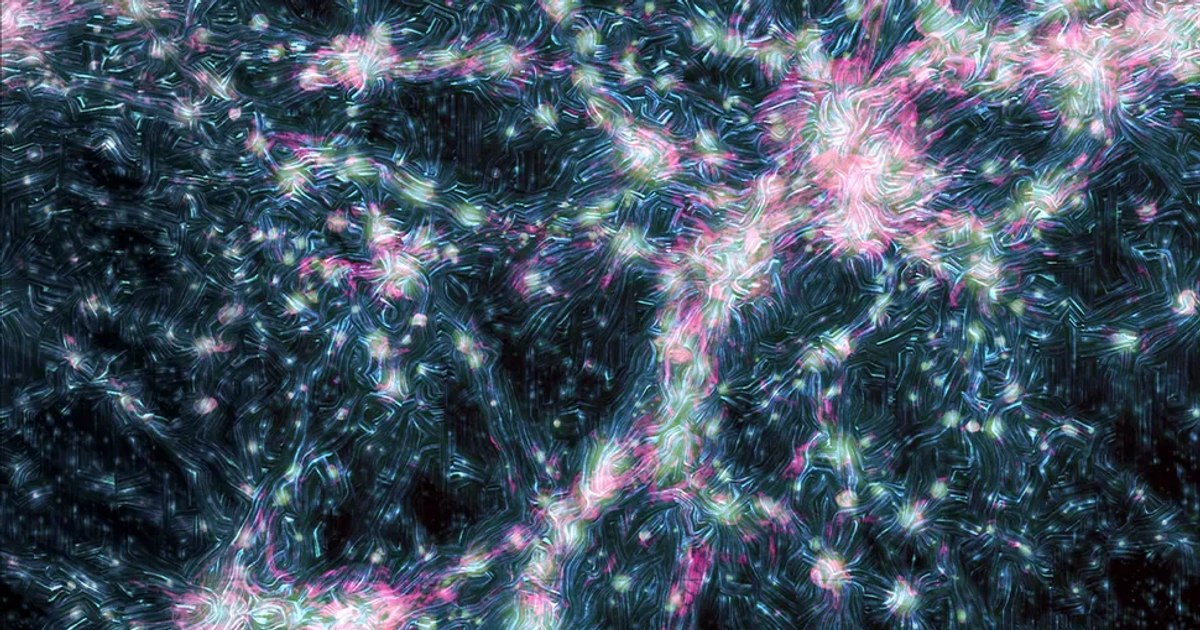
The study changes everything I knew so far about the creation of the Universe / Photo source: F. Vazza
New simulations on the computer suggest that the first magnetic fields arising after the Big Bang were much weaker than initially believed – containing the equivalent of the magnetic energy of a human brain, according to livescience.com.
The first magnetic fields of the universe would therefore have been much weaker than we have imagined so far, with an intensity close to that of the magnetic activity in the human brain, according to a new study. Researchers used hundreds of thousands of computerized simulations to analyze the remains of these ancient fields, which still persist in “Cosmic canvas” to billions of years after their appearance.
Magnetism is a natural force generated by the movement of electric pregnancies and existed from the first moments after the Big Bang, when the early universe was full of moving electric particles.
For a long time, scientists suspected that these initial magnetic fields, called primordial magnetic fields, were much weaker than those generated by complex cosmic objects, such as stars, black holes or planets.
But the new study, published on August 13 in the magazine Physical Review Letters, shows that these primordial fields were even weaker than it was assumed. Using complex simulations, the team set a maximum limit for their intensity, concluding that they did not exceed 0.00000000002 Gauss – billions of times weaker than a trivial fridge magnet (~ 100 gauss).
Such magnetic fields are “Comparable to the magnetism generated by the electrical activity of the neurons in the human brain”the researchers wrote in a statement.
The cosmic canvas hides the remains of the first magnetic fields in the history of the universe
Despite their weakness, the traces of these fields still exist in the intergalactic structure called “Cosmic canvas” – a mysterious and huge network that crosses the entire known universe. This discovery was essential for the new results.
The cosmic canvas is a vast network of invisible filaments that connects the galaxies between them, like a three -dimensional spider canvas. There are still many unknowns related to its real composition, but in recent years scientists have begun to observe it more clearly and to map it in detail.
One of the biggest enigmas is the reason why this canvas has its own magnetic fields, especially in the regions between the galaxies, where it seems to exist only “Cosmic emptiness”.
“Our hypothesis was that this (magnetism) could be an inheritance of events from the early cosmic eras, during the birth of the universe”explained the main author of the study, Mak Pavičević, a doctoral student at the Higher International School of Advanced Studies (SISSA) in Trieste, and co-author Matteo Viel, astrophysicist in Sissa. “This is the question we tried to answer through our work.”
The team believes that these primordial magnetic fields would have been “Captured” During the initial inflation of the universe and subsequently integrated into the structure of the cosmic canvas, as it developed in the spaces between the galaxies.
In the study, the researchers used about 250,000 computerized simulations, based on observational data of the cosmic canvas, to rebuild this hypothetical process and to establish “Strict limits regarding the intensity of the magnetic fields formed in the first moments of the universe”, said Pavičević and Viel.
The results are still theoretical, because there is no direct method of observing the primordial magnetic fields. However, the team claims that they are in accordance with recent discoveries related to cosmic background radiation (CMB) – the radiation remaining after the Big Bang – even if they did not specify exactly which results refer.
Researchers also say that future cosmic canvas observations with James Webb space telescope (JWST) could allow even more accurate simulations to test the hypothesis in the coming years.
