
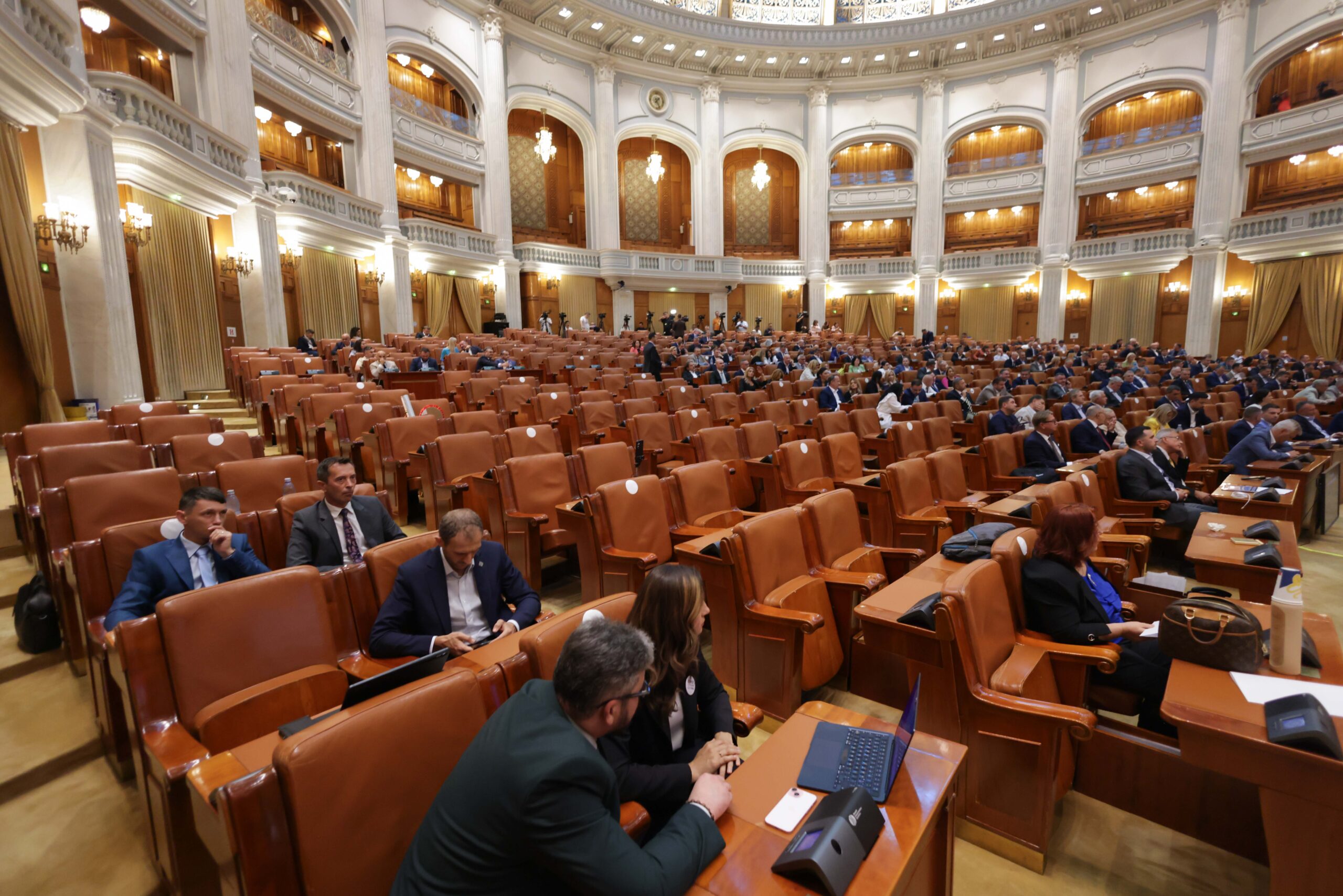
The Gold Party continues to grow in the intention to vote. The political formation led by former presidential candidate George Simion reaches 40.8% in the voting intention for parliament. In parallel, the preference for the other opposition parties fluctuates.
PHOTO Inquam Photos / George Călin
The data of an Inscop survey indicates a continuous growth of gold, in the first place in polls in recent months. The latest survey conducted between September 1-9, regarding the voting intention for parliamentary elections, shows that:
– 40.8% of voters would vote with gold (compared to 40.5% in June 2025, 38.1% in May 2025),
-17.9% would vote with PSD (compared to 13.7% in June 2025, 17.4% in May 2025),
-15.2% would vote with PNL (compared to 17.3% in June 2025),
– 12.8% would vote with USR (compared to 13.1% in June 2025, 12.2% in May 2025).
– 3.3% of voters indicates (compared to 4.2% in June 2025, 3.2% in May 2025),
– 4% indicates UDMR (compared to 5.2% in June 2025, 4.5% in May 2025),
– 2.8% indicates sauce (compared to 1.9% in June 2025, 2.5% in May 2025),
– 2.1% choose meaning (compared to 2.4% in June 2025, 3.3% in May 2025).
– 0.6% of voters express their preference for an independent (compared to 1.4% in June 2025, 1.5% in May 2025),
– 0.6% would vote for another party (compared to 0.5% in June 2025, 1.3% in May 2025).
Power vs. Opposition
In September, the power reaches 49.9%, and the opposition to 46.9%. “The first sociological measurement of the Inscop-informat.ro barometer, made after the holiday is completed, shows the consolidation of the voting for gold around the 40%threshold. There is a slight increase in the voting intention for the PSD, a slight decrease in PNL and stagnation in the case of USR.
The cumulative electoral support for the 4 parties of the government coalition (PSD, PNL, USR, UDMR) of almost 50% is only 3 percent higher than the electoral support for the opposition parliament (gold, can also) of about 47%. Even if the electoral support for the coalition parties does not collapse, the data suggests the sedimentation of a strong polarization, with half of the total voters who support the power parties and half supporting the opposition parties”, Explains the director of Inscop, the sociologist Remus Stefureac.
The presence at the vote
Regarding the presence of vote, on a scale of 1 to 10, in which 1 means that “sure” will vote and 10 “sure yes” will go to the vote, 11% of the survey respondents chose 1, 1.1% chose 2, 0.4% chose 3, 0.3% chose 4, 5% they chose 5, 2% and chosen 7. 1.2% do not answer this question.
The data were collected between September 1-9, 2025. The research method: interview through the questionnaire. The data were collected by the CATI method (telephone interviews), the volume of the simple sample, stratified by 1103 persons, representative on the significant socio-demographic categories (sex, age, occupation) for the non-institutionalized population, aged 18 years and over. The maximum admitted error of the data is ± 2.95%, to a degree of 95%.
