
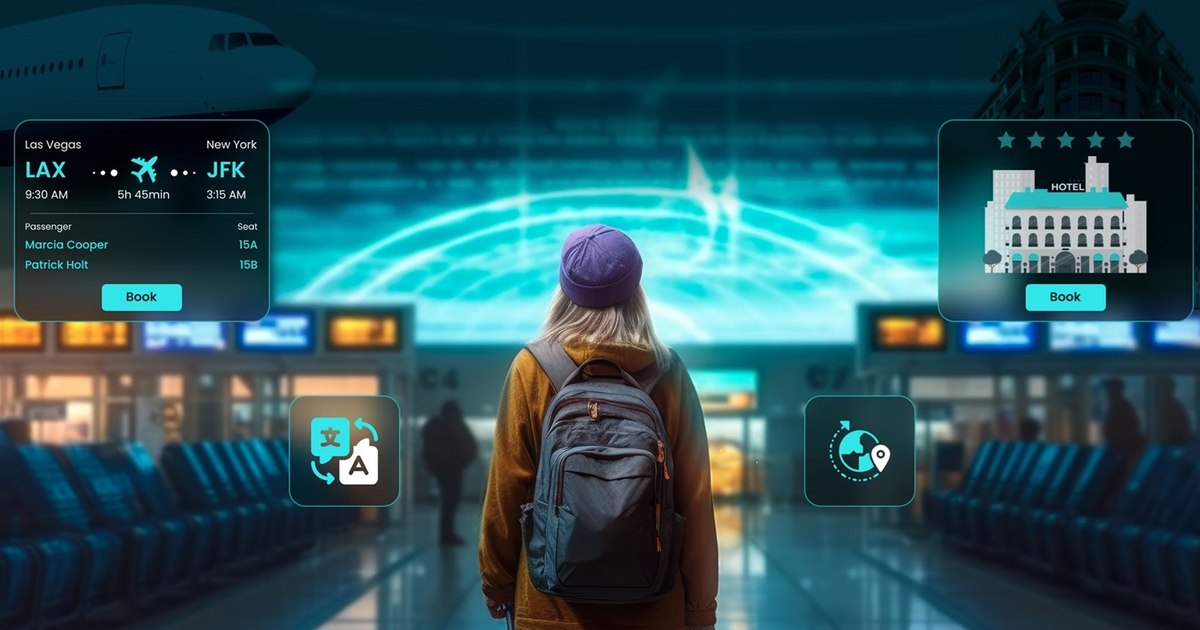
Artificial intelligence changes the rules of the game and in tourism. Technology becomes an increasingly important source of inspiration and support for travelers, gradually replacing the influence of bloggers / vloggers and influences. Tourists want more control, personalization and efficiency in organizing holidays, and you will come to respond to these needs.
Artificial intelligence changes the rules of game in the Tourism Intus com
Recent data shows that almost 90% of people want to plan their next getaway, and almost 1 in 5 already has more confidence in a digital assistant than in a content creator.
We are therefore in the middle of a major transformation in tourism: travel becomes smarter, flexible and sustainable, guided by not aspiring influences, but by calculated algorithms.
Next, we discover why tourists choose artificial intelligence instead of influences and how they completely transform their travel experiences.
Why more and more tourists prefer you instead of influence
More and more people give up the inspiration from social media in favor of AI based virtual assistants, offering personalized, updated and effective suggestions
According to the data in The global report on perception on artificial intelligence published by Booking.com87% of the respondents would like to organize their next holiday, and 19% already declare that they have more confidence in a digital assistant than in the content promoted by influencers or bloggers. These figures reveal a profound change in travelers’ behavior, including in Central and Eastern Europe.
Regardless of the country or destination, tourists are increasingly adopting a flexible, intelligent and personalized travel style. There are preferences for short escapades throughout the year, combining holidays with remote work (Remote work), choosing the middle season or extracus to optimize costs, and, above all, technology at all stages of planning.
In this context, you are no longer perceived as a search engine but as a true “Digital travel agent”able to recommend destinations, build itineraries and optimize budgets. 92% of users say they feel excited to use AI, and 74% say they understand how these systems work. However, the increased appetite to come up with requirements: respect for ethics, data protection and retaining decision control in the human hand remain essential.
Why more and more tourists prefer you instead of influencers: five types of users
Although the stated interest for artificial intelligence (Ia) is high, the users’ attitude varies considerably. Five distinct profiles are outlined.
- “Enthusiasts” (30%), curious and impatient to explore all the possibilities offered by Ia;
- “Supporters” (10%), who recognize the advantages of technology, but require responsible use;
- “Prudentii” (20%), especially concerned about privacy and cyber security clauses;
- “Skeptics” (13%), which draw attention to the risks of Bias or the lack of transparency of the algorithms;
- “Critics” (38%), reluctant to the idea that it takes too much land in the decision-making process-a concern that, moreover, is found to the other groups.
“It is essential to generate confidence, to ensure transparency and to put security in the first place when we guide our travelers and our industry through this transformation. The opportunities that await us are huge.”points out Pillar Crespo, regional director Booking.com for Spain and Portugal.
Artificial intelligence changes the rules of the game in Linkedin photo tourism
You have as an assistant, not a decision maker: the limits of accepting technology
As for important decisions, only 9% of the respondents would be willing to leave them exclusively, without human intervention. 26% still hesitate, and 12% categorically reject the idea. Therefore, the role AI is perceived rather as an assistant, not as a decision maker.
What tourists feel when they interact with AI: between curiosity and mistrust
As mentioned above, many users believe that artificial intelligence lacks an essential element: the human component, especially when they interact directly with people. Ask what sensations they cause them to use this technology, 30% perceive it as impersonal, and a significant part of them feel the need to check the information provided by AI systems.
“Generative artificial intelligence is one of the most important technological changes of our time and radically transforms how consumers interact with the world around them. As this technology evolves, not only changes how companies like ours anticipate and respond to the constantly changing needs of customers, but also raises the level of expectations,” says Pillar Crespo.
In fact, 38% of people say they always check the information received through these tools, and 29% do it occasionally – even when they trust technology.
How do you use tourists on holidays: from translations to editing pictures
Despite a certain dose of mistrust, among those who have already tested artificial intelligence, 99% use it mainly to plan their holidays or to make reservations. However, the data show that the usefulness does not stop at the travel preparation phase.
Among the most common uses are: instant translations (40%), search for activities (41%), orientation in unknown places (37%) and gastronomic recommendations (36%).
After returning from the holiday, 35% of users resort to AI to edit photos, either for social networks or for family albums.
Personalized and sustainable tourism with the help of AI
However, the modern traveler requires more than comfort. 59% appreciate the ease you offer in organization, but 67% are grateful when technology suggests less crowded destinations or alternative periods to those at the peak of season.
Moreover, 53% want to propose experiences with a positive impact on local communities – such as traditional markets, cultural projects in neighborhoods or rural routes that can reduce pressure on the most popular tourist destinations.
Future of digital travel: you propose, the traveler has
In the new era of travel assisted by artificial intelligence, you propose, the traveler has. This formula summarizes the change of paradigm in tourism, where the technology comes to support personal decisions and experiences, without replacing them.
