
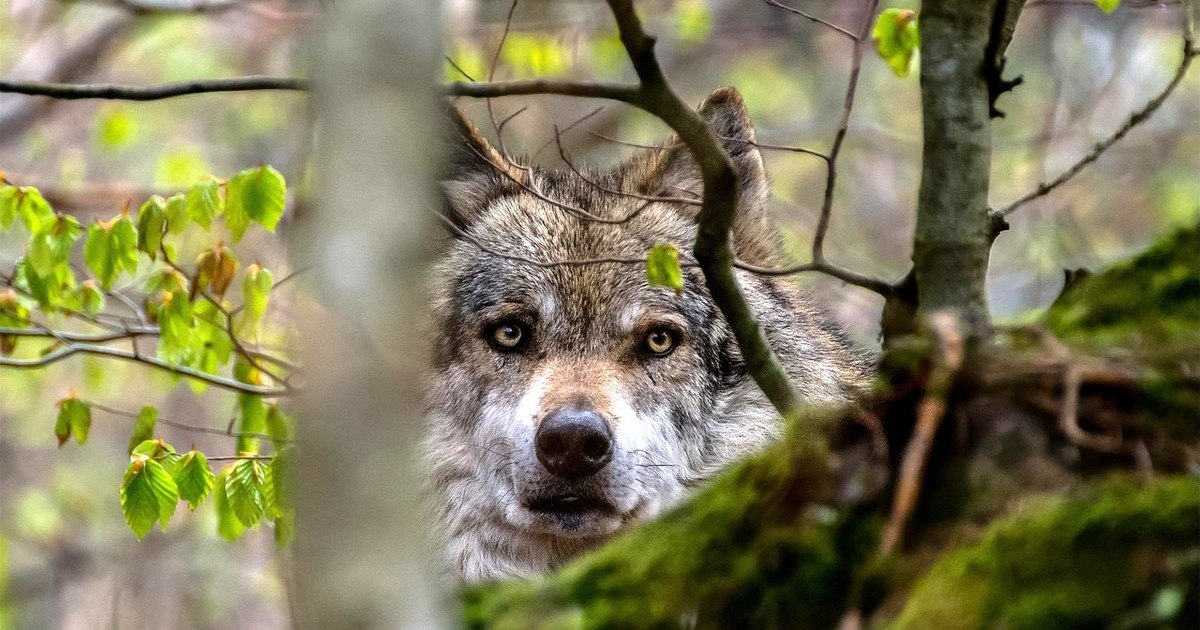
In the Poiana Ruscă Mountains, the locals kept the memory of strange confrontations between people and wolves alive, and the belief that the savages that often attacked the villagers would be people changed into wolves continue to wake them up.
Nearly 3,000 wolves live in the Carpathian Mountains, in Romania. Photo: Pixabay.
Since ancient times, the wolves were present in the culture of the people who lived on the territory of Romania.
Some historians showed that the Dacians considered them sacred animals and personifications of some deities. The wolf was illustrated on the Dacian fighters, and the warriors participated in initiatory rituals, which involved their transformation into a beast.
The wolf, revered by the ancient
The scientist Mircea Eliade showed that the name of the Dacians came from “Daoi” and designated a Thracian tribe from the Carpathians, whose name was related to the belief that his members resembled wolves: they were violently acting, like a pack, and even had the miraculous ability to turn ritually into wolves.
“In order to become a reducible warrior, the behavior of the beast, especially of the wolf, was assimilated, and the wolf’s skin was ritually dressed, or to share the way of being a carnivore, or to signify the change in the wolf.” the historian Mircea Eliade said in his work “from Zalmoxis to Ghenghis Han”.
Archeologist Ion Horațiu Crișan said that the wolf was the most common animal in the Geto-Dacian art, being represented not only as a flag, but also on many objects discovered after archaeological research.
“The modern man has to make only assumptions about the religion of the ancient Dacians, without imposing a certain opinion, at least as long as there are no other certain archaeological discoveries on its character.”added Ion Horațiu Crișan, in the volume “The spirituality of the Geto-Dacians” (1986).
Romanians worshiped wolf holidays
For centuries, the wolves have been mentioned in the popular holidays of the Romanians. On the late autumn days, the tradition celebrates the Philippines, personifications of the wolves who appear in the fog led by the Great Philippine or the Şchiop Philip, celebrated in Ovidenie, on November 21, or in Sântandrei, on November 30.
“On the nights of Philippi it was said that the wolves were looking for heated silence. Those who failed to eat fire, a universal symbol of masculinity and virility, remained for a year. In order for them to not find coals to eat, and to multiply, not to be, Filipi days ”, Ion Ghinoiu showed, in the “Dictionary of Romanian mythology” (2005).
Pricolici, tricolics and werewolves
In the archaic beliefs of the Romanians, the “pursuits” were the ones who, after death, became oyster and could take the appearance of wolves that haunted the villages to hurt people.
“The appearance of the porch, as well as its temperament and character, are zooanthropomorphs. Sometimes they wear a human -body head, sometimes a wolf head on the body of man. In the first hypostasis it represents a monstrous pseudometmorphosis, in the second hypostasis there is the carnivore in its demonic state. Roads between villages“, Show the scientist Romulus Vulcănescu, in the volume” Romanian mythology “(1985).
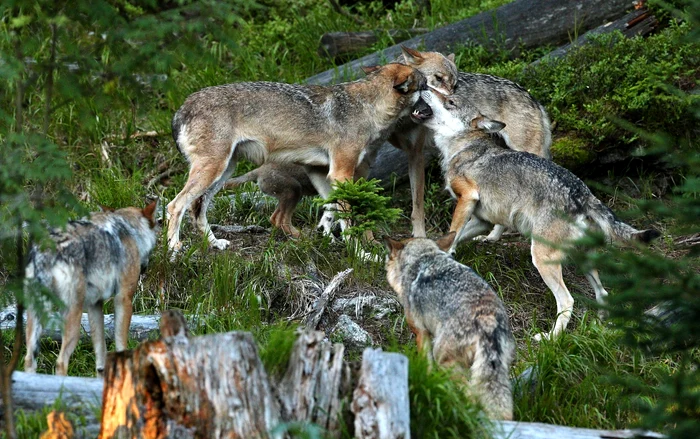
Wolves. Source: freepik.com
Due to his dirty nature and feeding with sick animals or corpses, the pricolic was considered to be a carrier of diseases and epidemics.
“His life is limited: he lives, on average, as a wolf. If the pricolic is” de -adimonized “, then a normal human life can live. It was believed that against his daimonic power could be used a pink grass that grows in the forests, in the places where a evil man or a wolf, giving the night three times over the head, turned into pursuits. The name of this plant is the “tail of the praise” (Latcus Silvestris) “adds the ethnologist Romulus Vulcănescu.
Other popular beliefs kept by Romanians were talking about tricholic, people with wolf fur. The tricolics were walking niches in the full moon nights, carnivores possessed by the demonism of destruction of everything that is alive. They were crushed on the sleeves of the praises and, once they devoured them, they turned into wolves to destroy the whole group.
“In the popular belief, the tricolics were the progeny of fantastic or infernal wolves, who were together with women with sensual nightmares in forests, or fantastic or demonic wolves who were landing with men under the same nocturnal and silvestre conditions,” said Romulus Vulcănescu.
According to the scientist, the pricolics and the tricolics should not be confused with the werewolf (in Bulgari Vurkoldak), a daimonic half -man – half wolf, which was believed to be in the sky to bite the moon or from the sun, thus causing eclipses.
The wolf who torn a family in a day
The Romanian folklore is full of stories about the fantastic endings of the wolves and about the beliefs in the associated personifications.
Years ago, in the villages of Fărășești and Poieni (Timiș county), hidden on the steep valleys from the Begăi Izvoarele, at the end of roads that are sinking in the forests of the Poiana Ruscă mountains, several villagers saw their relatives and neighbors torn by wolves. The most terrible tragedies happened, they tell them, in the 1970s, and the time could not delete them from the collective memory.
In a single day, a wolf had twice attacked the people of the meadows. He then killed a shepherd and his mother-in-law and ended his shepherd’s wife and his sister.
Maria Sârbu, then about 30 years old, survived the attack and managed to save her daughter of just a year and a half of the wild animal. However, she remained mutilated for the rest of her life.
“It was a kind of wolf, but I didn’t get to see it too well, that Mo took from the back. Mo put to the ground and torn my skin on the back. I crouched over the girl, to see. Good luck. Then I broke my mouth.“, Maria remembered, in 2000, at the age of 81.
An unknown woman had then intervened in the aid of Maria, he remembered, and managed to chase the wild animal, with a hammer. Accompanied by his mother, who had reached her, seriously injured, Maria was heading for the village to ask for help. But the wolf followed them and attacked them again, close to the house. The old woman tried to protect her daughter and granddaughter, but was seriously injured, and later died.
Also that evening, while Maria had been brought to the hospital in Timisoara, the wild animal would make a victim. She crushed over her husband, at a sheepfold from the edge of the country and killed, clasped her corners in her neck. Hearing the shouts of the man, his sister, in the hut, came out with a knife and managed to come to the animal.
“He put the wolf and attacked him, managing to stab them with a bush. Then he cut his head. It is said, in the village, that it was something unclean with that animal, that he had human features,” Tell Mircea Pasca, a local from Poieni.
Superstitions marked the village life
The villagers remained with the tragic incident in Poieni, a place in the Poiana Ruscă Mountains in which the strange superstitions have been in charge for centuries. One of them told about how, in the 1970s, also because of a “unclean spirit” that took the appearance of a wolf), people unearthed graves and beat spikes in the bodies of deceased suspected to hurt the village. Others believe that the wolf had been the embodiment of an orphan of the village, disappeared in the forest.
Another strange event, spent in 1891 in the same village, arrived in the Hungarian press. Then, the villagers broke the cave of the noble Ferencz Bogdanovici, in the belief that if they take pieces from the coat and throw them in the river they would stop the rains that had devastated the valley. The young man, son of Countess Leopoldina, had shot in 1881, at the age of 19, and had been buried in a rock-torn crypt on the edge of the village. Other versions of the story showed that not only his coat, but his body had been thrown into the waters of the river, to quench the anger of nature.
In Chergeș (Hunedoara County), another village at the foot of the Poiana Ruscă Mountains, the strange story of the Săvuță porch has circulated under numerous variants in the village.
The strange character, the locals told, got up at night from a grave and wandered the settlement to make trouble people, and sometimes change into the dog or wolf. One night, however, the locals in Chergheș unearthed and avenged them on his remains, remembered the village elders.
Romania, full of wolves
The Carpathian Mountains are home to one of the most numerous wolf populations in Europe. In Romania, the number of these wild animals is estimated at 2,500 – 3,000 copies, according to a European Commission report published in 2023.
At the level of the European Union, the total wolf population was evaluated, for the period 2013 – 2018, at 11,000 – 17,000 copies, and Romania has the highest wolf concentration between all EU states.
The wolf population gradually decreased in the 20th century, and the number of their victims also reduced. The Romanians have retained superstitions and scary legends about wolves, but the specialists claim that the fears of Romanians are generally unfounded.
“Contrary to myths, scientific evidence shows that wolves are not a danger to people: they do not see people as a prey and generally avoid contact with people, recognizing them as a threat. The presence of the wolf in European landscape Natural prey is missing or when there is an inadequate surveillance or protection for animals ”said Cristian-Remus Papp, coordinator of wild species department, WWF-Romania (World Fund for nature), on the organization’s website.
