

Europe risks registering over 2.3 million deaths caused by extreme heat until the end of the century, if continuous greenhouse gas emissions. The conclusion comes from a large study that warns that the south of the continent will be the most affected.
In 75, Europe will face a sanitary disaster due to heat / photo source: Skynews
So many people will die in Europe because of climate change by 2099. The figures are shocking
A new study has revealed the shocking balance of deaths that Europe could record due to temperatures up to 2099. Figures are much higher than previous estimates-and even the most optimistic scenarios outline a gloomy image, according to dailygalaxy.com
Over 2.3 million people in Europe could die from extreme heat until the end of this century, if continuous greenhouse gas emissions, according to a new analysis published in Nature Medicine. The research, conducted by London School of Hygiene & Tropical Medicine, covers 854 cities in 30 countries, being one of the most comprehensive assessments of mortality related to climate change on the continent.
The study estimates the net impact on the health of temperature changes – taking into account both the deaths caused by heat and those caused by the cold – for the period 2015-2099. The image is bleak: even in the regions where fewer deaths could be recorded due to the cold, the massive increase of mortality associated with extreme temperatures far exceeds these benefits.
Without real measures to reduce emissions, Europe is going to a dramatic escalation of the climate deaths.
Using 19 global climatic models and detailed demographic projections, the researchers estimate that, in the most pessimistic emission scenario (SSP3-7.0), there could be about 2,345,410 additional deaths, despite natural demographic changes or health systems improvements. The warning comes against the background of the increasingly intense heat waves in Europe – 2023 has already been the hottest year, and the data in 2024 indicates even higher temperatures, according to Copernicus Climate Change Service.
Mediterranean cities, the most exposed as heating exceeds the global average
The biggest burden is forecast in South and Central Europe, where cities such as Barcelona, Rome, Napoli and Athens will record the largest increases in heat -caused deaths. Barcelona alone could record over 246,000 climate deaths by 2099.
These regions already have high temperatures, accelerated urbanization and aging populations – factors that amplify the impact. Throughout the Mediterranean area, countries such as Spain, Italy and Greece are expecting more and more common heat waves – hot days followed by suffocating nights – which disrupt sleep and overload the cardiovascular system.
Malta occupies the first place in the standings, with projections of 268 excess deaths per 100,000 inhabitants, more than twice the average of South Europe. By contrast, parts of Northern Europe, including Sweden, Ireland and Finland, could temporarily record a net decline in temperature deaths, mainly due to the decrease of winter mortality. But the researchers warn that this break is short -lived. By the end of the century, even cities such as Helsinki and Stockholm will move on to net increases caused by extreme heat.
In Romania, 47,468 people will die over the next 75 years due to extreme temperatures
The study also shows that in Romania, about 47,468 people will die over the next 75 years due to extreme temperatures. Our country is among the states of Central and Southern Europe where the impact of heat waves will be strongly felt, both because of the increasingly torrid cousins and the vulnerabilities generated by the aging of the population and the lack of effective adaptation measures.
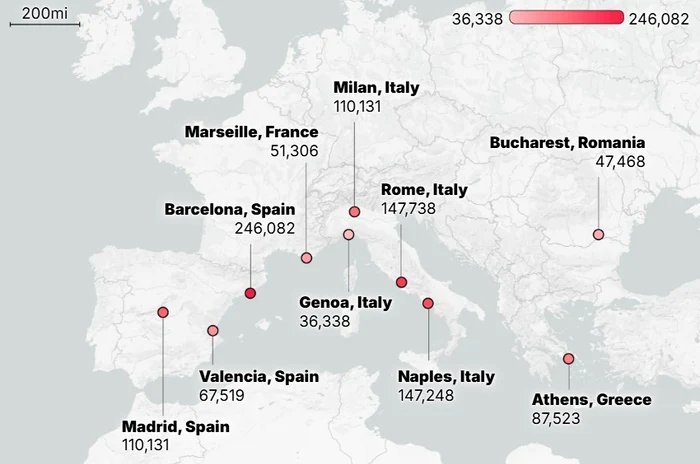
Romania was not bypassed in the study on deaths caused by climate / photo source: Skynews
Adaptation helps but not enough in accelerated heating scenarios
The study also evaluated the impact of adaptation measures – such as urban afforestation, better housing insulation and extending the use of air conditioning – on reducing mortality. Although they can bring some benefits, especially in moderate emission scenarios (SSP1-2.6 or SSP2-4.5), adaptation alone cannot compensate for the increase in the number of deaths in the future with high emissions.
Even a 50% reduction in heat -related risk – a more ambitious goal than most countries have achieved – leave Europe with a six -digit balance. “It would need a 90% reduction in the risk to completely reverse the trend-an unlikely level based on current evidence,” said Dr. Pierre Masselot, co-author of the study.
Some countries, such as Switzerland and Sweden, have shown encouraging levels of adaptation to heat waves in recent years, but others – Greece, Great Britain and Czech Republic – have made few or no progress, according to data cited in the study.
The research team also controlled for demographic changes, such as population aging, and separated the effects of climatic changes from those of population growth. In other words, additional deaths are directly related to global warming, not just societal changes.
The science behind the warning: sturdy, detailed and earthquake
Unlike previous studies, based on general national estimates, this research used temperature -mortality curves specific to each city, adapted for five age groups. The methodology integrated projections from 19 statistically corrected climatic models, demographic data from Wittgenstein Centre, as well as epidemiological functions published in the Lancet Planetary Health.
The team also ran 500 Monte Carlo simulations for each scenario, to consider uncertainties, obtaining wide trusted intervals – especially in extreme heating scenarios. In the most pessimistic scenario (SSP3-7.0), the cumulative deaths caused by heat could reach up to 4.7 million, although the central estimate is just over 2.3 million.
“There is no alarmism. These projections are based on empirical data, and the burden on health is probably underestimated.”stressed Dr. Antonio Gasparrini, main author and director of EHM Lab in LSHTM. “Our models have not taken into account other climatic risks, such as vegetation fires, tropical storms or air pollution episodes – all expected to increase in intensity.”
