
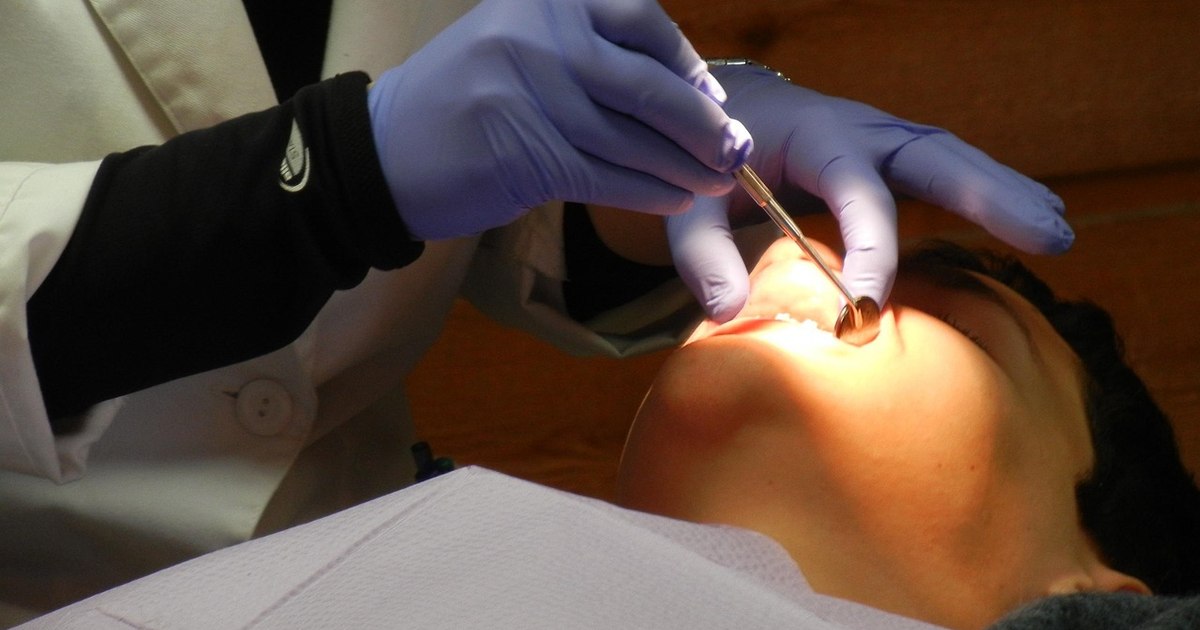
Romania is a “champion” in the prevalence of dental caries in children between the ages of 1 and 9, despite the fact that in recent years the number of dentists and the number of cabinets is increasing.
Most children get to the doctor with high photo pain: Pixabay
Europe is, in turn, the region with the biggest oral health problems among the population between the six regions of the World Health Organization (WHO), although the number of dental doctors has increased, in 2020, in all EU countries.
Over half of the adults in the European World Health Organization (WHO) region had an oral disease in 2019, the data from the WHO/Europe report from April 2023 shows, this data being included by the National Institute of Public Health (INSP).
The latest data show that the European WHO region also registers the highest prevalence of permanent tooth decay, 33.6% (approx. 335 million cases). Also in the first place between WHO regions is also in cases of loss of teeth, with a prevalence of 12.4%, almost double value compared to global prevalence (6.8%).
And oral cancers are a concern in Europe, registering the second largest estimated number, between WHO regions, new cases of oral cancer, respectively 18.5% of the total estimated cases at global level. Over 26,500 deaths in the region were attributed to the oral cancers in 2020.
Oral health problems start from very young ages, the prevalence of temporary teeth in children between 1-9 years in WHO Europe being 33.6% (294 million people). In Romania, the figures are much more worrying, almost one in two children having such a problem (48.2%).
The percentage of Europeans who suffer from problems in the oral sphere increases with aging. Thus, over 50% of the European population may suffer from a certain form of periodontitis and over 10% have severe diseases, the prevalence increasing to 70-85% of the population between the ages of 60-65, statistics show.
The number of specialists, constantly increasing. The obstacle remains the cost of services
The number of dentists operating in Romania has increased, according to the data presented by Insp, both for the public and the private environment, the growth being more obvious in the state sector. In 2022, 4,677 dentists in the public system (compared to 3,894 in 2021) and 16,753 in the private system (compared to 16,088 in 2021) carried out. However, the number of dental offices in the public sector remains reduced, practically less than a cabinet/county. In 2022, in Romania there were 16,305 private dental offices, with 163 cabinets more than in 2021, and in the public system, only 36 cabinets, with 1 more than in 2021. The costs of dental services are, in fact, one of the main impediments in treating oral health problems. In the contract with the Health Insurance House are few doctors, and the monthly ceiling that comes to each doctor to treat the insured patients (all children, for example, are eligible for such services) is below 1,000 euros, which represents a very small amount.
Diseases of the oral cavity include a wide range of problems, from dental caries, periodontal disease (gingivitis), loss of teeth, to oral cancer, oro-dental trauma or congenital defects (lip and palace). However, oral disorders that affect the general health and quality of life are caries, severe gum disease and periodontosis (severe teeth loss).
Consumption of tobacco, sugar and alcohol and precarious hygiene, the main risk factors
Sad is that oral disorders could be avoided or reduced by reducing risk factors.
“It is estimated that about 3.5 billion people are suffering from oral disorders worldwide; These conditions are caused by a number of modifiable risk factors common to many non -transmissible diseases (BNT), including sugar consumption, tobacco consumption, alcohol and poor hygiene, as well as social and commercial determinants underlying them. Over 530 million children suffer from untreated dental caries (milk teeth) and 796 million people are affected by periodontal diseases. Oral diseases are a major burden of public health for many countries and affect people throughout their lives, causing pain, discomfort, disfigurement and even death, although they can be prevented to a large extent ”, is shown in the quoted analysis.
Oral cancer, which includes lip cancer, other parts of the mouth and oropharynx, became the most common world cancer, the global incidence of lip and oral cavity being estimated at 377,713 new cases and 177,757 deaths in 2020.
“Oral cancer is more common in men and older people, more fatal to men compared to women and varies strongly depending on socio-economic circumstances. The consumption of tobacco, alcohol and nuts (Bel Quid) are among the main causes of oral cancer. In North America and Europe, infections with human papillomavirus are responsible for an increasing percentage of oral cancers. ” It is also specified in the insp.
A single school dental office, in the village, throughout Romania
It is noted in statistics the increase, from year to year, of the number of registered dentists, both in the public and private environment, but the access of the population to dental services remains a problem.
In 2022, most dentists registered in the public system were in Bucharest, followed by Iași and Cluj. In the private system, most doctors were also in Bucharest, followed by Timiș, Mureș, Iași, Prahova. At the opposite pole, the counties with the smallest number of dentists were Giurgiu and Călărași.
“In the rural area, there were 2.6 dental offices per 10,000 inhabitants, both in 2021 and in 2022, six times less than in the rural area. Regarding the accessibility, in the urban environment, a number of about 711 inhabitants return to a dentist, while in the rural, 3,885 inhabitants are served by a doctor ”, The source quoted also mentions.
Only 16.18% of children with access to a school dental office – examine or curative
Only half of the population visits a dentist every year, the insp. Children from families with low incomes or belonging to minorities almost do not have access to oral health care. Categories as widowed by such services are older adults, people living in rural areas and people with disabilities.
A project carried out by Inspot in partnership with UMF “Carol Davila” in schools, initiated in 2022, revealed a cruel reality: out of 3,843 standardized sheets according to the WHO format it turned out that only 403 of the examined children come from the rural area (10.5%). Data from 36 counties were collected, being included, from each county, 90 students each. Out of 2,439 children for whom it was possible to calculate the DMFT score (the number of teeth in the primary dentition) found a proportion of only 24.31% of children who have primary dentition (without caries, fractures, severe malpositions or other dental pathologies). The specialists found an average of about 3 carriages/ missing or plumbing for each examined student.
Problems were also found in the permanent dentition, although the figures showed something better.
Apart from the dental caries were found: gingival bleeding, fluorosis, dental erosions, dental trauma, lesions in the buccal mucosa, gums and/or lips (the most common being dental abscesses, followed by ulcers).
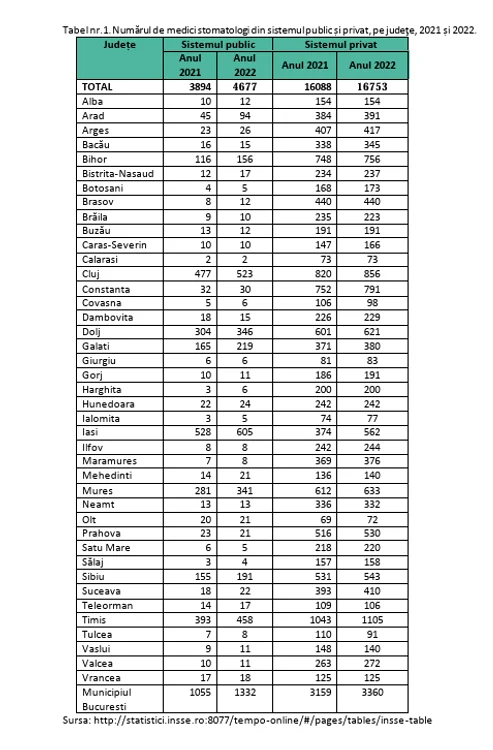
Distribution of doctors dentists by counties, in 2021 and 2022 Source: Insp report
In all the children examined, preventive or curative treatment was required, but 453 children (11.8%) would have required the immediate establishment of treatment (including descaling). 13% of the children examined needed emergency treatment, due to infection, pain or bleeding.
Another analysis, carried out on the basis of monitoring, through 316 school dental offices, oral health of the schools between the ages of 6 and 14, for three months (September, October and November 2022), revealed that they were examined for prophylactic or curative purposes only 60,939 students from a total of 376.52 School dentists, which means 16.18%. The figures indicate a very weak access of the school dental services, even where they are available.
“Given that the eruption ages of the first and second definitive molar are 6 respectively 12 years, special attention should be paid to examining children in these two age groups. From the analysis of the data received does not result any significant difference from the other age groups, only 19.2% of the total 6 -year -old students, respectively 12.8% of the total 12 -year -old students being examined in the school dental offices. Regarding the dental status, a percentage of only 32.3% of the students examined have an integral dentition, without carious lesions, so on average, 7 out of 10 children present one or more dental lesions ”, It also mentions the insp.
In 2022, in Romania there were 515 school and student dental offices in the urban environment and a single such cabinet.
“I come with very great pain, when parents can no longer handle the problem at home.”
Children are a segment of patients that not all dentists dare to treat, for various reasons. On the other hand, there are too few parents who understand the role of periodic control and who take their child to the dentist when there is no serious problem. Most of the children walking on the door of the clinic, says dentist Andreea Dumitrescu, are small patients with high pain. “They come with great pain, when parents can no longer handle the problem at home. They reach a far too advanced stage, in which the treatments are complex and we save what we can. And those who arrive for prevention are in small numbers, but fortunately growing. They also reach children that parents are constantly checking. And, very important, parents know these children. Milk teeth can be treatedbecause from this point of view we have a big problem. It is difficult with parents’ education, most of the time it is difficult to convince parents why children need to be treated. There are family doctors who do not send them to us, I tell them that milk teeth are not treated, not to come with children. Milk teeth must be treated ”stresses Dr. Dumitrescu.
For many families and costs are a problem, and the CAS ceiling means very little money compared to the need. “The funds from the CAS are exhausted in the first days, sometimes even on the first day”says the doctor.
This is one of the reasons why only very few doctors accept a contract with CAS, because they would be obliged, month by month, to decide who treats on the basis of insured quality and who does not, all the more so as another category of vulnerable patients is the elderly, who have many problems to be solved in the oral sphere and do not allow the costs.
