
Crete hides secrets that the gods do not reveal to all: each stone whispers a legend, and each wave hides a mystery. If the west of the island hypnotizes you with lagoons in shades of green and amazing blue and pink sandy beaches, and the north takes you through cities with a Venetian perfume and monasteries whispering stories for centuries, wandering in the footsteps of the old civilizations in the Minotaur’s maze and among the walls of the Knossos Palace. The realm of living myths, of the exotic landscapes that seem painted by the gods and the legends that have echoed by millennia comes as a final challenge: fabulous, mysterious, full of contrasts.
Image 1/16:
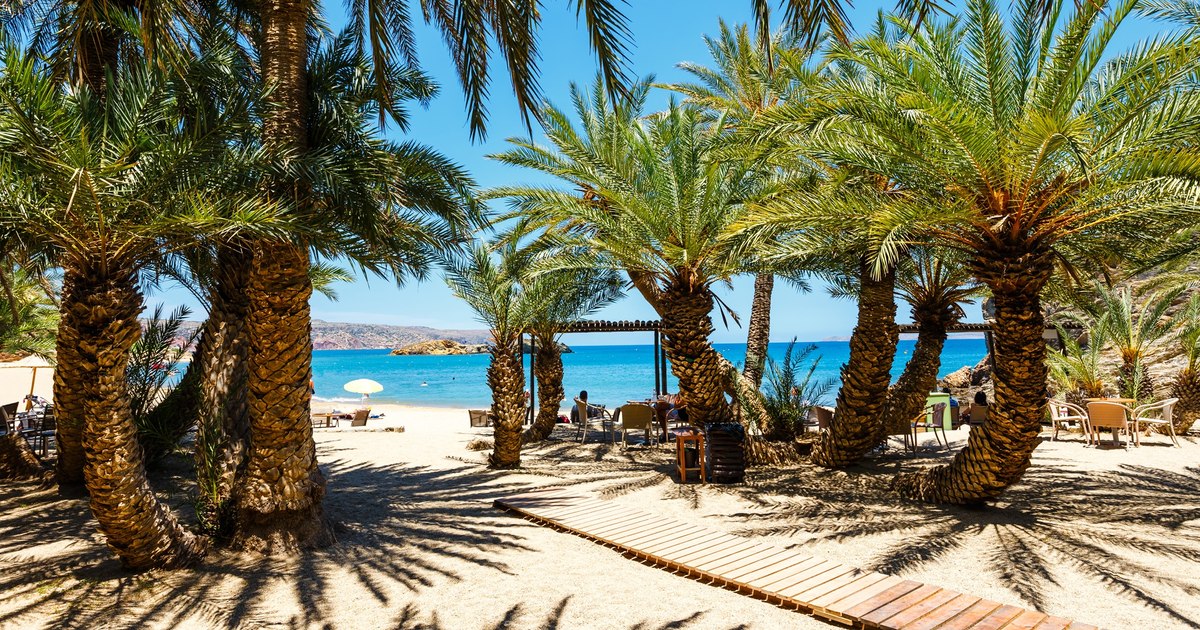
Beach Vai from Crete Greece Photo Shutterstock JPG
Here you walk into the cave of Zeus, the place where the king of the gods of Olympus was born. Cross the island of Spinalonga, a witness to the hopes and dramas that defy time, and feel the magic, where the palm trees of the largest natural forest in Europe are overflowing over the fine white sand to the turquoise waters (See photo gallery).
And after all these miracles, if you feel tired or you just want to hide from the scorching sun, the shadow of the oldest olive in the world gives you a cool and full of history.
Zeus’ cave – the place of the Olympus god’s birth in Crete
The road to the extreme east of Crete is not only a journey to turquoise and white sands, but also a descent into the heart of the myth. Up, on the Lassithi plateau, in the shadow of the windmills that still rush the old stories, the Dikteon cave is hidden – the place where, the legend, said Zeus, the king of the gods, and where Rhea hid from the devouring anger of his father, Cronos.
To reach the natural sanctuary you must climb the chest, on a path guarded by pine forests and smell of wild thyme, and then descend into the depths, on almost 200 steps twisted in the rock. In the cool silence of the cave, the bizarre forms of the stalactites and stalagmites seem carved by the gods: a stone cradle, a baby body, a mother hidden from the world.
Here is a feeling that you do not find in any book of mythology-only in the wet silence of the cave that was, once, the cradle of Olympus, the beginning of a story that would model the whole Greek mythology.
On the surface, the Lasushi Plateau also offers other treasures: Panagias Keras church, with Byzantine frescoes of rare expressiveness, an old two -millennia plate, which has seen more history than any book, and taverns where you can taste authentic chalk, in a lunch with local cheeses, slow meat and oil.
Elounda – Pearl of peace in the east of Crete
Located in the east of the island, with a spectacular opening to the Bay of Mirabello, Elounda is a charming tourist city, especially appreciated by British tourists for its relaxing atmosphere and impressive landscapes.
Along the high coast, elegant hotels, flirty cafes and refined restaurants offer views that cut your breath-the ideal place for a quiet day or a romantic getaway. Although the city is small and picturesque, its charm consists precisely in this authentic simplicity.
You can explore a few local stores, enjoy traditional dishes on a tavern on the seafront or you can walk on the promenade, which takes you to the nearby windmills.
Elocunda is often the starting point for a trip to the famous Spinalonga Island, one of the most popular attractions in the area.
Spinalonga – the island of lepers, tears and convicts, from Crete
Spinalonga, a small island, but loaded with history, is located in the Gulf of Elounda, north of Agios Nikolaos. Although today it is uninhabited, this patch of land has known centuries of greatness, pain and hope. Initially fortified by the Venetians, the island was conquered by the Ottomans in 1715.
But the most disturbing period in its history began in 1904, when it became one of the last colonies of lepers in Europe. Here, the sick were isolated, but also treated with compassion and dignity, and the island received the torn name of “The island of the convicts / tears”. The last inhabitants left it in 1957.
The reputation of the island of Spinalonga was reborn in 2007, with the publication of the novel “Island” by Victoria Hislop, who brought to the general public the painful and human stories of those who lived here. The local authorities carefully restored the houses, streets, shops and walls of the fortress to keep the island’s memory alive.
Today, Spinalonga is one of the most impressive attractions of Crete. It can only be reached by boat, from the ports of Elounda or Plaka, on a short journey, but loaded with emotion. Once you arrive, you will have about an hour to explore: from the ruins of the old homes to the Venetian fortress, the guard towers and the belvedere points where spectacular views are opened on the Cretan coasts.
Vai beach and palm forest forests in the east of Crete: Oasis with coconut and curm flavors
In the wild east of Crete, far from the noisy tasks and crowded beaches, it is perhaps the most exotic corner of the whole of Greece: alas. A real oasis, not only in the geographical sense, but also visually, sound, sensory.
Near the city of Siia, once known for the export of grapes of sultanine type – a white variety, without pips, used for raisins -, begins a strip of land that takes you from the Mediterranean and throws you directly into the Caribbean.
Vai – hidden tropical paradise, the Caribbean of Greece
Here is the largest natural forest of palm trees in Europe, a rare botanical wonder of the Phoenix Theophrasti endemic species, which descends in green waves to a white sandy beach and an almost unreal turquoise.
No wonder that in the 1970s, when an ideal image was sought for Bounty commercials, this place was chosen. The tropical paradise, said the commercials – and even this is: an exotic dream incarnated in the heart of the Mediterranean, on Greek soil.
UNESCO geoparc and routes in eastern Crete
But alas it’s not just a background for photos. The area is part of a UNESCO geopark, recognized in 2015, which gathers in a pure nature, archaeological heritage and adventure. The 23 routes lead through forests, dramatic keys and forgotten villages. The Toplou Monastery, erected in the seventeenth century as a fortress, discreetly dominates the region, and the spectacular routes that start from here-such as the Richtis Gorges with their 20-meter waterfall hidden in the vegetation, the dramatic keys of the dead, a steep canyon guarded by the minoic tombs, which leads to the Palace, to the Palace Perfect for those who prefer to discover places with stories.
Prepress – wild palm trees and hidden beaches of Crete
Only, if in the east of Crete, the palm forest forest flows directly on the fine white sand and the unreal turquoise of the sea, in the southern part of the island, nature chose another story. At Preventi, the palm trees grow along a clear river, which snakes through a steep gorge, and then reversed in a hidden bay, on the edge of Libya. It is one of the most spectacular meetings between fresh water and salt water in all Greece, which you cannot forget. Here, the atmosphere is different: less tourist, less sweetened by clichés, but even more intense.
Access is not the easiest: the descent (and especially the climb) is done on a steep path, dug in the rock, with a panoramic view on the bay. But once you get down, you have the feeling that you discovered a well -kept secret: palm trees, beach with coarse sand and the water coming from the mountains offers a feeling of another world.
Preventi – wild oasis between mountains, sea and history
In fact, Prepăli also has a special symbolic load: nearby is the Prepii Monastery, a place with a long history of resistance, from the revolts against the Ottomans to the support offered to the allied soldiers in World War II.
Maybe this makes the place seem not only beautiful, but also deep – a corner of chalk in which you feel, simultaneously, far from the world and closer to it anywhere.
And Crete keeps two more treasures, each with its story and charm, which awaits you to discover them.
Traditional villages and Crete gastronomy: the soul of the island
Crete means much more than spectacular beaches or famous historical sites. Beyond the dream landscapes is hidden an authentic world, unaltered by the alert rhythm of modern tourism: picturesque Cretan villages, with narrow streets and old houses, traditional farms and wild nature, which keep the culture and spirit of the island for generations alive.
For a truly memorable experience, we recommend a walk, with an electric bicycle or on foot, through these villages. A classic route, for example, starts from analipsi, where, in four hours, you will cross endless orchards, green pastures and paths that lead to the heart of Cretan rural life. On the way you can stop in traditional kafenions, charming places, where you will surely make friends with the locals and pamper yourself with a Cretan pie.
The Vouves olive – the oldest olive in the world, the living miracle of Crete
And if you are still in Crete, you may want to see the olive that started to bear fruit at the time when Socrates the philosopher under the sky of Athens – the oldest in the world, still alive. You will find it in the village of Ano Vouves, from the Chania region. His age is estimated between 2,000 and 3,000 years, although some research push him to an venerable existence of over 3,500 years.
The 4,000 -year -old tree still fruit
Scientists at the University of Crete, studying its huge trunk-with a circumference of 12.50 meters and a diameter of 4.60 meters-, I think has, in fact, over 4,000 years. However, perhaps the most incredible, amazing detail is that, despite its age, this ancestral tree continues, quietly, to bear fruit – year by year, under the dogitor rays of the Mediterranean, it offers olives.
The olive of Vouves is not only a vegetable record, but also a symbol of the Greek spirit. The branches cut from him were used to interweave the winners at the Athens Olympic Games (2004) and Beijing (2008), a living bridge between Greek mythology and the sports glory of the modern world. Right next to the tree, a small olive museum offers a fascinating foray into Cretan traditions, explaining how, for millennia, olive oil fed, healed and wrote the history of the island.
Cretan olive oil – the liquid gold of the Mediterranean
In fact, Crete is not only the island of myths and spectacular landscapes, but it is also a land of this liquid gold: extra virgin olive oil. Over 90% of local production reaches internationally recognized standards of excellence, and this success is not by chance. This yellow-green elixir fascinates by its intense aroma and balanced taste, and the extremely low acidity gives it a rare fineness. The secret? The rich soils, the generous sun and careful harvest, promptly done, followed by pressing in the first 24-48 hours. Thus, each drop retains the purity and nutritional value that made Cretan oil a true symbol of Mediterranean quality.
Crete in all its splendor: the conclusion of an unforgettable holiday and tourist attractions
Crete invites you to discover every corner of the island: the East impresses with the cave of Zeus, the island of Spinalonga and the palm trees of the valley; The south conquers you with the exotic beaches from Elafonisi and natural oasis from Prelii; The North combines history and culture, in the Labyrinth of Minotaur and the Kossos Palace, to the Venetian cities and the White Mountains; And the West amazes with the Balos lagoon and the Vouves olive, the oldest in the world, a symbol of Cretan tradition. Each region offers authentic experiences, from pure nature and ancient myths, to local gastronomy and extra virgin olive oil. Crete is not only an island, but a complete trip, where each visit becomes memorable and full of authentic discoveries.
