
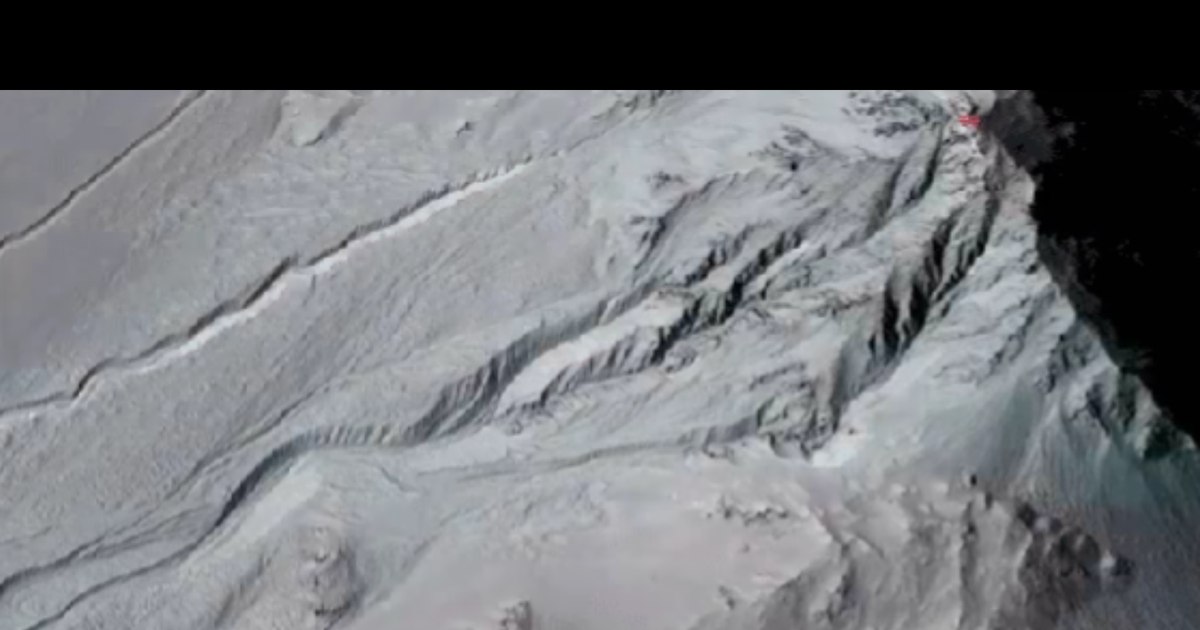
The mysterious movements beneath the dunes on Mars are not caused by water, but by dry ice, according to a new study published in Geophysical Research Letters.
Trenches on Mars/PHOTO: X@NASA
For years, scientists have wondered what created the sinuous grooves found in sand dunes on Mars. These forms, which stretch across the mid-latitudes of the planet, resemble erosion caused by liquids. However, a new explanation has emerged, writes the Daily Galaxy.
The trenches were first identified in 1999 through high-resolution images captured by Mars orbiters.
Initial theories of how these trenches formed focused on the seasonal flow of water, an idea that quickly gained ground in the search for signs of possible life on Mars.
But despite the appeal of the water hypothesis, there was a lingering problem: Mars is too cold and dry to support liquid water. Direct water flow has never been observed in the areas where these ditches occur.
In 2013, researchers proposed an alternative theory: the trenches could be dug by dry ice (solid CO₂) sliding down the dune slopes, sublimating as it moves. However, some of their most distinctive features, such as their sinuous curves and well-defined banks, remained unexplained.
A team led by Lonneke Roelofs from Utrecht University recreated conditions on Mars in the laboratory. In their study, using a Martian chamber at the UK’s Open University, they mimicked the Red Planet’s thin atmosphere and cold temperatures.
The experiment consisted of releasing blocks of solid CO₂ onto inclined surfaces covered with sand. The cameras recorded the behavior of the ice under various slope angles and surface conditions.
The result was unexpected: on gentler slopes, the dry ice did not simply slide, but partially sank into the sand. As it did so, it began to act like a burrowing object, ejecting material and digging channels very similar to those on Mars.
The process takes place by sublimation: the dry ice turns from a solid directly into a gas, and the pressure built up under the ice blocks causes them to “explode“, throwing sand and forming winding trenches. Experiments have shown that large chunks of ice can project sand up to 13 meters in the low gravity of Mars.
During winter, the CO₂-rich atmosphere on Mars freezes on the surface, forming a layer of dry ice that can be up to 70 cm thick. When spring comes and the planet warms, this layer begins to sublimate.
The last fragments of ice, often found in the shade and located on the crests of the dunes, crack and slide down the slopes. Even after they stop, the ice continues to sublimate, accumulating gas that pushes the sand out and leaves a distinct gap at the base of the slope. This process only works in fine sand, explaining why trenches are not found everywhere on the planet.
