
More mining ponds will be greened in the coming years, the Romanian state announces, but Romania has kept many such “industrial scars”, which create a lot of environmental problems and for the communities living near them.
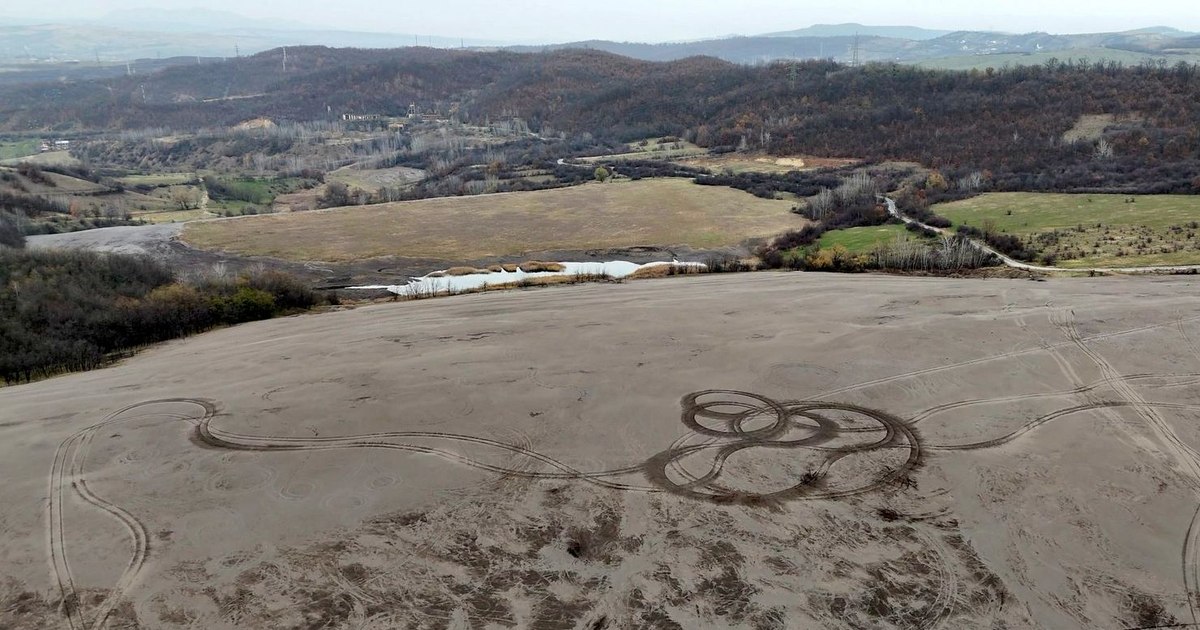
The settling ponds from Teliuc. Photo: Daniel Guță. TRUTH
The mining industry, which went into a steep decline after 1990, left behind almost 100 tailings ponds and over 1,000 tailings dumps, originating from the numerous mining operations that operated on Romania’s territory and were closed after 1990.
Hundreds of ponds and tailings dumps
After mining ceased, buildings and industrial facilities were decommissioned, but greening, an expensive process, encountered difficulties. Almost half of the country’s counties have preserved abandoned industrial “scars” in the vicinity of former mining areas.
Starting from 1998, according to a recent report published by the Directorate of Mineral Resources of the Ministry of Economy, through 11 Government decisions, the definitive closure, conservation and monitoring of post-closure environmental factors of 556 mines, located on the administrative territory of 227 local communities in 28 counties, was approved.
“Within these mining objectives, there are important industrial waste deposits that fall under the provisions of the legislation on the storage and safekeeping of hazardous waste, respectively 78 settling ponds with a total stored volume of 341 million cubic meters and an occupied area of approximately 1,770 hectares, and 675 mining dumps with a volume of 3,101 million cubic meters and an occupied area of approximately 9,260 hectares, for which must ensure the monitoring of the stability over time of the mining deposits and the performance of the minimum works and activities necessary for safekeeping, as well as a number of 2,504 mining works connecting the surface (galleries, shafts, shafts), through which it is possible to penetrate underground into an artificially maintained mining atmosphere”, shows the 2023 report of the Directorate of Mineral Resources.
The problems of mining ponds
Most of the settling ponds are located in counties where metal mines played an important role in the local economy: Maramureș, Hunedoara, Alba, Caraș-Severin, Bihor, Suceava, Harghita and Cluj. By the end of the 2000s, almost all of these operations were closed, and their ponds received less and less attention from the companies that managed them and the state.
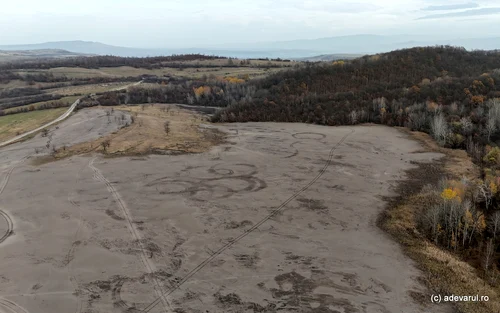
Image 1/15:
The ponds at Teliuc Photo Daniel Guță THE TRUTH (42) JPG
Many of these ponds have raised environmental concerns, being located near human settlements or nature reserves. A 2017 Ministry of Economy report, which inventoried the state of ponds and tailings dumps, showed that several tailings ponds had deficiencies in safety works: partially destroyed dikes, ravines and seeps caused by rainwater, clogged channels.
In some cases, the waters carried the tailings towards the base of the dikes or formed extensive puddles on the surface of the ponds. Others were at risk of material being washed away by floods or slope failure. There were also ponds exposed to the wind, which raised dust clouds laden with heavy metal powders over the surrounding areas.
In several cases, closure and greening work that had begun was abandoned due to lack of funds. In others, monitoring was almost non-existent or the owners of the perimeters were not clearly identified, the ponds belonging to companies in bankruptcy or liquidation. The authorities have announced in recent years the continuation of greening works where they have already been started, obtaining new funds to fix damaged works, starting new greening projects or, at least, monitoring the ponds’ behavior over time.
Maramureș and Hunedoara ponds greened
Recently, the Ministry of Economy, Digitization, Entrepreneurship and Tourism (MEDAT) informed that the Government Decision was approved which ensures the continuation of financing from the Environment Fund for the closure and greening of some tailings ponds in the mining sector, until December 31, 2028. It concerns industrial areas entered into greening processes, which have been suspended for several years.
“The financed works are aimed at securing and greening the tailing ponds related to mining perimeters that have been abandoned for over three decades: Certej Mine – Valea Mireşului and Valea Mealu ponds (Hunedoara county), Teliuc Mine – ponds no. 1, 2 and 3 (Hunedoara county) and Baia Sprie Mine – Tăuţii de Sus pond (Maramureş county). implementation of the works varies between 12 and 24 months, depending on the technical complexity and environmental conditions in each location”the Ministry of Economy shows.
The financing program for the closure of settling ponds was initiated in 2010, by GD no. 1034/2010, with a total value of 100 million lei, and continued by GD no. 181/2020, which allocated 57.8 million lei. The new decision allows the continuation of the works until 2028, and the financing of the greening projects in Maramureș and Hunedoara amounts to over 126 million lei.
“Romania has dozens of contaminated industrial sites, inherited from the period of intensive mining operations. Many of these sites present significant risks for groundwater, soil, biodiversity and the health of local communities. In the context of climate change and the increase in the frequency of extreme weather phenomena, every year of delay increases the risk of ecological accidents – landslides, tailings leaks or water contamination“, adds the Ministry of Economy.
Maramureș County, affected by historical pollution
Since the Middle Ages, Maramureș has been an important mining region of Transylvania, whose activity gravitated around the city of Baia Mare, surrounded by mining towns. In the 1980s, Baia Mare plants produced copper, selenium, lead, gold, zinc and numerous chemical products — from sulphides and sulfuric acid compounds, to inorganic salts, bleaching earths, reagents and liquefied oxygen. They had over 10,000 employees and a history of over a century.
In the 2000s, the big factories in Baia Mare and most of the mines in the vicinity of the city were closed. The Phoenix industrial platform was partially demolished, and tens of hectares of industrial ruins remained behind it, dominated by the highest decommissioned tower in Romania, over 350 meters high, abandoned for over two decades. Much of the land is covered in ruins and contaminated with toxic residues and heavy metals, even though the city’s air has become cleaner in the meantime.
Less than three kilometers away, the former Phoenix Lead Plant, which went bankrupt in 2012, offers a similar picture, albeit on a smaller scale. The industrial decline of the 1990s left more than 300 tailings dumps and nearly 20 mine ponds around the mining and metallurgical center of the north of the country. Some have never been greened, and in recent years, pollution issues have frequently returned to public attention.
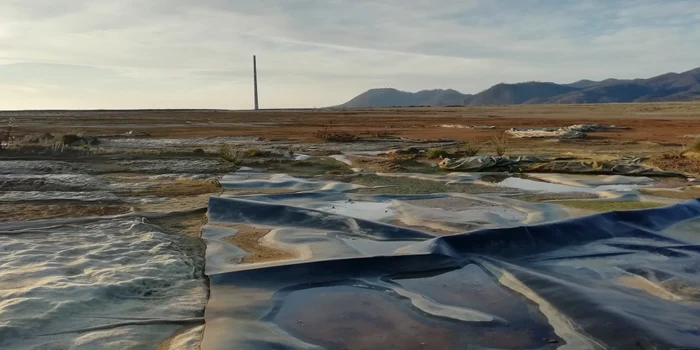
The pond from Tăuții de Sus. Photo: Gogreenresources.
The greening of the pond at Tăuții de Sus, located in the immediate vicinity, was seen as the beginning of steps to remedy the pollution problems caused by heavy industry. However, the process was not completed, with the works reaching 60 – 70 percent.
“The works, blocked for years, will be unblocked and accelerated in order to definitively eliminate this major risk for public health and the environment. The tailing pond at Tăuții de Sus, abandoned after mining operations, contains arsenic, lead and cadmium, polluting the water, soil and air”, recently informed the Minister of the Environment, Waters and Forests, Dan Buzoianu.
Greening involves covering the pond with topsoil, installing successive layers of protection (geotextile, geomembranes, ballast drainage layer) and reconfiguring the land for the installation of perennial vegetation.
The ponds in Teliuc, Hunedoara desert
The iron mines of Teliuc and Ghelari, located in the vicinity of Hunedoara, have a history of almost two millennia. In the 1970s, Teliuc mining reached its greatest expansion, following massive investments by the communist regime in the extractive industry. Thousands of people worked at Teliuc and Ghelari, to secure part of the ore used in the steel plant in Hunedoara.
Entering an irreversible decline in the early 1990s, all the iron mines in the Poiana Ruscă – Hunedoara Mountains were closed, and by the mid-2000s mining activity had completely disappeared.
The former Teliuc and Ghelari mines left behind hundreds of hectares of land occupied by disused mining buildings, facilities, mining ponds and various other industrial ruins, on which time, nature and people have left their mark.
The greening works started at the end of the 2000s in Teliuc started with the three ponds of the former mine, which together cover almost 90 hectares.
They were later suspended, and until now only one of the three ponds has been completely greened, another only partially, and in the case of the third pond and some former mines in the area, the resumption of work by the Ministry of Economy has been expected for several years. Meanwhile, the ponds of Teliuc look like a gray desert, over which the winds raise waves of toxic dust.
Near the tailings ponds, the former Teliuc mine, decommissioned in the 2000s, was gradually flooded and turned into a mining lake of over 10 hectares. The water level is constantly rising and is gradually covering the former mining buildings on the banks. The local authorities’ plans aim to fence the lake, stabilize the banks and develop it as a recreational area.
The Certej pond reminds of the catastrophe of 1971
Located at the foot of the Metaliferi Mountains, the Certej mining town has an industrial history of over two and a half centuries. Gold and silver were mined here, as well as complex ores. The former decantation pond at Certej caused one of the biggest mining catastrophes in Romania.
On October 30, 1971, nearly 100 people died in Certej, after the dam of the mine’s tailings pond broke, and hundreds of thousands of tons of mud and tailings fell on the houses and workers’ blocks in the locality.
In the following years, the mining activity continued and expanded to the surface, with the opening of the Coranda quarry, one of the largest mining quarries in Romania. In the 1980s, Coranda expanded to more than 60 hectares, with steps of 10–15 meters.
Excavators with buckets of more than four cubic meters and huge drills worked here, and 40-ton tippers and funiculars were used to transport the gold and silver ore, containing copper, zinc, iron, magnesium and sulfur, to the preparation plants in the locality.
The Coranda quarry and the mines in its vicinity went into decline after 1990, and by the mid-2000s they ceased to operate, as did all the metal mines in Hunedoara.
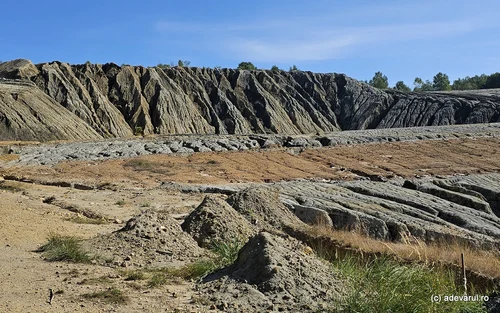
Image 1/9:
Iazul Certej Photo Daniel Guță THE TRUTH (19) jpg
The new decantation pond in Certej, set up in a less risky area than the former decanter, remained abandoned at the edge of the town, bearing visible signs of degradation.
