
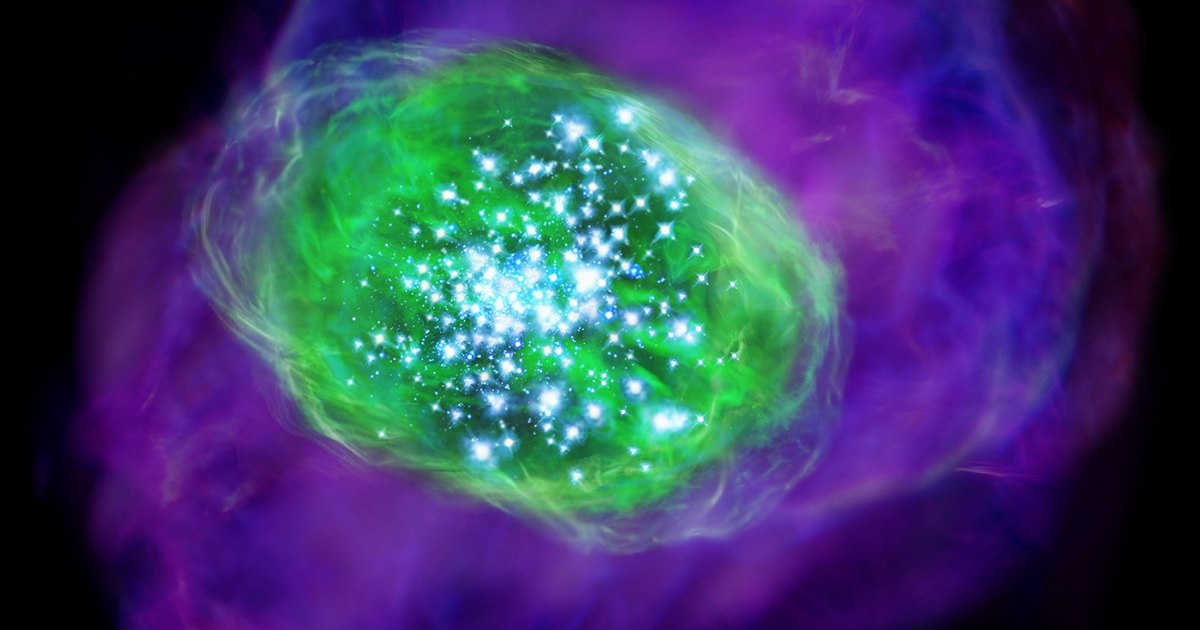
JWST captures an extremely young galaxy with unusually intense stellar activity that contradicts current models of early galaxy formation.
The galaxy, called SXDF-NB1006-2 PHOTO> X
Astronomers used the James Webb Space Telescope (JWST) to study a remarkably young and highly active galaxy in the early universe, revealing intense star formation and massive gas flows that contradict some existing models of galaxy evolution, writes Space.
The galaxy, called SXDF-NB1006-2, existed when the universe was less than 500 million years old and appears to be only 1–2 million years old, making it one of the youngest large galaxies ever discovered.
An explosion of stars in an extremely young galaxy
SXDF-NB1006-2 forms stars at a rate of more than 165 solar masses per year, more than 16 times the rate of the Milky Way.
This accelerated rate generates many massive, very hot stars that send huge amounts of radiation and particles into space.
These stars rapidly explode as supernovae, injecting even more energy into the galaxy and heating the gas to extreme levels.
As a result, JWST has detected huge streams of gas being ejected at more than 500 km/s, three times faster than the galaxy’s escape velocity.
Once gone, this gas never returns, leaving the galaxy without the material needed to form future generations of stars.
Unexpected elements indicate the existence of an older stellar population
Although the galaxy is extremely young, JWST detected surprisingly high levels of heavy elements.
Because such elements only appear in earlier generations of stars, astronomers suspect the existence of an older stellar population hidden behind the intense light of newly formed stars, an unexpected finding for such a recent galaxy.
The fate of an extremely young galaxy
The researchers estimate that the galaxy will use up its gas reserves in just a few hundred million years, turning into a massive but “quiet” galaxy in which stars are rarely formed.
JWST reveals surprisingly massive and bright early galaxies, contrary to expectations. Astronomers liken them to “teenagers in a kindergarten class,” an image that suggests a much more active early Universe than previously thought.
