
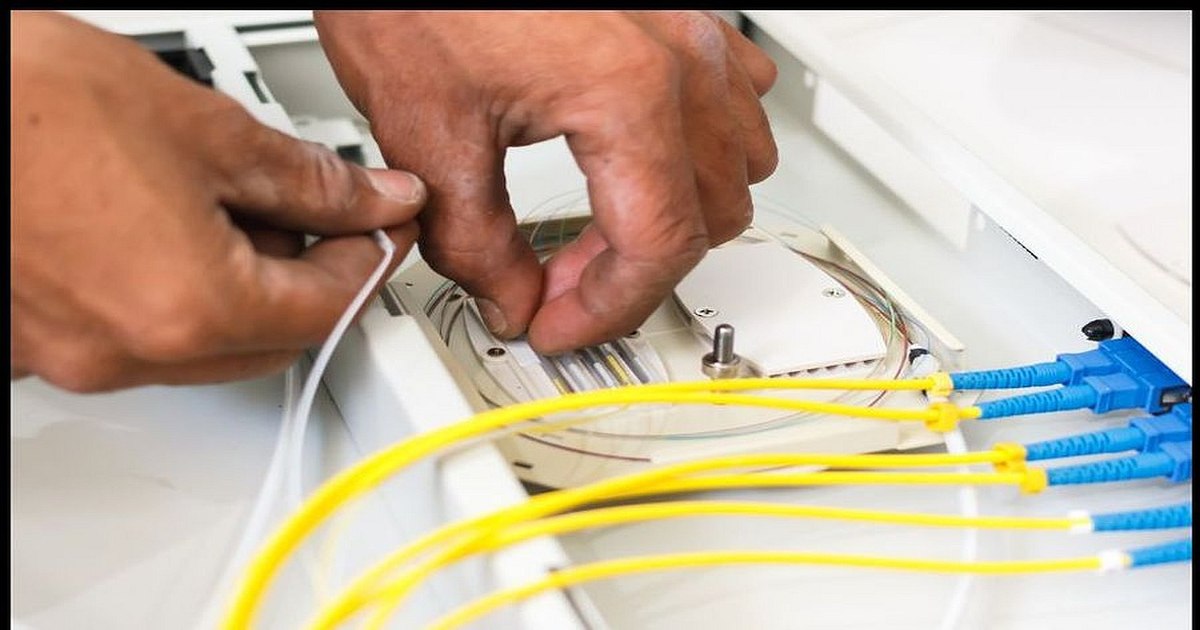
In this article, we will learn all about a fiber optic cable, shedding light behind a technology that is well-known, but little understood by the general public.
Fiber optic technology is all around us—in high-speed Internet networks, data centers, telecommunications, and even video surveillance systems. And yet, few know what is actually “inside” a fiber optic cable.
This article explains simply, clearly and in a way that everyone can understand how these cables work, what types there are, where they are used, and how to choose the optimal solution for your application – whether it is a home or professional one.
What information does a fiber optic cable transmit, at what speeds and over what distances?
Fiber optic cable is a medium for transmitting data through light pulses. Instead of an electric current, the signal is transmitted optically, using a laser or LED that “pulses” through an extremely thin glass wire.
Thanks to this principle, transmission speeds can reach and even exceed 100 Gbps, depending on equipment and standards. The distances covered are impressive — from a few meters to hundreds of kilometers without major signal loss, in the case of singlemode fiber.
This means that basically a fiber optic cable can transmit an HD movie in fractions of a second, with no interference, no loss and no risk of signal degradation.
What applications and uses does a fiber optic cablefor home and professional purposes?
The uses are varied and depend on the needs of the user:
- In the home environment: for FTTH (Fiber to the Home) internet connections, digital television, VoIP telephony or video surveillance (CCTV);
- In the professional field: in IT infrastructures, data networks, data centers, telecommunications, industry, automation, smart buildings or metropolitan networks.
Whether we’re talking about an apartment with gigabit internet or a data center serving thousands of simultaneous connections, fiber optic provides stability, speed and reliability.
What features does an outdoor fiber optic cable have?
Outdoor cables are built to withstand harsh conditions. They can have:
- UV protection – to resist prolonged sun exposure;
- LSZH (Low Smoke Zero Halogen) mantle – which do not emit toxic gases in case of fire;
- Metal armor – for mechanical and anti-rodent protection;
- Resistance to moisture and extreme temperatures – for installation in various environments, from mountainous areas to industrial environments.
These cables can be buried, run underground or installed overhead.
What models of fiber optic cable and accessories does a professional supplier offer?
A complete fiber optic supplier like the one mentioned above offers a wide range of products including:
- Singlemode cables (SMF) – for long distances, with a thin core, ideal for telecommunications;
- Multimode cables (MMF) – for local networks, with a thicker core, ideal for buildings or data centers;
- Cables with OM1, OM2, OM3, OM4 standards – for different capacities and speeds;
- Cables with G.652 (classic) and G.657 standards – for applications with a reduced radius of curvature;
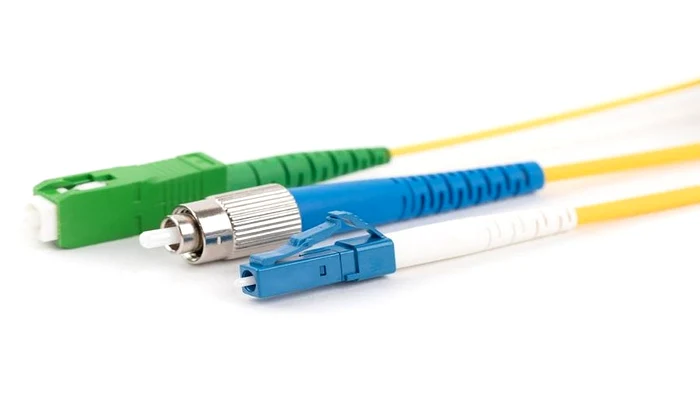
- Patch cords and pigtails – for quick connection;
- Distribution boxes, splitters, connectors, 1,000m cable reels – for small or large scale installations.
The diversity of accessories is as important as the quality of the cable.
How do you choose the right fiber optic cable for your application?
The right choice depends on several factors:
- Installation environment – indoor or outdoor;
- Distance – for long distances, singlemode cable is recommended;
- Required speed – for gigabit or 10 Gbps networks, higher standards are chosen (OM3, OM4);
- Number of fibers – depending on how many connections you need (1, 4, 8, 12, up to 144 fibers);
- Connection method – plug-in cables, SC/LC/ST connectors or by welding;
- Budget and Durability – some applications may require additional armor or flame retardant protection.
An important criterion is compatibility with existing equipment – switches, routers, media converters, etc.
In conclusion, fiber optic cable is undoubtedly the “backbone” of modern communications. Whether you’re using it for your home internet or interconnecting hundreds of servers, it offers blazing speeds, high reliability, and unmatched flexibility.
Behind a simple, seemingly fragile wire, lies a whole world of cutting-edge technology. And if you know how to choose the right type of cable and the right accessories, your network will work flawlessly for years.
