
Although the education system’s operating regulations prohibit taking students out of class, complaints from parents show that this method is still used for discipline. I analyzed the situation together with two school principals and the president of the National Student Council. The situation also raises questions about the tools that teachers have at hand in order not to disturb classes.
PHOTO Shutterstock
The National Council of Students: The measure, excessive and unconstructive
The National Council of Students refers to the Regulation on the Organization and Operation of Pre-University Education Units (ROFUIP), the document that establishes the rules according to which all schools, kindergartens and high schools in Romania operate. Specifically, in article 183, which provides that “Measures that can limit the access to education of the primary beneficiaries are prohibited, such as, for example, making them perform the service at school, prohibiting them from attending classes or sanctioning the primary beneficiaries who do not wear the uniform of the educational unit”.
Consequently, sending the student to the corridor or outside the classroom not only violates this provision, but also creates the feeling that he is excluded from the educational process instead of being supported to correct his behavior. “Most students perceive this measure as excessive and unconstructive, because it does not aim to understand the cause of the behavior, but only to isolate the one who disturbs”, says Mihnea Haiduc, president of the National Council of Students.

Mihnea-Adrian Haiduc PHOTO National Council of Students
And this practice does not lead to beneficial effects either in the short term or in the long term, says the young man.
“Eto amplify classroom tensions and stigmatize the punished student without offering any real solution. (…) Removing the student from the classroom does not help the student understand the impact of his or her actions, does not provide guidance, and does not contribute to the development of responsible behaviors. On the contrary, it creates ruptures in the student-teacher relationship and can encourage the repetition of the behavior, either out of frustration or from the lack of real intervention”.
Headmaster: Such a method should not even be considered
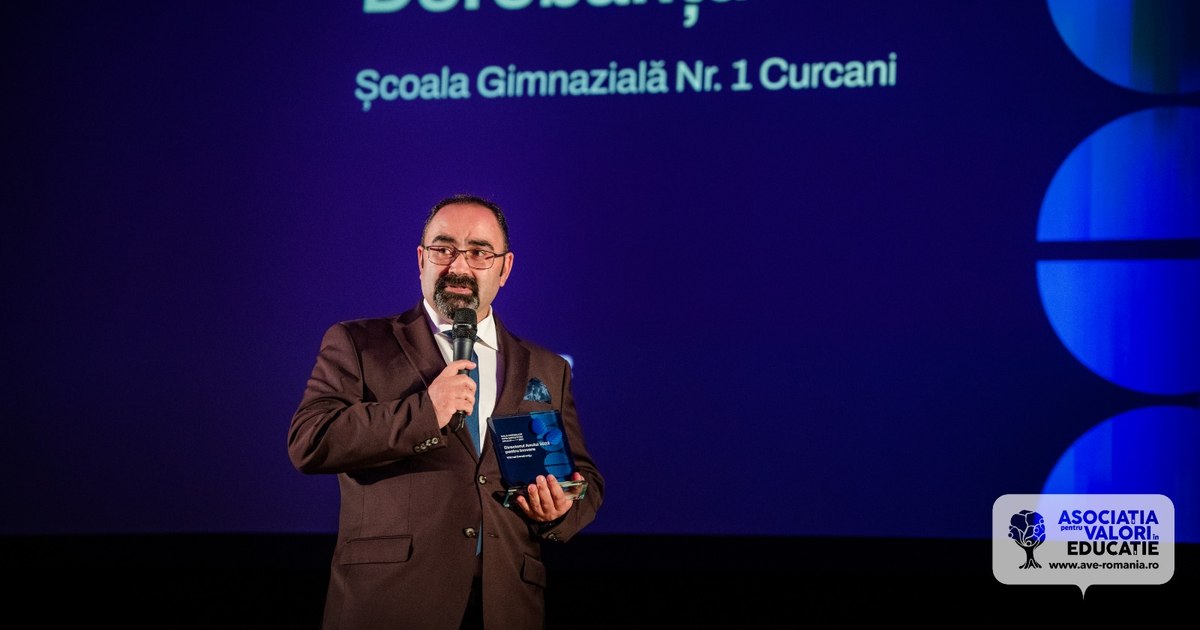
Viforel Dorobanțu, the director of “School Gimnaziale no. 1 Curcani”, from Călărași county.
“From my point of view, such a method should not even be considered in an educational system from the year 2025. (…) I don’t think that “kicking out” was ever a solution. To what? To the silence of the class, to the silence of the teacher? A lesson must be lively, arouse students’ interest. In my opinion, this “kicking out” does not work in the long term and depends, to the greatest extent, on the ability of each teacher to “hold” a class in his hand so that learning happens there, not being a “battlefield” of the two categories, teachers-students. If a certain behavior of a student endangers the integrity, health of students and teachers, I recommended my colleagues to call 112 so that things can be clarified legally”says the director, who is also a Physics teacher.

Viforel Dorbanțu FOTO AVE (Association for Values in Education)
He also adds that he does not want complete silence in the classroom:
“This kills the critical spirit, creativity and intellectual breadth that a learning process should have. I believe that if the approach of the teaching staff is exciting, full of real challenges for the students, the atmosphere, by itself, becomes peaceful. It all depends on the mastery of the teaching staff to captivate even the most “relentless” student. I start from the premise that a teacher has more experience working with people so that he can intellectually “dominate” a more recalcitrant student.
Training in differentiated activities, at different levels of reaching certain skills, is a solution that I adopt frequently and it gives results, because in this way each student does not feel ignored or bored, perhaps by a possible generalized approach”.
Regarding handling difficult situations, the director says: “It is very difficult until the teacher finds his mental balance so that he does not instinctively respond to any challenge. This line is extremely fine and can often be easily crossed.” Knowing the students’ background helps, believes Viforel Dorobanțu.
The director of a college in Bucharest: “The phrase is <>”
The regulation leaves no room for interpretation regarding the removal of children from class, says Andreia Bodea, the director of the IL Caragiale National College in Bucharest. She claims, however, that most of the time the school does not enjoy the support of parents when it comes to sanctioning inappropriate behavior.
“Discussions with parents fail. Okay, some parents are amazing people. But in most cases the discussions with the parents fail, because more and more often the parents don’t even want to know what the situation was, what the context was, although there are witnesses, there are other colleagues, there are other teachers. No, they come with the belief that teachers are a group that has a problem with their child and wants at all costs to apply a sanction. Which, at least for Caragiale, is totally wrong. No one wants to apply this idea that we take great joy in paying attention or giving bad grades. For years I haven’t met a parent who told me <

Andreia Bodea PHOTO Agerpres/ Sorin Lupșa
The internal regulation of the high school provides a method of sanctioning for disciplinary violations that can lead to a decrease in the performance grade.
“We have this electronic catalog where students can receive what are called warnings: either for clothing, or for using the phone during class without the teacher’s consent, or for situations in which they repeatedly disturb classes. And for five such warnings from anywhere, regardless of the teacher who gave this warning, the performance grade is reduced by one point. (…) Performance grade decreasing when the module ends.
It works, but we haven’t experienced any serious cases here. But yes, there are students who disturb us without reason and maybe that’s when they receive this warning. (…) Now, to what extent does the drop in wear grade affect them? It doesn’t affect them very much, because we don’t have semesters anymore, we have some modules. If he has an average of 8, let’s say at the end of the first module and in the other four modules he finished with an average of 10, he has an average of 10 in the end. So, unfortunately, the educational system, among many other sins it has, also has these: that these coercive measures – those that are left – only lead to a finality in extreme cases. (…) In the end, disturbing the teacher is one thing, but disturbing his colleagues who want to be careful.”
What legal tools do teachers have at their disposal?
According to the regulations of the Student Statute, for disciplinary violations students can be sanctioned by several methods, depending on the gravity of the act. These are:
a) individual observation;
b) written reprimand;
c) the temporary withdrawal or for the duration of the entire school year of the scholarships that the student benefits from;
d) disciplinary transfer to a parallel class in the same educational unit;
e) suspension of the student for a limited period of time, according to the law;
f) notice of expulsion;
g) expulsion with the right to re-enroll in the following school year in the same educational unit, according to the law;
h) expulsion with the right to re-enroll in the following school year in another educational unit, according to the law;
i) expulsion without the right to re-enrol, for post-secondary education students.
Totally prohibited, instead, are the following practices:
– Sanctioning students in the form of reprimanding in front of the class group
– Physical, verbal and/or any other form of violence, as well as aggression
