
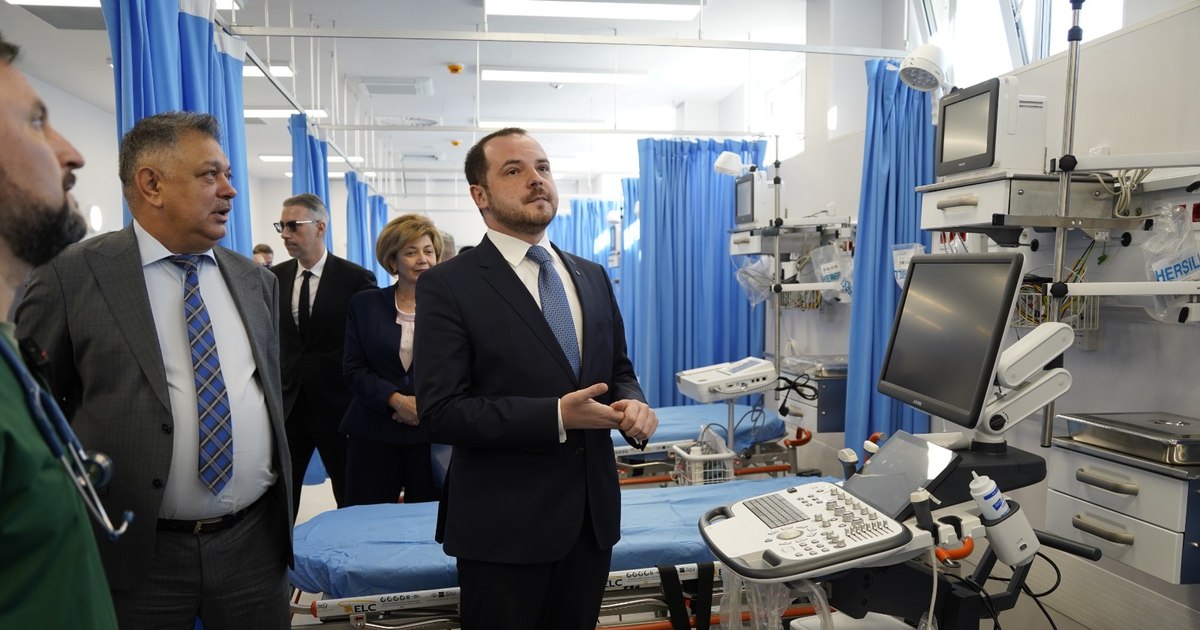
Alexandru Rogobete, the Minister of Health, announced on Monday, November 24, the publication in decisional transparency of the project that updates the Regulation on the organization and operation of the ATI sections and compartments.
Alexandru Rogobete, at a hospital in Pitesti. PHOTO archive The truth / Denis Grigorescu
“The events of the last few months have shown us that we need simple and clear rules. While some explain why «you can not»at the Ministry of Health we decided to analyze all the control reports together with the specialists in the field and come up with firm and concrete changes. And after you see exactly where the vulnerabilities appear, it becomes obvious that a system only becomes truly secure when the rules are updated and followed. we have to guarantee it”wrote Alexandru Rogobete, on Monday, in a post on Facebook.
“Changes are needed that reset the rules”
The normative act submitted for public consultation was developed with the support of the president of the ATI Commission from the Ministry of Health, Prof. Dr. Dorel Săndesc, and the president of the Romanian Society of Anesthesia and Intensive Therapy, the minister states.
“In this context, today I published in decision-making transparency the draft Order that updates the Regulation on the organization and operation of the ATI sections and compartments. Changes are necessary, which reset the rules and strengthen the area of anesthesia and intensive care, where every detail can make a difference.
What we change:
• We are introducing a clear mechanism for classifying ATI departments into three categories (category 1, category 2, category 3), depending on the complexity of the cases treated and the available infrastructure. In this way, we create a clear route of critical patients in the units in Romania and ensure that people get to where they can benefit from the best treatments.
• We establish the obligation for any public or private unit that performs anesthesia to have at least one properly equipped postanesthesia care bed. This measure increases the safety of the patient and the medical act, and the regulation becomes stricter and clearer.
• We ask all public or private units to prove that they own the medical equipment they use and that they have valid service and maintenance contracts.
• We require that all health facilities in which it is carried out anesthesia/intensive care for children to be equipped with medical equipment dedicated to the pediatric profile.
• We define more clearly the duties of doctors confirmed in the ATI specialty and of doctors from other specialties who hold a certificate in intensive care and work in the ATI wards or compartments.
• We clarify the criteria regarding the personnel regulations and define the structure of the multidisciplinary team. Medicine is not about one or two people, but about the team, and in ATI the team makes the difference”.
“We are completing the ATI team with an infectious disease doctor or epidemiologist”
Through the proposed changes, new categories of personnel are introduced: doctors confirmed in the specialty of epidemiology, doctors confirmed in the specialty of clinical pharmacology, pharmacist confirmed in clinical pharmacy, psychologists, physiotherapists, etc., explains the minister.
“In order to be able to control the spread of nosocomial infections in the ATI wards, we are coming up with concrete changes: we complete the ATI team with an infectious disease doctor or epidemiologist and we offer the possibility of hiring an assistant dedicated to monitoring infections associated with healthcare.
These changes are about real safety, not red tape. They are concrete measures that eliminate improvisations, firmly regulate anesthesia activities and strengthen patient protection. We will continue the control in all units, public and private, that perform anesthesia procedures”, Rogobete also said.
“Trust does us good only when the patient feels that he can really trust”
According to the minister, it is verified “every structure, every procedure, every opinion”.
“Trust is not built with slogans or empty words, but with administrative measures that bring about the necessary change in health. Trust is only good for us when the patient feels that he can really trust, and the medical staff is safe!”
