
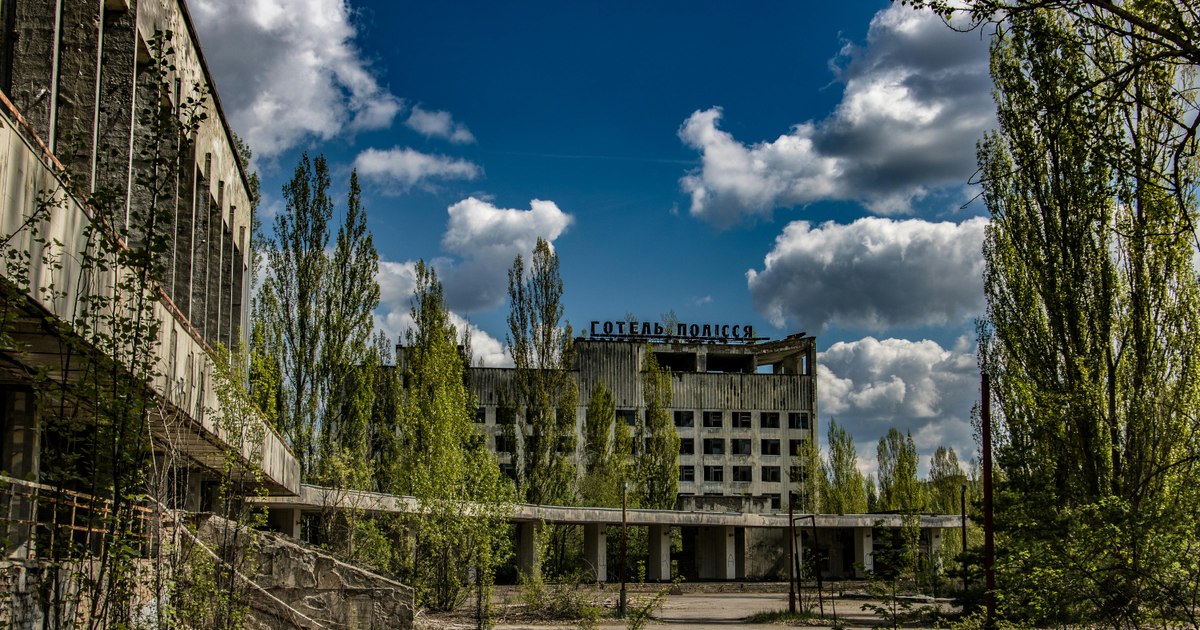
Mold found at the site of the Chernobyl nuclear disaster appears to feed on radiation. The discovery was made almost three decades ago by Nelli Zhdanova, a researcher at the Institute of Microbiology and Virology of the National Academy of Sciences of Ukraine, based in Kyiv.
In May 1997, Nelli Zhdanova entered one of the most radioactive places on Earth, the abandoned ruins of the Chernobyl reactor, writes the BBC.
On the ceiling, on the walls, and in the metal conduits that protected the electrical cables, black mold had made its way into a space once considered incompatible with life.
In the surrounding fields and forests, wolves and wild boars had recovered in the absence of humans. But even today there are areas where amazingly high levels of radiation are found, due to material thrown out of the reactor during the explosion.
Just as plants reach for light, Zhdanova’s research indicated that black mold fungal hyphae seemed attracted to ionizing radiation.
The mold, made up of several species of fungi, seemed to be doing something remarkable. Zhdanova had already discovered in previous studies of the soil around Chernobyl that the fungi were actually growing towards the radioactive particles spread in the area.
Now he noticed that they had reached the original source of the radiation, the rooms inside the exploded reactor.
Each study exposed her to dangerous radiation, but Zhdanova’s work overturned our ideas about how radiation affects life on Earth. Her discovery now offers hope for cleaning up radioactive areas and even protecting astronauts exposed to dangerous radiation in space.
Eleven years before Zhdanova’s visit, a routine test at reactor four of the Chernobyl nuclear power plant had turned into the world’s worst nuclear accident.
A series of errors in the reactor’s design and operation led to a massive explosion in the early hours of April 26, 1986, which resulted in an enormous release of radionuclides.
Radioactive iodine was primarily responsible for the deaths in the first days and weeks, as well as the later cancer cases.
To prevent radioactive poisoning and long-term health effects, a 30 km exclusion zone was established to keep people away from the most contaminated areas.
Dozens of mushroom species, found in the Chernobyl area
But while people were kept at bay, Zhdanova’s black mold was gradually colonizing the area.
In addition to radiotropic fungi, Zhdanova found 36 other common, but evolutionarily distant, mushroom species growing in the Chernobyl zone. Over two decades, her pioneering work on these radiotropic fungi has come to influence research around the world.
It helped discover a potential new way of life on Earth, one that feeds on radiation, not sunlight. And it led NASA researchers to consider the idea of mushroom walls to shield astronauts from radiation.
At the heart of this story is a pigment widespread in nature: melanin. This pigment, which ranges from black to reddish-brown, determines skin and hair color in humans.
But it’s also why the Chernobyl mushrooms were black: their cell walls were loaded with melanin.
Just as dark skin protects cells from UV radiation, Zhdanova suspected that the melanin in these mushrooms acts as a shield against ionizing radiation.
It’s not just fungi that use melanin for protection. In the ponds around Chernobyl, frogs with high concentrations of melanin were able to survive and reproduce better, with the local population gradually turning black.
“Melanin can convert this radiation into usable energy”
In 2007, Ekaterina Dadachova, a scientist at the Albert Einstein College of Medicine in New York, added new evidence: melanized fungi, like those in the Chernobyl reactor, grew 10 percent faster in the presence of the radioactive isotope Cesium compared to unexposed fungi.
Her team noticed that the irradiated fungi seemed to use the energy of the radiation for metabolism, that is, to grow.
Zhdanova had suggested that these mushrooms could capture radiation energy, and Dadachova’s research reinforced this idea.
These fungi weren’t just targeting the radiation for heat or some unknown reaction, they actually seemed to feed on the energy of the radiation. She called the process “radiosynthesis”with melanin as the central element.
“The energy of ionizing radiation is about a million times greater than the energy of white light used in photosynthesis”says Dadachova.
“You need a very powerful energy transducer, and we think melanin can convert this radiation into usable energy.”
Radiosynthesis remains a theory, as the exact mechanism by which melanin would convert radiation into metabolic energy has not yet been discovered.
In recent years, Dadachova and her team have begun to identify the pathways and proteins involved in this phenomenon. However, not all melanized fungi show radiotropism or accelerated growth in the presence of radiation.
In 2006, Zhdanova found that only nine of the 47 species collected at Chernobyl grew toward a source of radioactive cesium.
In 2022, researchers at Sandia National Laboratories found that two species (one melanized, one not) showed no differences in growth when exposed to UV radiation and cesium-137.
