

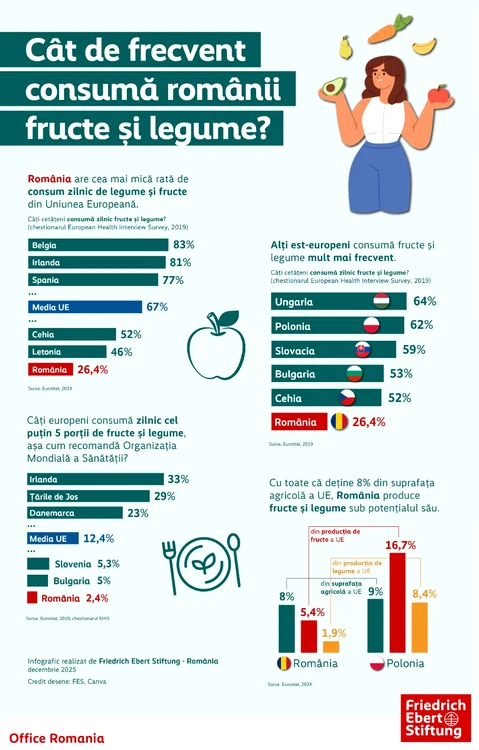
Romania has one of the lowest fruit and vegetable consumption rates in the European Union. Almost 75% of Romanians do not consume even one portion of vegetables or fruits per day, and 24% declare that they eat between one and four portions daily, according to Eurostat data processed by Monitorul Social, a project of the Friedrich-Ebert-Stiftung (FES) Romania.
The same data show that only 2.4% of Romanians consume five servings of vegetables and fruits per day, as recommended by the World Health Organization.
Although Romania has 8.1% of the EU’s used arable land and 4.2% of the Union’s population, it contributes only 1.9% to annual fresh vegetable production and 5.4% to fruit production, fueling import dependency and higher prices for low-income consumers.
55% of Europeans consume between one and four portions of fruit and vegetables daily
The situation in Romania is in strong contrast to the EU27 average, where only 33% of Europeans do not consume any portion of vegetables and fruits per day, while 55% consume between 1 and 4 portions, and 12% reach 5 or more portions per day. Even in Central and Eastern Europe, Romania lags far behind countries such as the Czech Republic, Poland or Bulgaria in terms of fruit and vegetable consumption. This reality sets up a vicious circle: insufficient production relative to the land resource, dependence on imports, higher prices on the shelf and, finally, reduced consumption.
“Theoretically, the distribution of agricultural land would allow covering a significant part of the internal need for fruits and vegetables. The EU27 states have a total of 157 million hectares of agricultural land in use, of which 12.8 million hectares of agricultural land are used in Romania, which represents approximately 8.1% of the total. Although it uses 8.1% of the agricultural land in the European Union, Romania produces well below its potential in the vegetable category (1.9% of EU production) and only marginally better in the production of fruit (5.4%); in general, the level of production in Romania remains below the potential that its share in the agricultural land would suggest and well below the potential of other countries in the region, such as Poland, which produces 16% of the fruits and 8% of the vegetables grown in the EU27 with only 9% of the agricultural land used. This underproduction perpetuates the pressure on imports and keeps the national consumption at very low levels. it is stated in a press release from the Friedrich-Ebert-Stiftung Romania Foundation.
“The impact on public health and the economy is major”
According to the quoted source “the impact on public health and the economy is major”, as low consumption rates correlate with increased risks for non-communicable diseases and decreased productivity. The World Health Organization recommends at least 400 g of fruits and vegetables per day, the equivalent of 5 servings, and Romania today has the lowest share of the population that reaches this target among the mentioned European states.
The very low consumption of fruits and vegetables could be one of the causes for the health problems encountered in Romania.
“This problem can only be overcome through coordinated interventions by the state and farmers in the country, as well as the development of a strategy through which citizens are informed about the importance of good nutrition. An integrated strategy, with annual production and consumption targets, would reduce dependence on imports, stabilizing shelf prices and increasing access for vulnerable households.” it is also shown in the communiqué.
Romania has the agricultural potential to quickly reposition its fruit and vegetable market, but this requires a combination of coherent public policies, investments and support tools for low-income consumers, the source said.
WHO emphasizes the crucial role of fruits and vegetables in maintaining immunity. The lack of fruits and vegetables in the diet contributes significantly to the occurrence of cardiovascular diseases, type 2 diabetes, obesity and certain forms of cancer. Research shows that these foods are important sources of fiber, vitamins, minerals, and antioxidants, which support the immune system, reduce inflammation, and help regulate blood pressure and cholesterol levels.
