
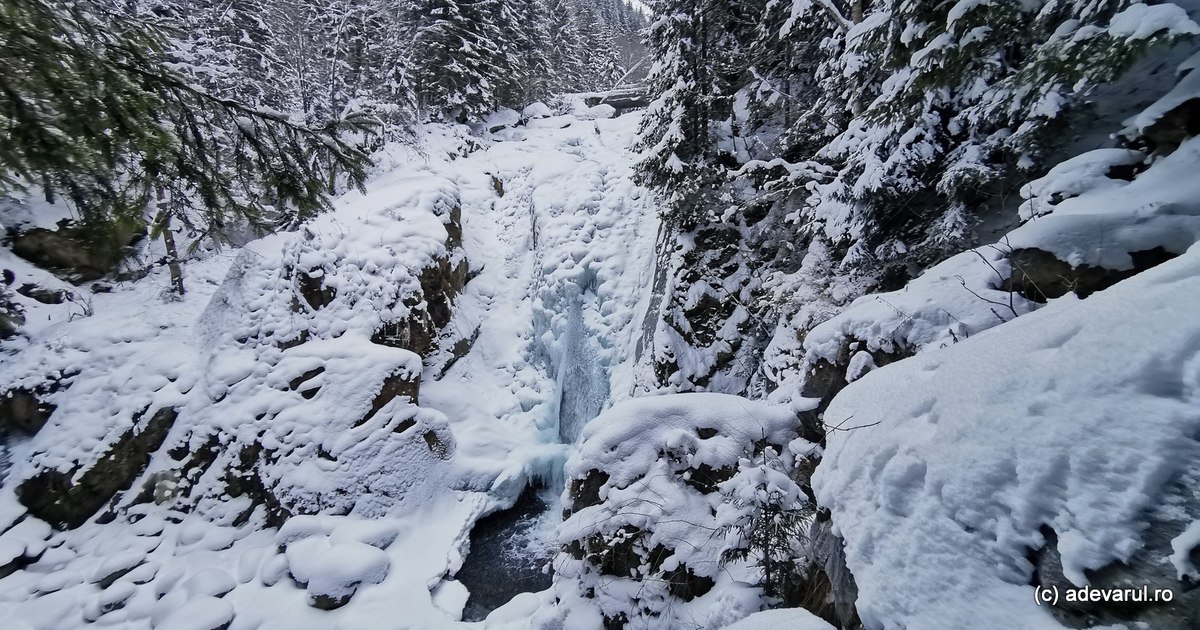
Winter adorns with ice and snow one of the most spectacular waterfalls in Romania, located in the Retezat National Park. The Lolaia waterfall has remained accessible to tourists and attracts them with its grand appearance, but also with its legends.
In winter, most of the forest roads in the Retezat National Park are closed to traffic due to the risks brought by the harsh climate, the abundance of snow and icy sections, which make it almost impossible to travel by car. Tourists can cross them on foot, but they need several hours to reach the alpine area, lakes and glacial caldera. Those who want to stay overnight in Retezat can find shelter in several refuges and mountain cabins on the territory of the reserve, the most accessible being Pietrele, Gențiana, Buta, Câmpul lui Neag, or in the guesthouses in the Râușor mountain resort and those in the Râului Mare valley.
The retezato, risky in winter
Mountain rescuers point out that many mountain trails in Retezat, located at high altitudes and crossing steep slopes, should be avoided.
They are closed during the winter due to the risks they present, from the danger of avalanches to slips and falls or the possibility of getting lost due to fog or the fact that the markings are covered in slush. For those who venture on them, ignoring the warnings, the mountain rescuers offer some advice.
“Never enter a closed area. Do not go alone. Check weather reports, avalanche forecasts and local information. Use appropriate equipment and check its condition. Notify a contact person of the chosen route. Follow the advice of an experienced person who knows the area well. Do not advance in a compact group, but behind each other, at a safe distance. Announce if you are late. Ask for information from professionals: mountain rescuers, guides, lodgers, ski instructors. Consider that there is no safe zone!”, Salvamont Romania representatives send.
Several places in the Retezat National Park remain accessible during the winter and offer reasons for satisfaction.
Located on the Pietrele river valley, the Lolaia Waterfall remains one of the most popular natural monuments in Retezat during the winter. It is covered with ice and snow, forming a frozen wall of almost 15 meters, broken here and there by the power of the two arms of its waters.
“The legend says that a long time ago, at the end of summer, a beautiful shepherdess named Lolaia was coming down with the sheep from Retezat to her village, Nucșoara. Suddenly, as if from nowhere, a huge and scary apparition descended on the flock and, with great greed, ate all the sheep. On the spot, out of fear, the girl’s golden locks turned white, and she thrown into the valley beside the road. In the place where it was thrown, a deep hole was made in the rock, and the water of the stream formed a waterfall. And now, at the waterfall of Lolaia, the two braids of the girl can be seen, flowing like two streams of silver.”says the administration of Retezat National Park.
The road to Lolaia Waterfall, accessible in winter
In winter, travelers can reach the Cârnic cabin by car, located in the vicinity of the waterfall, even if the road is only partially paved towards the entrance to the Retezat National Park.
The route to the entrance “gate” to Retezat, from Cârnic, starts from the village of Ohaba below Piatră, where the National Road 66 Hațeg – Petroșani intersects with the 10-kilometer county road that crosses the villages of Sălașu de Jos, Sălașu de Sus, Mălăiesti and Nucșoara and then plunges into the wilderness.
The ruins of the medieval fortresses of Sălașu de Sus and Mălăiesti welcome tourists before leaving human settlements. From Nucșoara, travelers continue their hike along the valley of the Sibișel stream, among the steep slopes covered with forests.
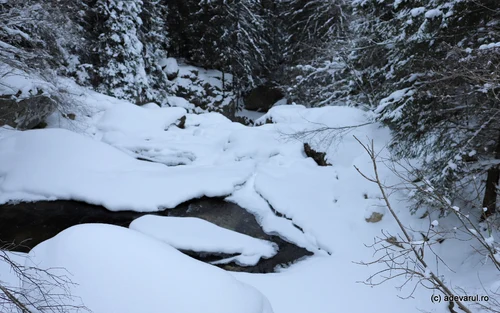
The road is asphalted until near the Cârnic stop. Here, travelers must leave their cars in the parking lot and can continue their trip on foot along the valley of the Pietrele stream, towards the Pietrele and Gențiana cabins, places where the paths to the ridges and glacial lakes of Retezet start.
The Lolaia waterfall is a 15-minute walk from Cârnic and is usually a stopping place and a landmark on the Pietrele Valley hike. It is not visible from the road, but the roar of the water fall can be heard from a distance. Tourists can easily reach its foothills by deviating a few tens of meters from the road to Cabana Pietrele and then going down a series of wooden steps. They can also go around the waterfall to reach the bridge that was built above it.
The Pietrele Stream bears several names (Stânișoara, Pietrele, Nucșoara, Sibișel) until its discharge into the Strei. In its upper course, between the Lolaia Waterfall and its springs, it forms numerous rapids and spectacular waterfalls, the streams creeping between the huge boulders, rounded by time, remnants of the old glaciations. Valea Pietrele from Retezat collects the sources of four large former glaciers: Stânișoara, Pietrele, Valea Rea and Galeșul.
“Their water, gathered in the red bed of stone, cuts a gorge finished at about 1,000 meters altitude, with a threshold of 15 meters above which the water breaks into two strips with the sound of thunder. Below, 200-300 meters from the waterfall, the water of Pietrelor joins with the water of Chiagul, also descended from the waterfall, thus giving birth to the Nucșoara river”. informs the geographer Nae Popescu.
From Lolaia, the road climbs to the Pietrele cabin, located at 1,480 meters above sea level, the oldest tourist cabin in Retezat and a traditional place from where travelers start on the paths leading to the glacial lakes and ridges that rise to over 2,500 meters above sea level. The route between Lolaia and Pietrele is covered in about an hour – an hour and a half, depending on the season, and most of the way is animated by the sounds of the Pietrele stream.
The waterfall of the legendary Maria Magdalena
Before the final climb to the refuge, the Retezat stream valley offers another natural attraction. The Maria Magdalena waterfall is smaller than Lolaia, but retains in its name the memory of an emblematic character of Retezat, Maria Magdalena Hamz, also called “the lady of the mountains”, the first mountain guide of the Retezat National Park, a nature reserve established in the mid-1930s.
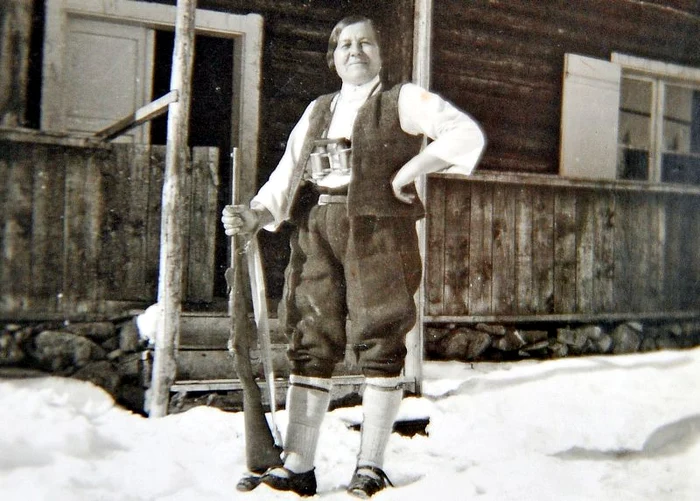
Maria Magdalena Hamz, the daughter of a forester, was born in 1894 in the village of Câmpul lui Neag, at the foot of the Retezat, and took care of the Pietrele cottage in the first years after its construction, in 1936.
“She was a special character, who takes shape in the history of the Retezat Mountains, a good connoisseur of the mountain, the first mountain guide who traveled this territory and who marked the first mountain routes with decoys”informed the administrators of the Pietrele complex.
Old images from the 1940s show Maria Magdalena in a hunter’s outfit, in the middle of groups of tourists arriving at Pietrele or alone, carrying a rifle or an axe. Among the famous guests who met her were the writers Marin Preda, Mihail Sadoveanu and Vasile Voiculescu. Marin Preda called her “the lady of the Retezat mountains”, and Vasile Voiculescu told about the amazement she caused him.
“For the first time I hunted trout in Jii, when the waters were not yet black from the washing of the coals from Petroșani. Later I fished them tactically, with a perfected rod and artificial fly, at two thousand meters above sea level, in the icy waters of Galeș and Bucurea. But I definitely did not eat trout until the famous Maria Magdalena, the Ohavnian host of Retezat, deigned to she brought them to us. She left the shelter alone, and in no more than two hours she was back, full of witchcraft. I think she had her own trout farms, where she caught them at will“, wrote Vasile Voiculescu.
A legend says that Maria Magdalena would have received a gold watch from an English lord, a guest of the Kendeffy family, who came hunting in Retezat. For this gold watch, however, she would have been robbed by several Soviet soldiers, whom she would have met in a mountain valley. As revenge, Maria Magdalena allegedly shot the Soviets in 1945 and hid their bodies in the place called “at the graves” in Retezat.
Another legend says that, in the refuge in Retezat, they would have sheltered the fugitives who arrived in the mountains during the years of war and the first years of communism. The time spent by Maria Magdalena at Pietrele extends until around 1950, when the cottage was taken over by the National Labor Confederation, and she was retired, informed the administrators of the Pietrele complex.
In the last years of her life, she would have remained a guard at a sawmill in Câmpul lui Neag, living in a precarious condition. She died in 1955, according to some testimonies, drowned with the bones of a trout she had caught in Retezat.
