

The simulation of the National Assessment exam began on Monday, March 16, 2026, with the Romanian Language and Literature test. Next is Mathematics, on March 17. The tests are conducted under exam conditions, and the evaluation of the papers will be carried out using the digital platform.
UPDATE: Schools where the simulation did not take place today can organize their own tests
Secretary of State Sorin Ion announced that the schools where the simulation was not held today, due to the teachers’ boycott, can organize their own simulations, with topics written by specialists from the National Center for Curriculum and Evaluation (CNCE). Moreover, the Ministry of Education can give them access to the evaluation platform.
“The Ministry of Education can support these schools by providing subjects made by professionals from the National Curriculum and Evaluation Center and, if necessary, even making the evaluation platform available, because there the rigors are different, it does not correct the classroom teacher: the papers are randomly distributed to other teachers in the system, as is happening at the moment, when the papers will be sent to the approximately 10,000 teachers who have chosen to be involved in the evaluation of the papers. So, in conclusion, we can say that for almost all children in Romania, simulation takes place today”declared Sorin Ion.
What were the subjects in the Romanian Language and Literature exam
The simulation started at 09:00, and the students had two hours to solve the topics.
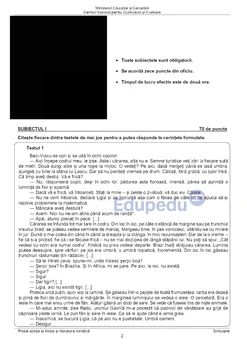
In subject I, the texts on the basis of which they had to solve several requirements were “Why is mother crying” (by Ion D. Sîrbu) and “me and the fox” (an article written by Vintilă Mihăilescu and published in Dilema Veche). In point 9, for example, the students had to associate the fragment from the opera “Why is mom crying?” with another literary text studied in class or read as additional reading and to present, in 50-100 words, a common value.
In the IB subject, the students had to solve eight points related to the area of grammar
And for subject II, the requirement was to write an argumentative text, of at least 150 words, in which to support the answer to the question “do you think we know how to react when things don’t go the way we expected?”by capitalizing on text 2 and personal or reading experience.
Simulations under the specter of boycott
On Monday, March 16, 2026, the first test of the simulation of the National Assessment took place, the one for Romanian Language and Literature, under the conditions in which the education unions announced that most of the teachers-members of the union spoke out for the boycott of this activity. Despite the announcement of the two pre-university education federations, the Ministry of Education announced that the simulation tests are supported, from the centralized data at the end of last week, there were less than 130 school units-exam centers where the activity could not be carried out because the teachers refused to participate. The unions, in turn, asked their members to show solidarity with the teachers in the 127 educational units where the simulations will not be held.

Over 4,500 centers are organized throughout the country, students who will graduate from the 8th grade present themselves for the simulation in the exam centers, as they will do in the actual exam in the summer, the simulation being an opportunity to test the degree of preparation for both the students and the administrative apparatus.
How to run the 2026 National Assessment simulation
The written exam in Romanian language and literature will start at 9:00 a.m., with students assigned to the exam centers being allowed access until 8:30 a.m.
The allocation of candidates to rooms is done in alphabetical order, at the level of the exam center. According to the regulations, candidates are prohibited from bringing satchels, rucksacks, satchels, purses and other such objects into the examination rooms, candidates having the obligation to leave the said objects in the personal belongings storage room, established by the committee in the educational unit – examination center for this purpose. Access with pens and other such objects, textbooks, books, dictionaries, collections, forms, memos, notes, notes, summaries, drafts or works of other candidates, etc. is not allowed. which could be used to solve the subjects.
Education unions accuse teachers of pressure to participate in the simulation of national exams
Candidates are prohibited from having mobile phones, audio headphones, IoT devices, as well as any electronic means of calculation or communication that allows connection to the Internet/social networks, which could be used in solving the subjects, in the examination halls, on them, in their clothing or shoes, in their pencil cases and other such items or on the benches where they are seated in the examination halls.
Candidates are not allowed to communicate with each other or with the outside, copy, transmit material that allows copying or exchange among themselves paper sheets, drafts, notes or other materials that could be used to solve the subjects.
If candidates are found to have violated these prohibitions, they will be removed from that test, regardless of whether the materials were used or not.
In the exam rooms, before the beginning of the tests, the assistants will present the candidates with the methodological provisions related to the correct organization and conduct of the national assessment and will ask them to hand over all possible materials and objects that, according to the regulations in force, are prohibited in the exam room.
Candidates may leave the exam hall no earlier than one hour after the start of the test.
When leaving the examination hall, candidates do not receive the subjects.
At the end of the test, the students hand in the work, which will then be scanned and sent to the digital evaluation platform.
Simulation software
The Ministry of Education and Research previously established the syllabus for the simulation of the National Assessment exam, which is also available on the official website.
The subjects of the simulation evaluate the skills corresponding to the 5th, 6th, 7th and 8th grades, except for some notions from the 8th grade that the students have not yet studied.
Next week, between March 23 and 26, 2026, the twelfth grade students will take their turn through the written tests of the Baccalaureate exam simulation.
The subjects for which the simulation of the written tests of the national Baccalaureate exam in the 2025 – 2026 school year are organized are: Romanian language and literature, mother tongue and literature for students from all streams, profiles and specializations that followed high school studies in a language of national minorities, mathematics, history, physics, chemistry, biology, informatics, geography, logic, argumentation and communication, psychology, economics, sociology and philosophy.
Reactions after the publication of the draft budget: “Education cannot be treated permanently as a budget adjustment expense”
The valid programs for the simulation of the written tests of the national baccalaureate exam in the school year 2025 – 2026 have also been posted on the website of the Ministry of Education and Research.
National Assessment simulation schedule
The simulation of the National Assessment will continue on Tuesday, March 17, 2026, with the written test in Mathematics, so that on Wednesday the students will take the test in Mother Language and Literature.
March 16, 2026 Romanian language and literature — written test
March 17, 2026 Mathematics – written test
March 18, 2026 Mother tongue and literature – written test
March 30, 2026 Communication of results
When the exam takes place
The National Assessment Exam for 8th grade graduates will be held in the 2025-2026 school year, according to the following calendar:
June 8-12, 2026 Registration for the national assessment
June 12, 2026 End of classes for class VIII
June 22, 2026 Romanian language and literature – written test
June 24, 2026 Mathematics – written test
June 26, 2026 Mother tongue and literature – written test
July 1, 2026 Display of initial results (until 12:00), viewing of written papers and submission of appeals (between 14:00 and 18:00)
July 2-3, 2026 Viewing of written works and submission of appeals
July 4-7, 2026 Resolution of appeals
July 8, 2026 Display of final results after resolution of appeals
