
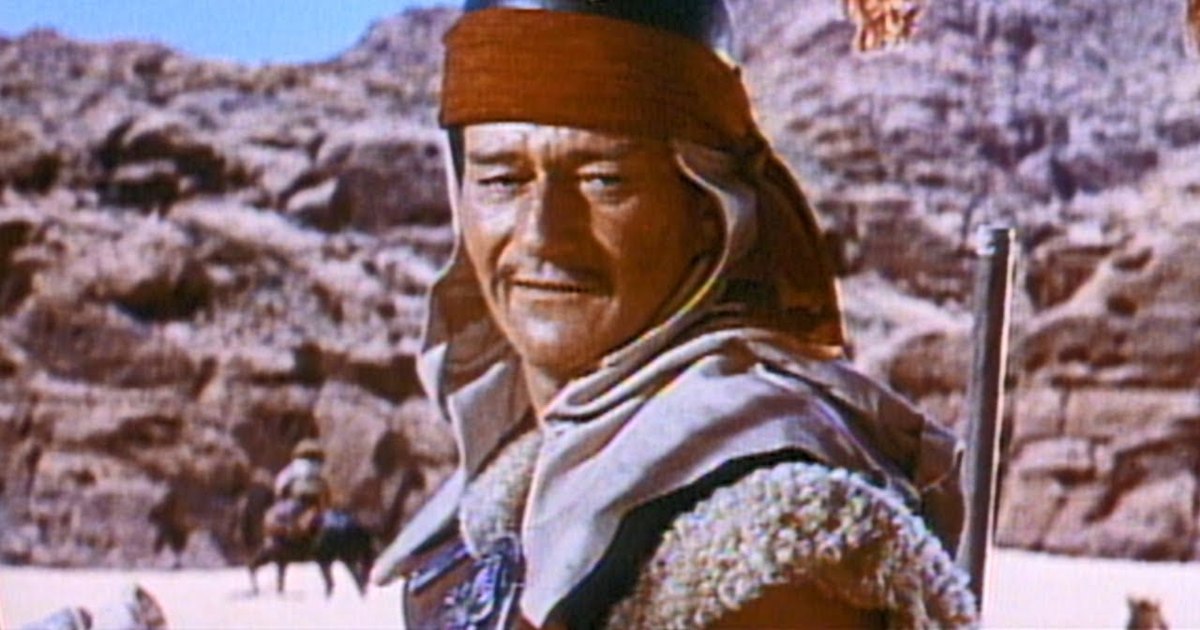
In the history of cinema, there are productions that have remained in the public’s memory not only for their story or cast, but also for the associated behind-the-scenes tragedies. One such earth-shattering case is that of film The Conquerorfrom 1956, considered by many to be Hollywood’s “cursed film”. The reason? An alarming number of members of the production team were diagnosed with cancer after filming, including the famous actor John Wayne.
A controversial production from the start
Directed by Dick Powell and produced by eccentric billionaire Howard Hughes, the film stars John Wayne, cast as Ginghis Han, a choice considered surprising.
Filming took place in the desert near the city of St. George, in the US state of Utah, a seemingly spectacular area, but located only about 220 km downstream from the nuclear site Nevada Test Site. There, the US government had conducted more than 900 atmospheric nuclear tests in the 1950s.
Radiation, the invisible danger
At the time of filming, the Atomic Energy Commission (AEC) claimed there was no risk to the local population or the film crew. But the reality would be much darker. The locals, later known as “downwinders”they began to notice strange effects: animals dying inexplicably and an alarming increase in cancer cases.
The situation was further aggravated after Howard Hughes decided to transport approximately 60 tons of sand from the contaminated area directly to the sets of the RKO studio in Hollywood to recreate the scenery in the interior scenes.
91 cases of cancer in the team
The data that later became public revealed a shocking statistic: out of approximately 220 members of the cast and crew, 91 were diagnosed with cancer, and 46 died from the disease. Famous victims included leading actors John Wayne, Susan Hayward and Afnes Moorehead, as well as director Dick Powell.
Mexican actor Pedro Armendáriz Sr. committed suicide after being diagnosed with terminal cancer, a tragedy that further amplified the film’s bleak aura.
However, the diagnoses did not appear immediately after filming ended, but over the years, and it was about different types of cancer.
Coincidence or direct consequence?
Although the numbers are alarming, epidemiologists said it is difficult to identify with certainty a single cause for the rise in cancer cases. However, there are aspects that are hard to ignore. Both Susan Hayward and Dick Powell died of cancer at relatively young ages (50), and among the population of St. George there were cases including among children.
Howard Hughes would later state that he felt “extremely guilty” about the film’s production. In his increasingly reclusive years, he is said to have bought nearly every copy of the film and watched it obsessively in his hotel room.
At the same time, the case attracted the attention of the general public after some investigations appeared in the press, which led to the declassification of internal documents of the Atomic Energy Commission and fueled suspicions about the real impact of the nuclear tests.
The “downwinder” community and the struggle for recognition
A documentary from 2023 called The Conqueror: Hollywood Fallout, directed by Will Nunez, brought back into focus not only the story of the film, but also the drama of the communities affected by the nuclear tests.
Thyroid cancer activist and survivor Mary Dickson says the effects of nuclear testing were not considered an emergency until the US Department of Defense began to worry that it could, according to an internal document, “to have killed John Wayne.”
The locals of St. George, including members of the Paiute indigenous community who were used as extras, did not receive adequate medical monitoring. Many of them continue today to fight for recognition and compensation.
In 1990, the law was passed Radiation Exposure Compensation Act (RECA)which offered compensation to victims of radiation exposure. However, the act expired in June 2024. And while there are legislative initiatives to renew and expand the program (including to more regions and to children of victims), they are still blocked by political disputes over costs and eligibility criteria.
For the communities of “downwinders”this means that many people affected by radiation were left without financial support, despite serious health problems
