
After the fall of communism, Romania entered an era of visible contrasts, in which many Romanians used their quickly made fortunes in real estate investments that would astound Romanians and foreigners alike. Others have given free rein to their imaginations in construction, with the same effect.
In the first years after the Revolution of December 1989, many Romanians quickly moved from the sober, economical and simple style of the architecture of the buildings erected during communism to constructions that attracted attention through their volume and theme, through abundant decorations and surprising combinations.
Some Romanians, but also Roma, who got rich quickly in the 90s, built opulent villas meant to reflect their material success, while others were inspired by their own passions or artistic knowledge, managing to transform, without expensive investments, modest projects into buildings meant to attract the attention of passers-by.
The appearance of the new buildings sparked controversy, with some being labeled “kitsch,” a term used to describe tasteless, ostentatious creations marked by decorative excess, imitation, and inappropriate combinations of styles, materials, and symbols.
Why did Romanians start building opulent villas
The villas with an unusual appearance from the 90s attracted the amazement of many Romanians, but also the interest of the international press. Over time, people have become accustomed to many of these, while others continue to remain attractive to amateur photographers. François Ruegg, professor emeritus at the University of Fribourg, has done extensive research offering explanations for many Eastern Europeans’ attraction to opulence. He asserted that the visibility of the nouveau riche from Eastern Europe and the former Soviet space is a relatively recent phenomenon that must be placed in a double context.
“On the one hand, it is about the behavior of the new elites: they reached this position through access to new jobs or profitable functions in the economy and politics, which provided them with the necessary capital. On the other hand, a wide variety of imported products became available in the East, together with a better knowledge of fashion and trends, which made architectural projects possible. All this was inaccessible during the old regime. The wealthy and privileged could hardly they could display wealth publicly. It is precisely this aspect—the public display of wealth—that characterizes the nouveau riche in the East, in contrast to, for example, the (Protestant) bourgeois tradition, which demands discretion regarding wealth and the practice of a certain frugality, if not stinginess, as can be seen in austere Calvinist cities like Geneva.” the researcher noted.
Along with luxury cars, multi-story villas and gaudy decorations, sometimes marked with the emblems of luxury brands or the owners’ names, were one of the most convenient means for the nouveau riche to confirm their social status. The definition of the nouveau riche, the researcher added, is usually based on the fact that they have not acquired a culture of spending money associated with taste and sophistication.
“In their case, ostentatious spending plays a clear role — it’s all about social recognition of economic and therefore social success in an environment marked by outward signs of poverty and underdevelopment, especially in terms of infrastructure: utilities, the road network, building materials and so on. In such a context, the nouveau riche can hardly go unnoticed and inevitably come to occupy the place that the privileged classes once had, but without having their culture and their historical recognition”, affirmed the teacher, in the study “The New Rich in Their ‘Palaces’: An Aspect of Urban Transformation in Formerly Socialist Countries”.
Roma palaces, between extravagance and kitsch
The first extravagant palaces of some Roma families were erected in the early 1990s, many of them in former slums on the outskirts of cities, inhabited by large and poor communities. The new “gypsy palaces” immediately stood out by the strong contrast with the modest dwellings in the neighborhoods where they appeared.
Their owners were often viewed with suspicion, both because of the opulence ostentatiously displayed on the outskirts of cities, and for their expansion into central areas in cities like Timișoara. In the capital of Banat, numerous Roma families ended up buying old houses, valuable for their architecture and history, taking advantage of the legislative chaos of the transition and the availability of large sums of cash, sometimes from controversial businesses.
In the 90s, palaces with turrets gained momentum in all corners of Romania. In Strehaia, Caracal, Sibiu, Huedin or Hunedoara, Roma have gradually transformed old slums into neighborhoods dominated by villas with an eccentric, incoherent architecture. The record for the number of palaces was held in the 90s by the commune of Buzescu in Teleorman, known in the past for the traditional community of boilermakers, where more than 100 palaces were built. The secret of some of their owners, later revealed by prosecutors’ investigations, was the illegal business with aluminum and other metals from the Slatina plant.
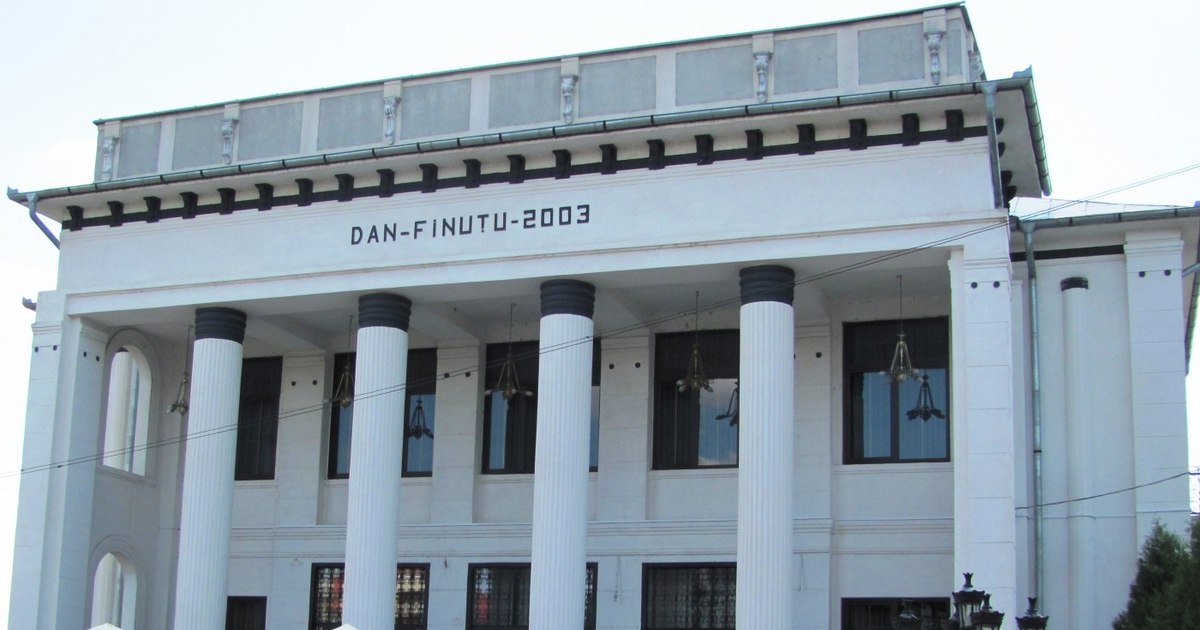
In the center of Buzescu commune, one of the palaces that would attract the attention of travelers for a long time was the residence of Dan Finuțu, a local who got rich quickly in the 90s, but was convicted of several crimes.
At the beginning of the 2000s, Finuțu built a palace designed to resemble the Caracal Court, as a reminder of the first conviction received at the court in Olt. From the four columns at the entrance to the windows and the roof, the preserved model was that of the Courthouse in Caracal. On the facade, where on the original building it was written “Judcătorie”, the rum from Buzescu wrote “Dan Finuțu – 2003”. Dan Finuțu died in 2012, in a road accident, together with his wife, and his relatives erected a tomb for him, which also depicts the Caracal Court.
The billionaire from Slobozia, inspired by Dallas
At the beginning of the 90s, Ilie Alexandru, a former boxer from Slobozia, with a past marked by several problems with the law during the communist period, would soon become one of the richest people in Romania. He recounts that he entered the business immediately after 1990, first trading in jeans and sweets brought from the bazaars of Istanbul and sold on consignment. Later, he invested the money, as well as the huge sums borrowed from Credit Bank, in a TV factory and a tourist complex.
How a house in Lupeni came to attract all eyes. The tricolor “oddity” from Valea Jiului PHOTO
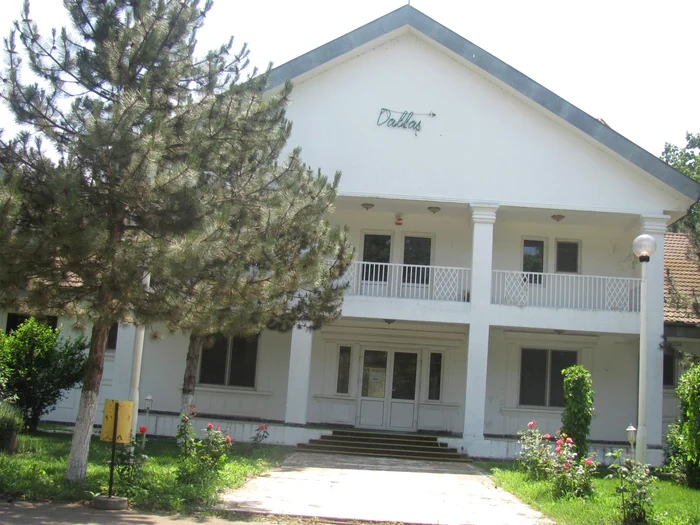
In the mid-90s, Ilie Alexandru wanted to associate his image with the famous character “JR” from the series Dallas. His complex in Slobozia imitated the famous Southfork domain from the American series, except that in his yard he also built an “Eiffel tower”, a smaller replica of the monument in Paris.
“I really like the series Dallas and I watch it with pleasure. What did I say to myself? What, sir, we can’t have farms like those in America? I can, how can I not. If there is money and a master’s hand, everything is possible. In 1992 I started the construction of the farm and, relatively quickly, I finished it. I spent about 300 million lei. A two-level casino is under construction, for which we have allocated so far around 800 million lei. But, by the time it’s finished, the investment will exceed one billion. The second project is a disco on three levels, built entirely of glass. I want to leave something behind and offer people a place like in the movies.” he said, at the beginning of the 90s.
In those years, the Hermes farm, which imitated the American domain, was visited by thousands of tourists, including the real JR, the actor Larry Hagman. But the billionaire’s business ultimately went wrong. Ilie Alexandru had several convictions for fraud in the 1990s and 2000s, and in 2010 he died.
The castle at the foot of Sarmizegetusa Regia
Some buildings that have attracted a lot of attention in recent decades did not require huge investments. One of these was built by the doctor Napoleon Săvescu, in the early 2000s, a few kilometers from Sarmizegetusa Regia. The scientist based in the USA, passionate about the history of the Dacians and author of several books on historical themes, built a villa-castle with an original appearance.
The building was built on the crest of a hill in the forest about 100 meters from the road, and a long flight of stone steps was made up to the entrance. Above the door, on the wall of the stone balcony, was placed a coat of arms depicting a bird of prey, a Pelasgian raven. Round towers guard the fortress-like settlement.
The bottle house
Vasile Piscureanu, a local from Jupânești commune (Gorj county), was proud in the past years to have built several constructions made of bottles in the yard of his house. One of the houses also has a floor and was built from crates full of bottles, used instead of bricks. The materials were collected over two decades, starting in the 90s, mainly from local bars. The bottles in the walls of his small villa were mixed with cement.
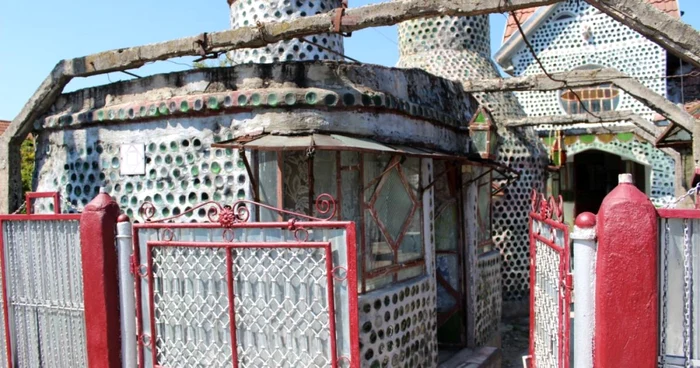
“It’s stronger than a brick. I built the crates with cement, as is done with bricks. It’s like a villa, because I also made a staircase that leads to the attic. There, it’s cool during the day and warm at night, because it’s about condensation and air circulation. The bottles give strength, and the crates are used instead of formwork,” he says.
House with the foundation of thousands of empty drink bottles, viral. “They were all drunk by you?”
The local resident also erected a glass-shaped structure and another one that resembles a plant in the yard of the household. For the first one, he used over 10,000 bottles, and another 4,000 bottles were embedded in the walls of the other one.
The house with a built-in car
In the 2000s, Ioan Bobocel, a local from Lupeni (Hunedoara county), arranged his house in a way that would make it famous. Its facades were painted in the colors of the national and European Union flags, and the roof was painted in blue, yellow and red. In addition to this, a bisected machine was integrated into the edges of the building’s exterior walls.
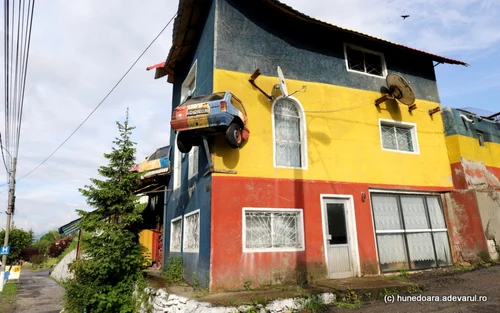
The idea of painting his house in the colors of the tricolor came to the car mechanic from the locality in 2006, when the representatives of the town hall warned him to paint it to give it a more pleasant appearance, the building being located on the main boulevard of the municipality. Also then, he told the media that he was complained about because he left the car parked on the sidewalk, in front of the house.
The car belonged to his son, who had gone to the West and was no longer using it, and the man thought that, if he still didn’t have a “park at home”, to anchor his car right “at home”, integrated into the walls of his house. Passers-by are used to the sight of the house in Lupeni, but often tourists stop in front of it to take photos.
