
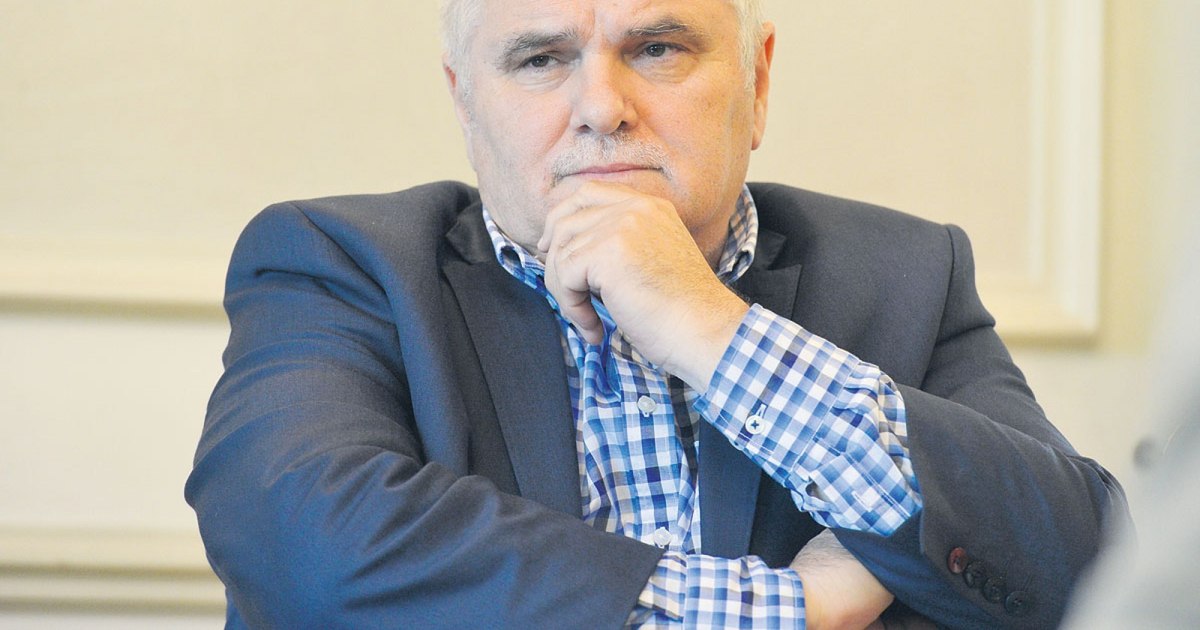
Ștefan Mitroi was born on May 5, 1956, in the village of Siliștea in Teleorman, on the very night of Resurrection – a coincidence of events that did not go unnoticed, says the writer. 70 years later, in an interview with “Weekend Adevărul”, he talks about his childhood, about his mother who clutched his books to his chest and about the prosecutor who decided to arrest himself.
There are three villages called Siliștea in Teleorman county. When someone says “legendary place“, the first thought leads to Siliștea-Gumești, the village of Marin Preda. Ștefan Mitroi was born in another Siliște, however. One with its legends: the mansion of the Noica family could be seen every day from the yard of the parental house, a step away across the river. Constantin Noica was born in the same village, several decades before. “The boyar and the boyar in it have gone“, says Mitroi. He didn’t know Noica then, he found out later, in the first years of high school.
The village was alive in his childhood, and the people, immortal. Even the school, which adjoined the cemetery, didn’t tell him anything about death… until one winter. Paternal grandmother, placed in a wooden box, mounted in a cart with ice flowers on her chest, and behind her full of people crying: this was his first encounter with death. “Although I still had a long time to become a man, I also cried, who was only a child, and not because I took after the adults, but because that’s how it felt to me”. He sometimes wants to cry even now, he says, when he thinks about all the people he’s lost. But another thought carries him the hardest: that he lost his, “almost without knowing how and when”childhood.
The typewriter from the headquarters of the CAP
He learned letters from teacher Bălțatu, but the first person who saw him write poems was a young teacher, just out of the Pedagogical High School: teacher Chiru Bălan. He wasn’t in Ștefan’s class, but somehow he found out about the talent of the little student, took him under his wing and started telling him about the writers and literary magazines of the time.
The only typewriter in the village was at the headquarters of the CAP. The president would give him the key, but they could only use the car at night. In the morning they would return home at daybreak. “I remember a frosty winter’s night. A big moon above our heads and the snow crunching under our feet. I wish that road could last forever. With the two of us bathed in the moonlight. A dog was barking in the distance, the last stars were fading in the sky, a horse could be heard neighing. And the clatter of the typewriter rang in my ears. It was as if all the beauty of that I had written it at night, and the teacher was typing it, getting down to my mind”.
The prosecutor who arrested himself
He graduated from the Faculty of Law in Iasi and entered the magistracy. This adventure lasted several months. “I only managed to arrest one person: myself, who felt all my dreams until then were locked in this profession”.
Nina Cassian, “the most attractive ugly woman in Romanian literature”, seduced famous writers. His regret VIDEO
His father didn’t speak to him for almost a year after he left. Mitroi commuted to Alexandria, and in the afternoons, until RATA arrived to his native village, he drank a few glasses of wine with his colleagues. “I saw my future in the hollow of one of those glasses and I decided to leave”. But there was something else that hurried him. A woman, about his mother’s age, rushed to him and kissed his hand. “I felt a great shame. I saw my mother in that woman”. He had never kissed his mother’s hand while she kissed his hand. “It was quite possible that the shame I speak of would be repeated. To make sure it wouldn’t be like that, I left”. He left Alexandria for Bucharest to become a journalist and writer. “I struggle to become even now“, he says at 70 years old.
Sae Preda and the visit she never got to
With Alexandru Preda, the youngest son of Marin Preda, Mitroi says that he is a friend and that he owes him a little, because he promised to help him buy a house in Teleorman and he hasn’t done it yet. But he also got to know Sae Preda, the prose writer’s brother, the only one from the family who does not appear in “Moromeții”. I visited him in Bacău: “To give you an idea of how excited he was waiting for me, he came after me to the place where I had parked the car, a few hundred meters from the block where he lived. I was coming from home, from his native places, not me, Mitroi, he came out to greet me, but them”.
Sae had not been in his native village for many years. Mitroi had been there a few months before and told him what he had seen – the people, the houses, the acacias. “It was as if Siliștea-Gumești had visited him through me. Shortly after that it went out. But not before passing, even if only with the imagination, at home”.
The future, between the pages of books
The most beautiful book from childhood, says Mitroi, was not a printed one. It was Grandma Tudora, “a talking book, which I read daily with my ears turned into a funnel”. Born in 1890, she recalled events and things from the past with a freshness that felt fresh. “La Medeleni”, “Winnetou” followed, but no book stayed closer to him than “Childhood Memories” and “Moromeții”: “I sometimes feel myself passing through the pages of the Moromets, coming out of their big world into this small world, although reality falsely presents them the other way around”.
He does not like to talk about awards, about their pomp. “Awards don’t make you a writer. Rather it spoils you. The fact that they do not bring friends. However, they also have a merit: they drive away from you some of those who claimed to be yours”.
About the children’s books, written out of love for his sons, he says that his talent as a writer mattered less than “the talent of love”. And that in an increasingly ugly world, the story “it is more than hopeful. It gives beauty“. He believes in the future of the printed book, “at least as long as we survive too”. And about technology he says that it is a tool that people bring to life and that school should teach children to keep their distance, “not pushing them to the past, but opening their eyes to the future“. As a conclusion, Ștefan Mitroi says that “between opening the eyes and opening a book can be put, without fear of making a mistake, the sign of equality”.
The full interview can be read in this week’s edition of “Weekend Adevărul”, available on newsstands starting Friday, May 8.
