
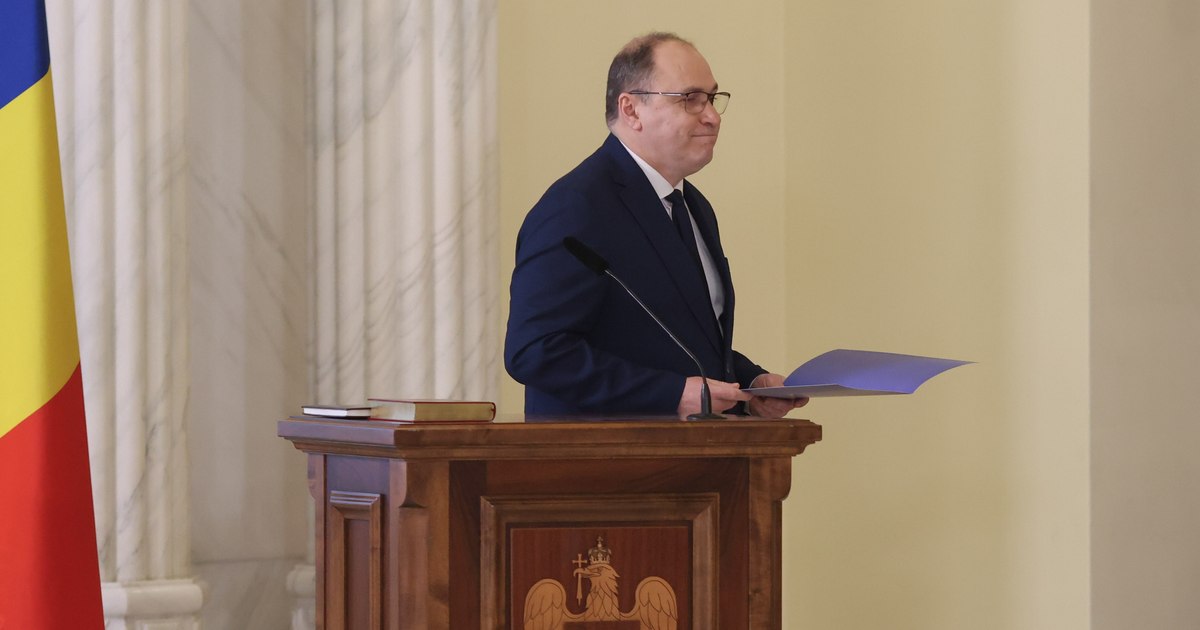
Following the censure motion, by which the Bolojan Government was dismissed, Education remains without a minister again. Mihai Dimian is not leaving the ministry yet, he will provide the interim for no more than 45 days, but his duties are limited. He was a “full” minister for just over two months. Together with several voices from Education, we analyzed what Mihai Dimian is leaving behind in a critical field.
A short mandate and no clear direction
Mihai Dimian took over the mandate of Minister of Education on March 3 this year, at the proposal of the PNL, but without being a party member. His appointment came after a period of more than two months in which Prime Minister Ilie Bolojan was looking for a replacement after the resignation of Daniel David. But no one seemed to want the position.
Dimian came to the management of Education from the university environment, after in recent years he was rector of the University “Ștefan cel Mare Suceava”.
From the beginning of the mandate until the no-confidence motion, he did not organize any official press conference to explain his priorities, but he had several punctual interventions and communications on social networks. Among the things he said he would like to do is increase hourly pay for teachers by 50 percent. And recently he was noted for a controversial statement, which provoked a lot of criticism, according to which parents are responsible for the failure of students in simulations.
It’s been a quiet two months, but that quiet hasn’t meant stability, performance, or really a solution to the problems in education
says Mihnea Haiduc, president of the National Council of Students, regarding Dimian’s mandate.
“Unlike some of his predecessors, Mr. Dimian did not come with many “visionary” directions. On the one hand, this also had a positive component: it seemed more anchored in the reality of the territory and in the concrete problems of the system. On the other hand, however, the lack of a clear vision of the portfolio you coordinate inevitably becomes a management problem, because without assumed objectives and a coherent direction it is very difficult to deliver consistent results. All the more so as his lordship has repeatedly stated, both in events and in public statements, that he does not know how long he will remain in office”. the student adds.
Professor Doru Căstăian finds it difficult to characterize the minister’s activity.
It doesn’t seem to me that the minister has made any difference or created anything substantial in these two months. Maybe I missed something, but nothing really comes to mind. It’s true, it’s only two months and this interval at the head of a ministry means very little, he says.
Education specialist Gabi Bartic believes that:
“It was a short mandate, in which intentions and positions were seen rather than clear directions carried through to the end”.
What was missing during Dimian’s tenure
“I think what was missing was a firm signal that the student is, in fact, at the center of all decisions in the system. This means not only discourse, but also policies and mechanisms that start from the simple question: what does this decision actually change for the child in the classroom? Without this benchmark, there is a risk that many initiatives—even well-intentioned ones—will remain at the system level without actually being reflected in student progress.”Gabi Bartic thinks.
Political crisis shakes economy: Fiscal Council president’s warning: “The country must be governed now”
In addition, it says:
,,I think it was a good time to open an honest conversation about what performance and quality means in education: how we define it, how we measure it, and how we use it in system decisions—whether we’re talking about students, teachers, or school management. I understand that in a sensitive context there is a temptation to avoid topics that can generate tension. But without these discussions, we risk delaying the very reforms the system most needs.“
Professor Doru Căstăian, for his part, adds a number of things that he would have liked, but which Mihai Dimian did not tick:
“I would very much like Minister Dimian to reconsider the measures that were taken by his predecessor. Because, in my opinion, they are superficial, purely accounting measures that have produced “new evil” and aggravated older evils within the system. Not that it should not be reformed, there are many of us who have been talking about it for a long time. But these measures that were taken with only a budget deficit in mind are measures that should have been rethought and reconsidered from many points of view.”
The president of the National Student Council talks about “timid attempts”.
“He had attempts, timid indeed, to express his desire for change on certain topics, such as the introduction of more subjects to the National Assessment. We would have wanted, and we still want, to see the reforms started for years and left in the air”says Mihnea Haiduc.
What political instability means for Education
“Education is one of the fields that suffers the most from political instability, because real reforms need longer mandates than this average of under one year of post-December mandates.
Ludovic Orban at “Interviurile Adevărul”: “If the PSD managed to pass the motion, it does not mean that it will also pass its new government in Parliament”
Every leadership change risks resetting priorities, delaying projects and fragmenting efforts already underway. In this context, the system remains stuck in a sequence of initiatives that fail to produce results”Gabi Bartic thinks.
Doru Căstăian describes this instability as a “boot effect in the viscera of education”, but it comes with a tragicomic perspective:
The bright side, if you’ll allow me a dose of dark humor, is that education is already so used to these shocks that it will most likely not feel them anymore and will continue in its autoimmune logic further.
What Mihai Dimian can and cannot do as interim
Although the official mandate of Mihai Dimian lasted only two months, it was not the shortest in recent history. The record belongs to Ioan Mang, who was minister for only eight days, between May 7 and May 12, 2012. He resigned after it was revealed that he had plagiarized.
Mihai Dimian will continue his mandate until the inauguration of a new government or for a period of no more than 45 days, as interim minister. From this position, he cannot initiate major policies or structural reforms, promote important bills or ordinances, and make long-term appointments. Basically, it can only ensure the usual administrative functioning.
