
The Ministry of the Environment, Waters and Forests has published the first national guide dedicated to the occupation and use of beaches on the Romanian coast, a document developed by the Order of Romanian Architects. It is the first time that Romania has a unified set of rules regarding the organization of beaches, public access and the quality of facilities.
The guide represents the first stage of a wider process of reforming the way in which the beaches in Romania are managed, following that in the following phases, applied solutions will be developed, directly in the field, which will form the basis of future urban documentation and regulations for the future summer seasons, the Ministry of the Environment stated, on Friday, in a statement.
“This guide is the first step by which we bring order to a space that has operated for years without coherent rules. We are not only talking about aesthetics, but about real public access, about the balance between economic interest and environmental protection, and about predictability for operators. In view of the new 10-year leases, this document provides clear benchmarks for how the beaches will look and function. We are also looking at the possibility of these principles becoming an integral part of the contracts, so that the rules are no longer optional”, said the Minister of the Environment, Diana Buzoianu.
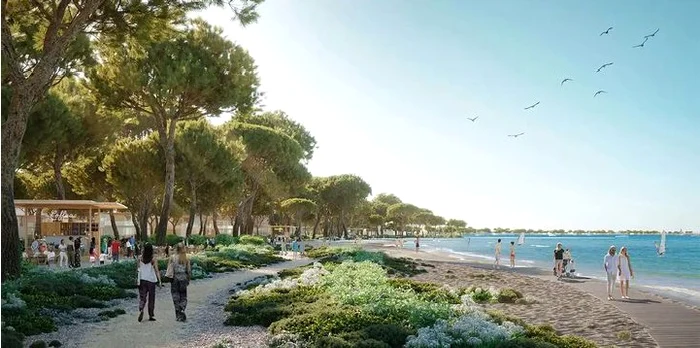
The national guide for the organization of beaches comes in a context in which the Romanian coast has gone through accelerated transformations – the expansion of beaches through sanding, the increase in tourist pressure and the diversification of economic activities – without a coherent organizational framework, which has generated uneven occupancy, access blockages and the decrease in the quality of public space.
“Unitary rules, adapted to each area, and a real increase in the quality of the coastal space”
According to the Ministry, the document proposes a clear model for the organization of beaches, based on a balance between economic use and public interest, and introduces concrete rules regarding occupation, access and the type of permitted interventions.
“The guide we are launching today is a practical tool, built together with specialists, which starts from the reality on the ground and offers concrete solutions for the organization of beaches. We encourage all operators to consult it and apply it in the arrangements they will make in the coming period, especially in the context of the new long-term contracts. The second and third stages follow, in which we will go to the field, we will work directly on coastal sectors, with renderings and organizational proposals that they can later form the basis of urban documentation. It is a staged process, but with a clear direction: uniform rules, adapted to each area, and a real increase in the quality of the coastal space”said Elena Tudose, secretary of state within MMAP.
A continuous area of contact with water, which must remain free
Regarding the occupation of the beaches, the document establishes a continuous zone of contact with the water, which must remain free of any sites, to ensure the movement and unrestricted access of all users. At the same time, the use of sunbeds and umbrellas is kept limited to a maximum of 70% of the rented area, the rest being mandatorily reserved for the free beach, on the sand.
Open war in tourism: industry associations warn that the 2026 summer season is at risk due to the lack of public policies
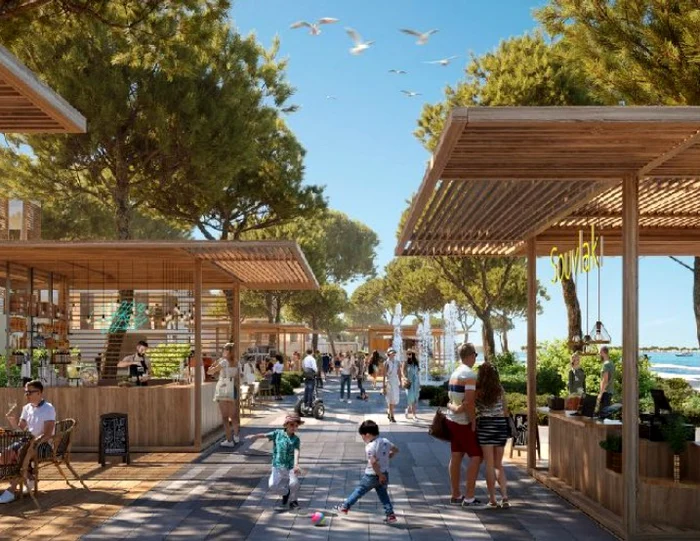
“Public access becomes a central element: the guide provides for the maintenance of clear and continuous pedestrian routes, without blockages, as well as the integration of accesses from the city or the seafront in a coherent system, adapted to each area. Solutions are encouraged that facilitate access for all categories of users, including people with reduced mobility, families with children or the elderly”. it is also shown in the communique.
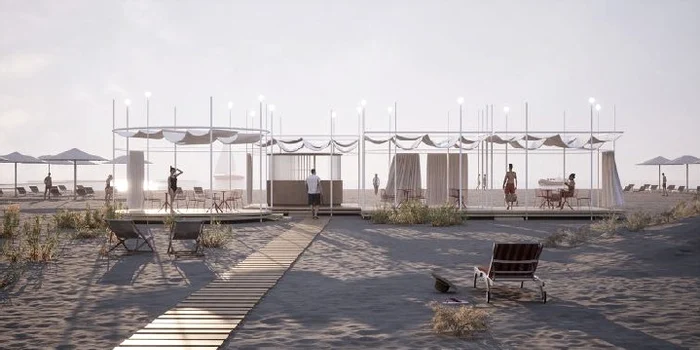
The guide also introduces explicit rules for the type of permitted constructions and facilities. All interventions must be temporary, demountable and reversible, without permanent foundations or interventions that affect the natural structure of the beach. Only facilities strictly necessary for operation are allowed – showers, cabins, first aid stations, lifeguards or light structures for beach services.
The guide also limits inappropriate developments: chaotic siting, overcrowding of the beach, blocking of sea views and continuous linear expansion of commercial structures are discouraged. The organization of functions must be done in a controlled manner, in well-defined areas, in order to preserve the visual openness and natural character of the coastline.
Using appropriate materials and avoiding improvised solutions, non-conforming materials or aggressive colors
A separate chapter is dedicated to the architectural quality and materials used. The guide recommends using durable materials suitable for the marine environment (treated wood, metal, natural textiles) and avoiding improvised solutions, non-compliant materials or aggressive colors that affect the visual coherence of the beach. The interventions must be integrated into the landscape and contribute to a unitary identity of the coast.
New rules on the beaches. The warning of the Minister of the Environment: “This year, all deckchairs placed illegally will be removed”
“At the same time, the document introduces a clear differentiation between the types of beaches (urban, natural or rural) in order to avoid the application of uniform solutions on the entire coast and to adapt the rules to the specifics of each areait is also shown in the document.
The guide covers seven representative areas of the coast – Năvodari, Mamaia, Constanța, Eforie Nord, Eforie Sud, Tuzla and Vama Veche – selected to reflect the diversity of existing situations and to substantiate rules applicable on a national scale.
