
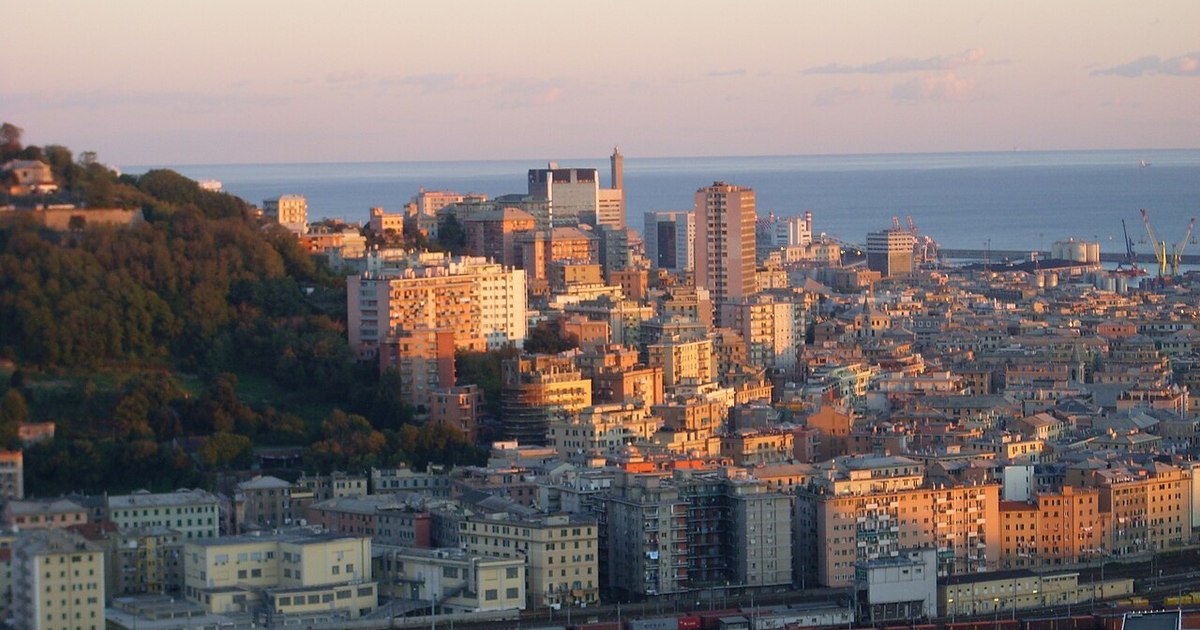
A real estate ad in Italy has sparked waves of reactions online from Romanians, after the cost of the apartment put up for sale was compared to that of homes in the capital and other cities in Romania.
An ad for sale of a two-room apartment in a suburb of Genoa has sparked a wave of reactions on social media.
The clip, intensely debated by Romanians, proposes the purchase of a two-room house, at the price of 45,000 euros, in the Sampierdarena district, in the west of the large Italian port. Sampierdarena was an old fishing village, transformed over time into an industrial-port district with over 42,000 inhabitants, but affected by the demographic decline and the aging of the population. Moreover, real estate agencies in Italy present several real estate offers at similar, but also much lower, prices: apartments in blocks of flats and houses offered for only a few thousand euros, in peripheral, isolated or infamous areas.
In Romania, housing prices are constantly increasing
The debate surrounding the announcement mainly concerns the comparison between housing prices in the Italian city and those in the Capital and in the big cities of Romania. Bucharest leads the list of the most expensive homes, followed by Cluj-Napoca, both following the rising trend of prices on the real estate market.
Most often, ordinary apartments in the Capital are offered for at least 100,000 euros, sometimes the selling price exceeds 200,000 euros. In rarer cases, the price of two-room homes put up for sale through real estate agencies drops below 80,000 euros. In Cluj-Napoca, houses are sold at an average price of 3,200 – 3,400 euros per square meter, in the city center they can reach up to 4,000 euros. Thus, a two-room apartment in Cluj, of 50 square meters, is offered for 150,000 – 160,000 euros, according to real estate agencies. In Iasi, Timișoara and Constanța, the cost of housing is somewhat lower, but increasing compared to previous years.
Only in some small towns in Romania, affected by the industrial decline and depopulated in the last decades, the price of some apartments remained more affordable. In extreme cases, it starts at around 10,000 euros, but the modest living conditions, isolation and economic or environmental problems of the localities mean that such offers are bypassed by many Romanians looking for a home.
Compared to the offers in Bucharest, Cluj-Napoca, Iași, Timișoara, Constanța or Sibiu, the proposed price for the house in Genoa seems, for many Romanians, surprisingly low.
“45,000 euros for two rooms in Genoa, Italy? No, brother, I have nothing to look for in those macaroni shops, I want to give from 200,000 euros upwards at my place, in Romania”an internet user commented ironically, on the Reddit platform.
The price of the home has sparked controversy
Someone else points out that the price of 45,000 euros seems suspiciously low for Genoa, especially since the city is touristic, and during busy periods accommodation can be very expensive.
“I happened to be on May 1, a few years ago, in Genoa. There were a lot of Italian tourists who came there, the city being considered a destination to visit. Because it was a holiday, you couldn’t find accommodation for less than 250 euros per night. It’s hard to believe that, for that money, the apartment is not in a dubious area”he adds.
The same netizen shows that after looking for opinions about Sampierdarena, he came to the conclusion that safety depends a lot on the exact area of the neighborhood. The upper part of the Sampierdarena is generally considered safer, while the areas towards the train station, port and Via Buranello or Via Sampierdarena can be more unfriendly, especially at night.
Another Romanian claims that it is not only the country where the house is located that matters, but, first of all, the area and the opportunities it offers.
“And in Ploiești, Slobozia or Brăila you can find apartments for 30,000-40,000 euros, but even more expensive. After two or three years when people will stop buying, prices will drop. There is no point in comparing an almost abandoned city in Italy, Spain or France and Bucharest, a city with jobs and infrastructure”, add this one.
Some locals from Slobozia and Brăila, however, contradict the internet user, stating that even in these cities housing prices are much higher and have risen constantly in recent years.
Another commentator says that Genoa cannot be put in the same category as the almost deserted towns of the West.
“It’s a big city, with a normal economy. It’s not the capital, but there are jobs. In terms of infrastructure, it has everything you need: an airport, highways, a train, and in the future it would also have a high-speed railway. However, we’re talking about the infrastructure of a city where half of the area is in the mountains. It’s better to live in Genoa than in Bucharest”he thinks.
Housing price controversies in the Capital: “How did it get to 200,000 euros? It’s only the buyer’s fault”
Someone else completes it, stating that he has noticed on Italian real estate websites several such apartments, priced between 40,000 and 60,000 euros, all over the city.
“Genoa is an area with a port that Constanța is only hoping for. You can go by train or car to Monaco, Monte Carlo, Portofino, Cinque Terre. It is a city with a population of around 500,000 inhabitants, in an area where there are probably as many tourists as in all of Romania every year”, add this one.
What an offer Genoa really is
A Romanian believes that Genoa has remained one of the most affordable big cities in Italy in terms of real estate, but is not a bidder in terms of income.
“If there were high wages and cheap apartments, Italians from the south, Romanians, Ukrainians, etc. would move in and balance the market”he says.
A Romanian claims that housing in Western cities can be a real estate investment opportunity.
“Instead of buying a small house for 200,000 euros, maybe it’s better to settle for two apartments in Spain or Italy. Or buy one for 120,000 euros and keep some money. The idea is to see other options, because it’s possible otherwise. The more people buy elsewhere, the lower the demand here and, implicitly, the prices”he says.
A Romanian adds, however, that Genoa is not a suitable city for such investments. He says that Genoa is a port city with a run-down center, even if it has many old palaces.
“There are a lot of African immigrants, there is prostitution and crime, and in general it would be risky to walk the narrow streets at night in certain areas. There is a lack of economic development, an aging local population, and many modest shops, such as tobacconists, barbers, and other small businesses. The city also has museums, restaurants, and good bars. An apartment in a quality building would be much more expensive, but the area does not give the impression of a place that attracts people to they move there from other countries”he says.
Someone else wonders what Romanians could do after buying such a home in Genoa, adding that they would end up living in a foreign country, where they would find jobs with low wages and where they don’t know the language, although Italian is one of the easiest languages for Romanians to learn.
One commentator claims that the situation would be similar in Turin, in certain neighborhoods, where old two-room apartments, which 15 years ago were worth around 150,000 euros, would now have reached 50,000–60,000 euros. The main reason would be, he says, that the demographic profile of the neighborhood has changed. Italians left those areas, and their place was taken by immigrants, who were perceived negatively.
“Let’s not think that everyone is stupid because they pay 200,000 euros for an apartment in Bucharest and don’t prefer to pay 45,000 euros for one in Genoa”adds a netizen.
Genoa, important port, affected by demographic decline
Genoa is Italy’s most important port, and its development was based on trade. In the 19th century, it also became an industrial center, specializing in metallurgy and shipbuilding. In the early 1970s, Genoa’s population exceeded 800,000, but since then it has been in almost continuous decline.
The paradox of small towns in Romania: frozen in time, suffocated by traffic and with ever-increasing prices
In those five decades, the port city’s population fell by almost a third, to around 500,000. In the 80s, deindustrialization and globalization were among the causes that led to the numerical decline of the population, complemented by the phenomenon of its aging. Some Italian sociologists explained Genoa’s peculiar demographic profile by showing that the city’s population was no longer growing through migration from southern Italy.
After the decline of the 1980s, the port economy began to show encouraging signs of recovery, and over time Genoa once again became one of the most important Mediterranean hubs for maritime trade flows from Asia. Also, tourism began to play an important role in the city’s economy.
“Genoa has had, since the 19th century, a particular demographic pattern: low or negative natural increase, the reduction of the average number of members of a household and a constant aging process. This pattern is characterized by a negative natural increase, caused by the low fertility and the high age of women at marriage, by the high life expectancy and, implicitly, by the high share of the elderly in the total population. The reduction in the average size of households is caused by both aging — which leaves many people alone after the death of relatives — as well as family instability and a rate of marriage breakdown that is particularly pronounced for the Italian context,” note a study on the demography of Genoa.
The Liguria region, whose seat is Genoa, is at the top of the regions in terms of population aging, statistical reports show.
“The aging population index in Liguria, on January 1, 2024, reached the historical maximum of the last 20 years: 276.6 elderly people over 65 for every 100 young people under 15. The indicator is increasing by almost 6 percentage points compared to the previous year, when it was 270.9, and by 35 percentage points compared to 2004, when it was of 241.6. Thus, Liguria confirms its status as the oldest region in Italy”. says ANSA, Italy’s national news agency, citing data presented by Istat in the 2025 edition of the report “We Italy – 100 statistics to understand the country we live in”.
