
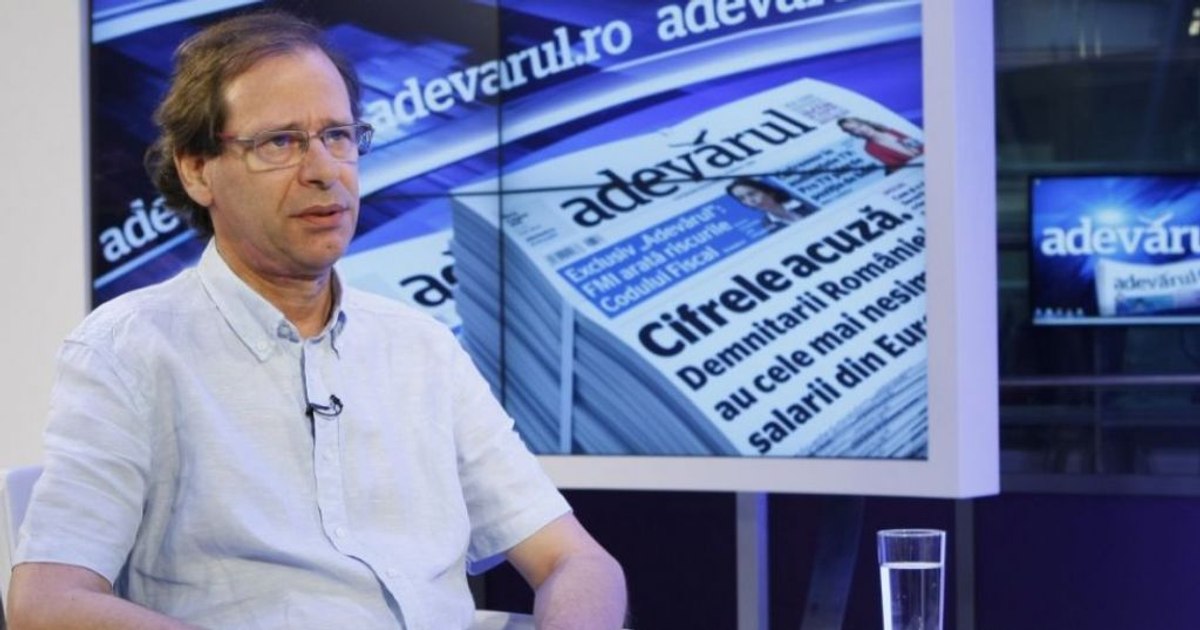
A new conflict of proportions broke out between the AUR party and the “Elie Wiesel” National Institute for the Study of the Holocaust in Romania, after a branch of the political formation officially asked the Parliament and the Government to abolish the institution. In an interview given to “Adevărul”, the director of the institute, Alexandru Florian, dismantles the accusations related to the management of the budget and reveals an intimidation strategy that would include threats of physical presence at the institution’s headquarters. While the central leadership of the AUR distances itself from the approach, the real stake seems to be the “Vexler Law” and how extremist manifestations in the public space are punished.
“It is a notification, as you can see, officially sent to the two Chambers of the Parliament and to the Prime Minister, by which the AUR organization, Balotești, Ilfov County, requests, based on some arguments that are drawn up there, the dissolution of the institute and the repeal of the law on the establishment of the National Museum of Jewish History. Now that it’s not about the central organization, I think it matters less.
It is a clear message from a political structure of this party, and this message does not come on empty ground. Over the years there have been demonstrations, messages from national leaders, let’s say, of the AUR party, regarding the Elie Wiesel Institute, regarding, I know, the activities that we carry out. And not that there were messages, let’s say, of appreciation or criticism, they were messages that clearly expressed this attitude of closing or censoring the activity of the institute.
Therefore, it is not the first, probably not the last manifestation from GOLD, but this is speculation, that it is not the last.”says Alexandru Florian.
“They said they want to come here to intimidate, to come to the headquarters of the physical institute”
The conflicts between the AUR party and the National Institute for the Study of the Holocaust in Romania are frequent and mainly related to the way the history of the Holocaust is approached in our country, the memory of the victims and the positioning towards controversial historical figures. One of the disputes in the past was related to the introduction of a course in schools.
“I would like to recall, related to the introduction of the course, the compulsory subject “History of the Jews. The Holocaust” at the high school, the messages given by various leaders, so to speak, of the AUR party, the messages they gave in relation to the position of the institute towards the memory of the Holocaust and the criminal character of the promotion in the public space of persons convicted of war crimes, clear expressions from videos on YouTube or on TikTok of some AUR leaders who said that they want to come here to intimidate, to come to the institute headquarters, physically to intimidate us and so on. So we are not in the first position.
There were positions that were, once again, by national leaders. One or other of the national leaders of the AUR party. It is not appropriate here now to give different examples and nominally. And this is an excuse, a media excuse if you will, used to tell us that it is a local organization and that it is not the view of the central AUR organization and so on. It is not a point of view of a party member, but of a party organization itself.“, says the director.
He says that such an attitude towards the institute turns into threatening messages from party supporters or sympathizers of the extreme right in Romania.
“We also received threatening messages against the institute, turned into criminal complaints and so on.”.
The budget of the institute is sent to the Government and voted by the Parliament
The main arguments contained in the notification sent are related to how this institution uses the state budget and how it manages its own revenues. Alexandru Florian says that, like other entities of this kind, the allocation procedure is transparent and voted in Parliament.
“At the request of the main authorizing officer of credits, which can be, I am referring to these similar institutions, it can be the Romanian Academy for research institutions or other entities; for us, from a financial point of view, the main authorizing officer is the General Secretariat of the Government. We make a draft budget every fall, at the request of the General Secretariat of the Government.
A draft of the country’s budget is built, it is voted on in Parliament, and finally it goes back to each chief authorizing officer, and he distributes, in part, according to the requests and the budget he received. If the overall budget is lower, the allocations may be changed. If it is a budget that the principal authorizing officer requested, in general, each subordinate receives the budget that he estimated at the request, based on some projects that he proposed to carry out for the following year.
You should know that we are a small institution, with only 22 employees. And the data related to the budget is public. For example, for the year 2025 we published an annual activity report with economic data.”
The budget is based on the necessary expenses for human resources and the necessary expenses for the administration of the entity, the institution and, of course, expenses to carry out certain projects. The address sent by the AUR branch mentions the “excessive dependence on public subsidies and the low efficiency of self-financing: Of the total revenue budget for the year 2025 (1.45 million EUR), it is noted that more than 93% (1.35 million EUR) represent direct subsidies from the state budget”. On the other hand, in the same address, there is talk of exceeding revenues, probably covered by surpluses or additional allocations. Alexandru Florian says that, to the extent of the available programs, the institute has taken the necessary steps to complete the budget granted by the state.
“Apart from the budget subsidy, each entity is free. Over time, we have also managed to compete for various projects and obtain funding, either from the United States Department, which finances public projects, or from the European Commission, in Brussels.
So let’s get external funding, directly from Brussels. So it’s not about, as they say here, exceeding the expenses, because we also have it from another side. Because our income is realized, we have a production, so to speak, of publications, and the main form of income is to get a certain amount that comes back from publications, for example, books. Some that we publish, in general, in partnership with well-known publishing houses in Romania and that reach the book market, and we partially subsidize those publications, and while they are sold, we also receive a part, according to the various contracts we make. So this is the main source of income and which, you realize, cannot cover the expenses, and indeed 90% of the expenses for the operation of this institution and for the achievement of the objectives is the budget subsidy. We are audited from the point of view of managing public money.”
Where did the idea of abolishing the institute come from? “Vexler’s Law” and circulating interpretations
One of the stakes of abolishing the institute starts from the law initiated by Silviu Vexler, deputy of the Jewish minority. This aims to prohibit organizations and acts of a fascist, legionary, racist or xenophobic nature, extends the penalties for promoting the cult of extremist figures (up to three to ten years in prison), defines extremist materials and provides sanctions for the propagation of such messages online.
“This enhancement of such a message has been greatly amplified since the summer of last year, when the Emergency Ordinance no. 31 of 2002 was amended by what is called today in the media, in short, the “Vexler Law”, which brought some additions to this ordinance and through which, certain representatives of the AUR and other extreme right groups, believe, erroneously, that censorship is introduced.
That it would no longer be allowed to read, know or debate, from an academic point of view, the intellectual product, the work of certain intellectuals who were either people convicted of war crimes, or people who held positions of national leadership in extremist parties. The institute is seen as one of, let’s say in metaphorical terms, the entities that would aim to censor and would very closely supervise this public space in terms of the evocations of those individuals.“, concludes the director of the “Elie Wiesel” Institute.
