
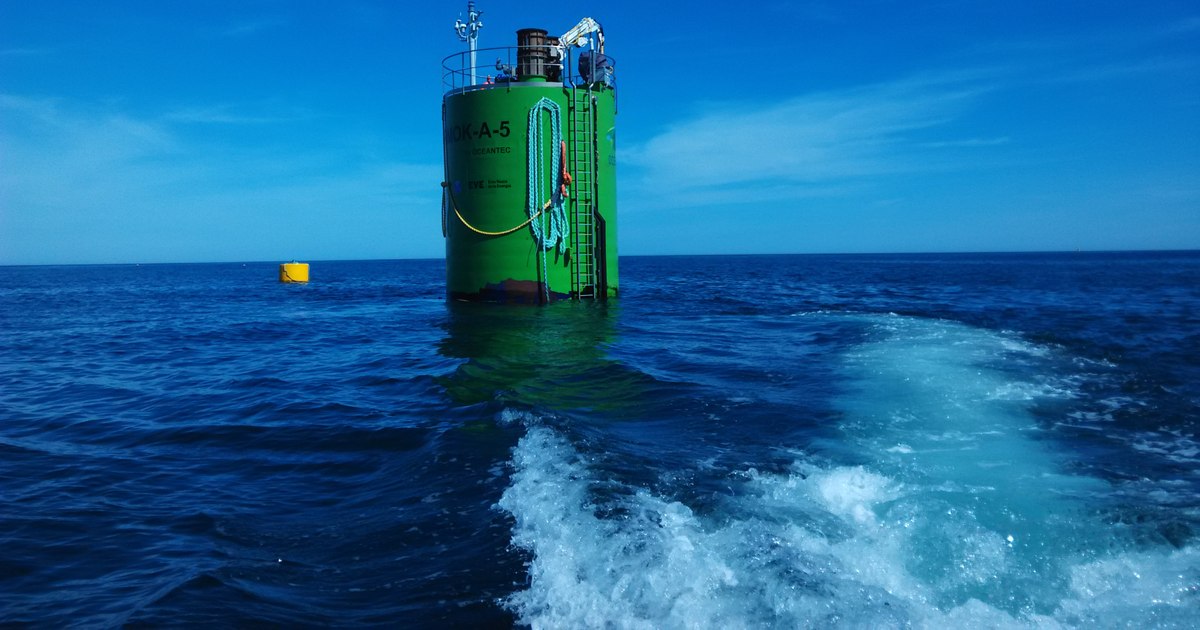
Wave energy has huge and untapped energy potential, say researchers. At the moment a Spanish company has successfully launched an energy project based on wave energy. It is a huge energy converter, experimental for now, according to newsaltasw.com.
The problem of electricity is extremely serious and complex. Globally, this is driven by the ecological transition, the massive increase in consumption, especially due to data centers and electric vehicles, but also by the need to reduce carbon emissions. In practice, global energy consumption has grown exponentially, especially in economically developed areas and large urban agglomerations in Europe, Asia and North America. The International Energy Agency (IEA) constantly reports huge pressures on distribution networks due to digitization and artificial intelligence. In addition, electricity production is dependent on fossil fuels such as coal, oil and natural gas, which are finite and highly polluting resources. Not to mention the fact that electrical infrastructure is vulnerable to extreme weather events and cyber attacks on centralized networks.
A power outage, in the medium term, can have catastrophic effects in today’s world. That is precisely why alternative sources, as least polluting and as cheap as possible, are always being sought for the production of electricity. Among them is decentralized renewable energy, by rapidly switching to solar panels and wind turbines. They allow both large companies and households to become prosumers (ie produce and consume their own energy). To these are added advanced storage systems, but also green hydrogen or small modular reactors. Nuclear power is coming back to the fore with these new reactors, which are safer, cheaper to build and easier to integrate into the grid. Well, in this quest for the “Holy Grail” of cheap and least polluting energy supply, a Spanish company has advanced a viable solution that can exploit a hitherto underutilized source. It’s a giant, experimental converter that uses the force of waves to generate electricity. So far it is delivering the expected results.
Wave force, an overlooked source of energy
Wave energy is considered one of the largest unexplored sources of renewable energy in the world, with a huge theoretical annual potential, estimated by the “Intergovernmental Panel on Climate Change” at about 29,500 TWh globally. This value exceeds the current electricity consumption of the entire planet.
The strategic importance of wave power for the future rests on three main pillars. First of all, it is about the higher energy density, water being about 800 times denser than air. This allows turbines and capture devices to generate a much larger amount of energy per square meter than wind turbines or solar panels. Then it’s about predictability and consistency. Unlike wind or sun, which are intermittent, oceans are always in motion. Capturing devices can generate electricity around the clock, and waves can be accurately forecast days in advance. In addition, waves are often stronger in winter, precisely when energy demand is at its peak. Finally, the third pillar refers to local energy security. For communities located on the coasts of the seas and oceans, this form of energy can drastically reduce dependence on fossil fuels without taking up valuable space on land.
Morocco expects the Nigeria Morocco gas pipeline to become a source of energy supply to Europe
Despite the massive potential, this energy resource is very little used. And that’s because wave energy conversion technology is still in an early, experimental development phase compared to other renewable sources. Existing designs are often expensive and marine infrastructure requires huge investment to withstand extreme weather conditions and corrosion. Specialists say that harnessing the power of sea waves to generate electricity is not at all easy.
A daring project: the “giant” in the Bay of Biscay
However, a Spanish engineering company is trying to harness this all-important form of energy with the help of a giant floating buoy. More specifically, on the Biscay Marine Energy Platform (BiMEP), located off the coast of Biscay in northern Spain, the Bilbao company IDOM is testing a low-power wave energy converter (WEC), which has been in development for several years.
The device is called the MARMOK-A-5 and is basically a point absorber oscillating water column (OWC). It resembles a buoy containing a cylindrical column of water inside, and the whole structure is an impressive height of about 42 meters, of which about 5 meters remain above the surface of the water. Its diameter is about 5 meters, and it is currently anchored on the seabed, almost 90 meters deep. This device, or rather its previous versions, have been tested since 2016 to withstand harsh winters at sea. The latest variant includes intelligent control systems, adjustable blades and integrated batteries.
Here’s how it works. The waves around the MARMOK-A-5 cause the water in the inner column to move relative to the buoy. This movement compresses and expands an air chamber at the top of the buoy, like a piston. The resulting airflow sets a turbine in motion, generating electricity that is transmitted to the onshore grid via an undersea cable. For now, this model only produces a small amount of energy, enough to power a neighborhood on a peak day. That is, it produces a maximum of about 30 kW of electricity, enough to power about 15–20 average US homes at peak conditions.
The importance of the Sun to humans. Explanation of a Qigong specialist: “The sun charges us with energy. You don’t feel the cold anymore”
A first step towards a new future
The model is experimental, but it represents a great achievement. Practically, it has been demonstrated that the production of electricity with the help of the force of waves is possible and that it has a future, including at a commercial level. “Achieving a secure installation and grid connection at BiMEP is a critical step in bringing wave energy closer to commercial reality”said Borja de Miguel, project manager at IDOM. The project is part of EuropeWave, a European research and development program that invests approximately 20 million euros in the development of technologies based on wave energy.
Now that the MARMOK-A-5 has been successfully installed and connected to the network, the next step is to put it into full operation. The data obtained from these tests will also help refine the technology before it can be commercialized and implemented on a large scale.
This is not the only wave energy converter tested on the oceans. In 2024, Ocean Energy launched the massive 826-ton OE-25 offshore Oahu, Hawaii. In the same year, the University of Western Australia began testing a new WEC design in King George Sound. And in February this year, the Danish company Wavepiston signed a memorandum of understanding to install a 50 MW WEC system to power Barbados.
