
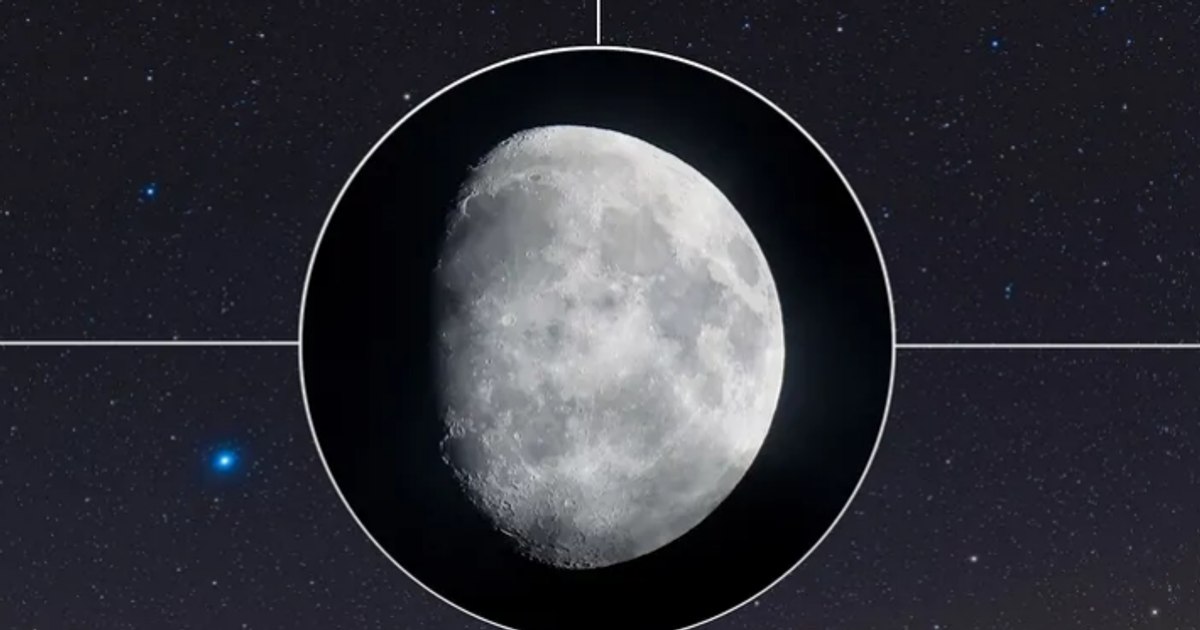
The night sky of May 26 offers an astronomical spectacle that is easy to observe with the naked eye: the Moon will be in close conjunction with Spica, a massive star, one of the brightest stars in the constellation Virgo, easily recognizable by its bluish-white light. It will provide a gorgeous astronomical picture just before a rare ‘Blue Moon’ appears later in the week.
The phenomenon is visible at sunset, when the Moon is at about 83% illumination and rises in the southern sky to a height of nearly 40 degrees above the horizon. At this moment, Spica appears nearby, slightly to the left of the Moon, forming a spectacular landmark on the sky. You will notice an extremely bright point of light, a sparkling blue-white, located just to the left of the Moon. It is not a planet, but Spica, one of the brightest stars visible from Earth.
Although it looks like a single intensely bright star, Spica is actually a double star system consisting of two giant stars that orbit each other about once every four days.
Together, they emit an extremely strong light, with a cumulative brightness estimated at more than 12,000 times that of the Sun, according to astronomical data frequently cited in the specialized literature, writes space.com. Spica is about 250 light-years away from Earth, while the Sun is 150 million kilometers away.
On the night of May 26 to 27, the Moon seems to “slide” slowly across the sky, visually approaching Spica, but not covering it completely. The two celestial objects will set together in the west in the early hours of the morning, continuing the astronomical spectacle that began at sunset.
According to the cited source, in the following days, the Moon continues its apparent trajectory in the sky, moving towards other important landmarks. Thus, at the end of the month, it will approach Antares, a reddish star in the constellation Scorpio, in another spectacular moment for astronomy enthusiasts.
The event occurs near what astronomers call “Blue Moon”popular name for the second full Moon in a calendar month – a relatively rare phenomenon, occurring once every few years.
