
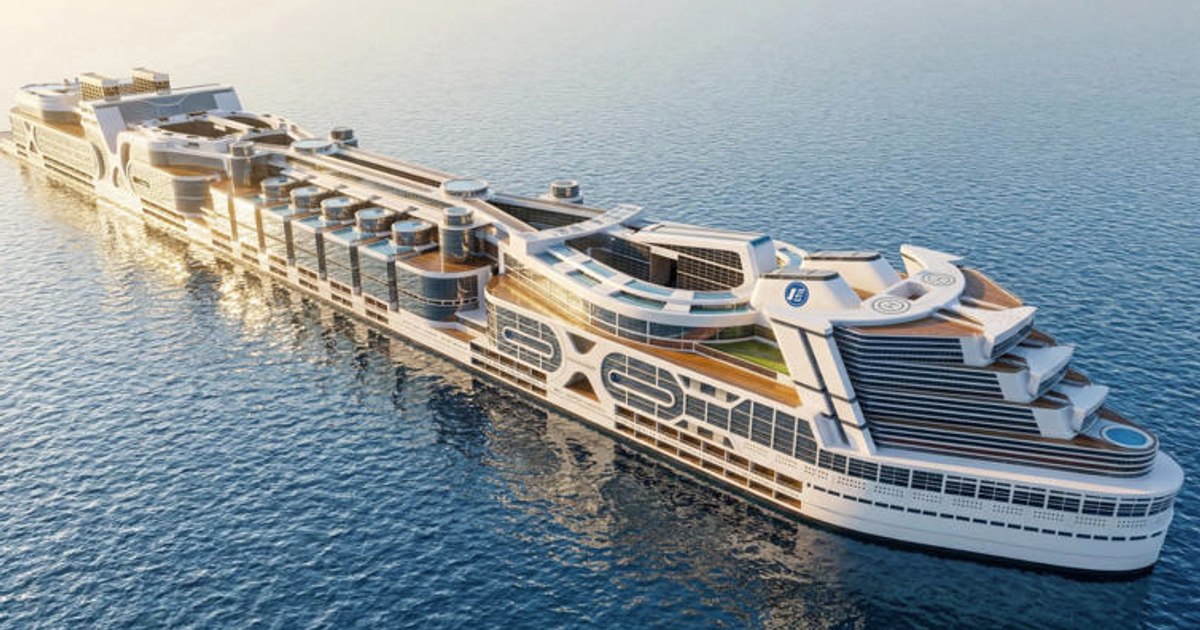
A futuristic project promises to build the most ambitious “floating city” ever conceived: a ship of gigantic proportions called the Freedom Ship. It will be able to accommodate up to 80,000 people and will be equipped with hospitals, schools, shopping centers and residential spaces, designed to function as a fully self-contained community at sea.
According to the plans, the vessel would be almost 1.6 kilometers long and about 240 meters wide, standing on 30 decks. The estimated cost of construction is 12 billion euros, and supporters of the project say the ship would function as a fully autonomous community at sea.
A complete city on the ocean
The Freedom Ship would house approximately 50,000 permanent residents, 10,000 visitors and 20,000 crew members. The concept envisages an infrastructure comparable to that of a modern city: homes, schools, hospitals, shopping centers and recreation spaces distributed on several levels, writes express.
Among the facilities announced are hotels, restaurants, shops, banking, museums, a symphony hall and a water park. It would also build a 15,000-seat stadium, a convention center, an aquarium, a nightclub and a two-level food court.
Education would be fully provided on board, from primary to university level, and commercial areas would house businesses and services similar to those on land.
According to the plans, the ship would continuously sail around the world at a speed of about seven knots, making a complete global circuit once every two years. Because of its size, the vessel would not dock at regular ports, but would remain permanently in international waters.
Passenger transfers and supplies would be carried out by ferries and auxiliary vessels, and other cruise ships could dock alongside.
The concept was initiated in the 90s by the American engineer Norman Nixon, who died in 2012. Over time, the project was resumed and abandoned several times, recently returning to attention under the leadership of Roger Gooch, a representative of Freedom Cruise Line International.
He claims that a team of 12 specialists is currently working on the development of the project and that investor interest is significant, although funding remains the main obstacle.
Where would it be built?
If funding is secured, construction would begin in Indonesia, where the hull would first be made. The structure would be built modularly, in sections, then assembled at sea.
Estimates indicate a construction period of three to four years, with the possibility that the first residents will move on board before the project is fully completed. Maintenance would be done while the ship is in continuous motion.
The proposed business model is based on renting commercial spaces to external operators, in a system similar to terrestrial cities. Restaurants, stores and service providers would pay rent, and the company could directly operate certain facilities, including a casino.
The developers also say there is interest from medical and research organizations in using the onboard facilities. A large hospital and research center with extensive activity is even proposed.
Proponents of the project say the vessel could also have environmental benefits, including using nuclear power for propulsion and helping to clean up the oceans, though those claims remain at the plan level.
Previous versions of the project included extensive green spaces and pedestrian areas, designed to cope with rising sea levels.
Spaces for sports and events have also been discussed, but even hosting major shows could be difficult due to the size and peculiarity of the structure.
Although the project has sparked both enthusiasm and skepticism over time, it remains one of the most ambitious architectural and engineering concepts ever proposed.
