
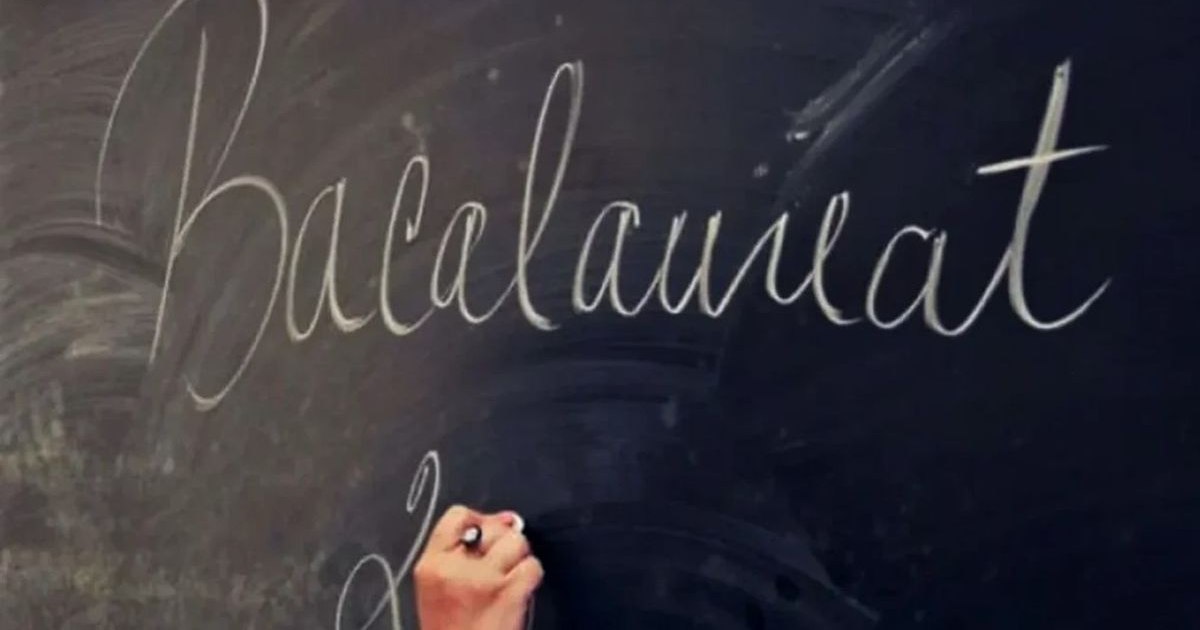
The Ministry of Education launched in decision-making transparency the draft order regarding the tests and subjects for the first generation Baccalaureate that will study according to the new framework plans (2026-2027), according to Law 198/2023.
According to the representatives of the Ministry, this project aims to ensure a predictable and coherent framework, in close connection with the new curricular architecture of the high school and with the skills acquired during the four years of study.
The new architecture has already caused reactions among teachers. Ionuț Oprea, Romanian language teacher and director at a high school in Bucharest, analyzed the project and offers a nuanced assessment, which welcomes some aspects, but points to numerous vulnerabilities.
“I carefully followed the draft ordinance regarding the new structure of the Baccalaureate exam for the generation that will graduate in 2030. First of all, I welcome the intention to correlate the exam more closely with the new curricular architecture. It is natural that students are evaluated according to what they have actually studied in the four years of high school, not according to outdated programs. In this sense, the differentiation of the written exam in Romanian Language and Literature on three levels – A1 for the majority students, A2 for philology and A3 for schools with teaching in minority languages – it seems to me a fair and pedagogically justified measure. We can no longer claim the same degree of literary depth as a future philologist. Therefore, in this chapter, I consider that the Ministry has found a healthy middle ground.”declared Ionuț Oprea, for Adevărul.
However, the teacher’s enthusiasm stops in front of other provisions. His greatest concern is generated by the introduction of the obligation of two tests to evaluate language skills in two studied modern languages.
“However, the problems appear, and they are numerous, when we analyze in more detail the proficiency tests and, above all, the written tests specific to each specialization. The most worrying change, from my point of view, is the introduction of the obligation of two tests to assess language skills in two modern languages studied. On paper, it is an admirable goal: our graduates should communicate fluently in two foreign languages. In reality, however, I wonder how many schools have the human and material resources to prepare with true all students at the level of a baccalaureate exam in a second foreign language. We all know that in many high schools, the second language is taught in a small number of hours, with overworked teachers and students who perceive it as an additional burden. The transformation of this subject into a compulsory exam, with the same valence as the first language, risks creating a huge gap between well-endowed and disadvantaged schools meditations and those who don’t. In addition, from an organizational perspective, I wonder how exam centers will be able to manage such a large number of oral tests in two different languages without turning the session into a logistical marathon”added Ionuț Oprea.
Controversies surrounding the transformation of Religion into an optional subject for the Baccalaureate
Another extremely sensitive point in his opinion is the appearance of the Religion discipline among the optional subjects for the written exam in the Social Sciences and Philology majors.
“Another sensitive point, perhaps the most sensitive, is the appearance of the Religion discipline among the optional subjects for the written test in the Social Sciences and Philology majors. I do not want to make value judgments on the status of this subject in the school, but as a director, I have serious doubts about the appropriateness of including it in a national exam that claims objectivity and equivalence between the options. The question arises: can there be a Religion test – no matter how rigorous the curriculum – comparable, in terms of the degree of difficulty and the objectivity of the evaluation, to a test of History, Geography or Psychology? There is a risk that many students choose Religion not out of conviction or cognitive interest, but because they perceive this discipline as easier to pass, possibly through an effort to memorize some catechism concepts insufficiently well weighed”the teacher explained.
“Extreme Flexibility” offered to Philology graduates is, in his opinion, another source of vulnerability.
“Last but not least, I must talk about the extreme flexibility offered by the project to the Philology specialization. According to the new regulation, philology graduates can choose for the first written test between Modern Language 1 and Modern Language 2, and for the second test from a motley list that includes History, Geography, Logic, Psychology, Sociology, Economics, Philosophy or Religion. In other words, a student can graduate with a Philology profile without do not take a written exam in a fundamental humanistic discipline such as History or Universal Literature, but only in a foreign language and Logic. In this case, what is left of the in-depth study profile of the Romanian language and literature. It is true that the test of Romanian Language and Literature remains mandatory, but the other two written tests can almost completely bypass the cultural and humanistic components a dilution of the identity of the profile and to an extremely heterogeneous training of graduates, which will cause problems both in admission to humanities faculties and in the labor market”warned Ionuț Oprea.
How to motivate yourself to learn! 20 tips from a psychologist
Issues regarding subject confidentiality
Beyond all this, the teacher draws attention to a systemic problem related to the actual organization of the exam.
“Beyond these particular aspects, there is a systemic problem that I cannot help pointing out: the organizational complexity of a baccalaureate in which each candidate chooses his own combination of tests. In the Natural Sciences specialization, for example, students can choose the first test from Physics, Chemistry, Biology, and the second from the same three plus Mathematics and Computer Science. This means that, in the same exam room, dozens of subject variants can coexist. How will ensure the secrecy of the subjects? How will so many variants be printed and distributed in a timely manner? There is a risk of major administrative errors and information leaks. Also, schools and exam centers will have to invest heavily in the logistics of printing, keeping and correcting, which involves additional financial and human resources that many counties, perhaps even Bucharest, do not have at their disposal.”the director pointed out.
Ionuț Oprea draws a weighted but firm conclusion, showing that the project has both strong points and major weaknesses, and hasty implementation without impact studies and without adequate funding risks turning a well-intentioned endeavor into a failure.
“To conclude, the Baccalaureate 2030 project has both virtues and major shortcomings. The virtues relate to the adaptation to the new programs, the level differentiation in the Romanian language and the encouragement of the study of two foreign languages. The shortcomings, however, are worrying. As a teacher and leader, I would suggest to the ministry that, before implementation, carry out impact studies and large-scale simulations, ensure adequate funding for disadvantaged schools and to reconsider the inclusion of Religion as a baccalaureate subject. Otherwise, the risk is to have a so-called modern exam in form, but deeply unfair and chaotic in substance. Until 2030, there is still enough time for adjustments, but the dialogue should not only be about form.”concluded professor Ionuț Oprea.
What subjects are taught at the Baccalaureate in 2026. Where can the syllabus be consulted
The provisions of the document under consultation
According to the document under consultation, all candidates will take tests to evaluate oral communication skills in Romanian, two separate tests of language skills in two studied modern languages, as well as a test of digital skills.
Candidates from national minorities will additionally take the test of oral communication in their mother tongue.
As for the written tests, students from most specializations will take Romanian language and literature A1, those from philology will have an A2 level test, and those from schools with teaching in the mother tongue will take a special test A3.
There is also a written test in the mother tongue, compulsory for those who attended high school in a minority language and optional for others.
For the written tests specific to each profile, candidates from Mathematics-Informatics must take Mathematics, and the second test at their choice from Computer Science, Physics, Chemistry or Biology.
In Natural Sciences, the first test is a choice between Physics, Chemistry or Biology, and the second is a choice between the same three subjects, plus Mathematics and Computer Science.
In Social Sciences, the first test is compulsory History, and the second is a choice between Geography, Logic, Psychology, Sociology, Economics and entrepreneurial education, Philosophy or Religion.
In Philology, candidates choose their first test between Modern Language 1 and Modern Language 2, and their second test between History, Geography, Logic, Psychology, Sociology, Economics and entrepreneurial education, Philosophy or Religion.
