
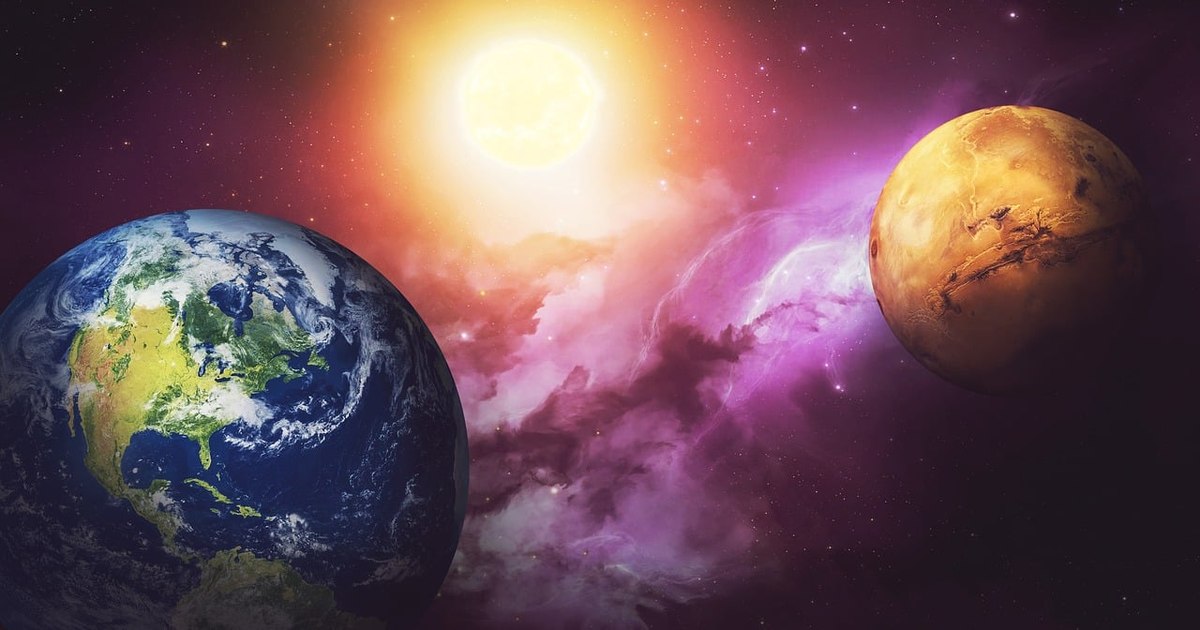
An analysis of data collected by NASA’s InSight mission not only changes the picture of the interior of the Red Planet, but also raises questions about the conditions under which a planet can become habitable.
Over time, one of the questions that has represented a real challenge for scientific research, but also for the human imagination, has been whether the Earth represents an exception or just an example among many other possible worlds in the Universe.
With the discovery of numerous exoplanets, the attention of scientists has increasingly focused on understanding the conditions that make a planet capable of supporting life and on the diversity of forms of evolution of geological structures that could exist in our solar system and even beyond it.
In this context, Mars remains one of the most important pieces of this puzzle. Relatively close to Earth in size and structure, but very different in its evolution, the Red Planet is being studied by scientists precisely to understand why some worlds become stable and potentially habitable, while others lose their atmosphere and geological activity.
Seas of magma inside the crust
An analysis of data collected by NASA’s InSight mission not only changes the picture of the interior of the Red Planet, but also raises questions about the conditions under which a planet can become habitable.
Measurements from seismic data recorded by NASA’s InSight mission, which operated on the planet’s surface between 2018 and 2022, indicate that Mars may have had, in its distant past, vast accumulations of magma within the crust, space notes.
Analysis of Martian earthquakes has revealed a clear “boundary” in the crust, located about 24 kilometers deep, between two distinct types of rock, formed under different conditions and associated with the presence of magma.
This structure suggests the existence of huge magma “pools” within the crust, stretching for hundreds or even thousands of kilometers, which would have allowed materials to separate by density. Thus, over time, the heavier rocks sank and the lighter ones remained on top, before the magma cooled and permanently fixed the layers.
“One of the big questions in planetary science is whether the Earth is unique,” said Jon Wade of Oxford University.
“If Mars could develop this kind of complex crust without plate tectonics, then perhaps the conditions necessary for habitability can occur on more planets than we imagined, including some that were previously ruled out because of their size or apparent lack of tectonic activity,” the researcher added.
What the homes of future colonists on Mars and the Moon could look like
On Earth, the crust is formed by plate tectonics, a mechanism that moves huge fragments of the crust above the molten mantle. This process generates earthquakes and volcanoes, creates new land areas, and helps regulate the composition of the atmosphere through cycles of carbon uptake and release.
No clear evidence has been discovered that Mars ever had such a system, and it is considered a “stagnant lid” planet, where the crust forms a continuous and relatively uniform layer. Below this layer, up to about 38 kilometers deep, the structure was considered, until recently, to be relatively homogeneous.
Data transmitted by InSight, obtained by analyzing seismic waves generated by meteorite impacts and internal motions of the planet, however, showed clear differences in the way these waves travel through the interior of the planet.
Researchers from the University of Oxford interpreted these signals through geothermal models, identifying two types of rock: an upper, mafic layer rich in iron, magnesium and silicon, down to about 24 kilometers deep, and a lower, ultramafic, denser and less silicon-poor layer that descends to the mantle boundary.
These reservoirs could have formed interconnected systems, fueling surface volcanism, including major structures such as Olympus Mons and the Tharsis region. Rather than being isolated centers, they may have been part of an extensive underground network, a phenomenon known on Earth as “transcrustal magmatism.”
This interpretation suggests that Mars had a much more complex internal evolution than assumed, even in the absence of plate tectonics.
Extensive volcanic activity could also have influenced the planet’s early atmosphere, releasing greenhouse gases that helped maintain higher temperatures and a denser atmosphere, scientists say.
Over time, however, Mars lost much of its atmosphere and water, due to reduced gravity and the lack of a strong enough magnetic field to protect it.
What makes a planet habitable
Beyond the geological implications, the new findings open up a broad discussion, starting with the idea that the fact that Mars could have supported a complex internal system without plate tectonics suggests that “habitability” does not necessarily depend on the same conditions as on Earth.
Taking the reasoning further, it turns out that, in fact, the conditions necessary for the emergence of life could be more widespread in the Universe than previously thought, including on smaller planets or on worlds with no obvious tectonic activity and which have not been taken into account until now.
“We have traditionally assumed that volcanism on Mars was relatively simple compared to that on Earth, but this discovery suggests that the planet could have supported huge, long-lived magmatic systems capable of evolving and remaking molten material throughout the crust.” said Tobermory Mackay-Champion, formerly a researcher at Oxford and now at the University of Bristol.
He added that these processes could also bring mineral resources closer to the surface than previously estimated, which could influence future Mars missions.
The researchers point out, however, that this prospect also raises big questions about how the exploration and possible exploitation of the resources of a planet that may still retain essential traces of its own evolution should be approached.
