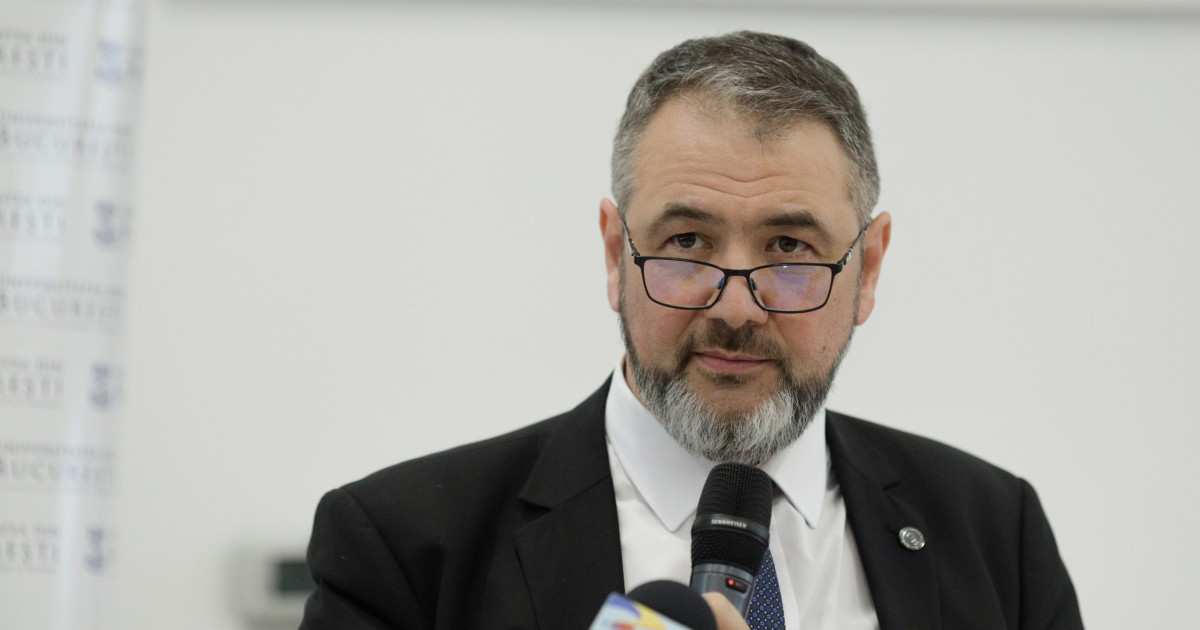
Romania cannot have a quality education without a safe educational environment, without the protection of children, as well as teachers, declared, on Monday, the Minister of Education, Sorin Costreie, at the closing conference of the project “Consolidating the response to violence against children through better-founded policies and increased institutional capacity”, held at the Victoria Palace.
The project was carried out by the Ministry of Labour, the National Authority for the Protection of Children’s Rights and Adoption, UNICEF Romania, the General Secretariat of the Government, together with partners from Poland and the European Commission.
“I want to welcome this project funded by the European Commission, but which is under the auspices of UNICEF and which is done in collaboration with our colleagues in Poland. And, if I still arrived in Poland, I also convey all our support and understanding for the tragic events of a few days ago and give the signal that we, in theory, are talking about school violence, but we see more and more often that this school violence translates into street violence. Look what is happening and in France at a macro level, in Greece, look at what happened in Serbia and more recently, we saw the demands even in Texas, so they have crossed the ocean, they are all about education and with a safety component at school, which is crucial. We cannot have quality education without a safe educational environment and without the protection of both the children who participate and the teachers,” Costreie said.
According to him, education is a broader, integrated concept that ensures the foundation and orientation of young people in society.
“We’re not talking about formal education, especially education, we’re talking about education. And that’s why I want to greet my colleague Florin Manole, with whom we will have a lot to do and we will, because we also discussed social grants and other plans, because these measures are integrated, I don’t just look at education as a system, I look at education as a broad concept and that’s what parents and children do and, yes, politicians who are role models and many other things the foundation of this education. So, school violence is not just a school problem,” the minister emphasized.
He mentioned that there are public policies transposed into legislation, but the phenomenon of violence in schools persists.
“We have done everything we can, we have projects, we have approved the National Plan to combat school violence, we have management procedures and the anonymous reporting mechanism. We are doing well, but how are we doing with violence? We are doing badly. Why? Because, beyond documents, projects and other things of this type, I believe that the mentality must be changed. I strongly believe that the teacher must also assume a social role and look after the child. Many of these social forms, which, yes, also manifests itself in school, starting from the fact that our children are not seen, are not heard, are not understood, are not listened to, and listening does not mean taking them to the blackboard and asking them about the information that has been poured into them. It means seeing it in everything that each child means, in this whole that constitutes the human mind and soul”, explained Sorin Costreie.
The minister also highlighted the importance of school counseling. “School counseling is needed and I want to send a signal, because what happened in the Parliament is not ok. So, we had a law that failed that removed parental consent for children to go to a counselor. In some cases, excuse me, but the parents themselves are the problem, so how can this loop and this lack of trust be solved, because the school counselor is seen in our schools and high schools in much the same way as the psychologist or psychiatrist is seen in our society. I mean, if you go there, you already have a little label, you see, you have some problems at the mentality level, but for that, I hope that, in the end, this law will be corrected, and our children can go to the school counselors, of course, from the age of 14 or 16 it doesn’t matter, but not from the age of 18, when we are already in a different situation,” the minister said.
He also drew attention to the way in which cases of violence in schools are presented to public opinion, noting that the “obsessive circulation of some images” only creates the premises for even more such cases.