
A rare cosmic flare is expected to occur in the Milky Way in the coming months – an flare so bright that a “new” star will briefly appear in the night sky.
PHOTO: NASA
The event, known as “new”will be a unique opportunity to observe the sky for those in the Northern Hemisphere, according to NASA, because the types of star systems in which such explosions occur are not common in our galaxy, writes nbcnews.com.
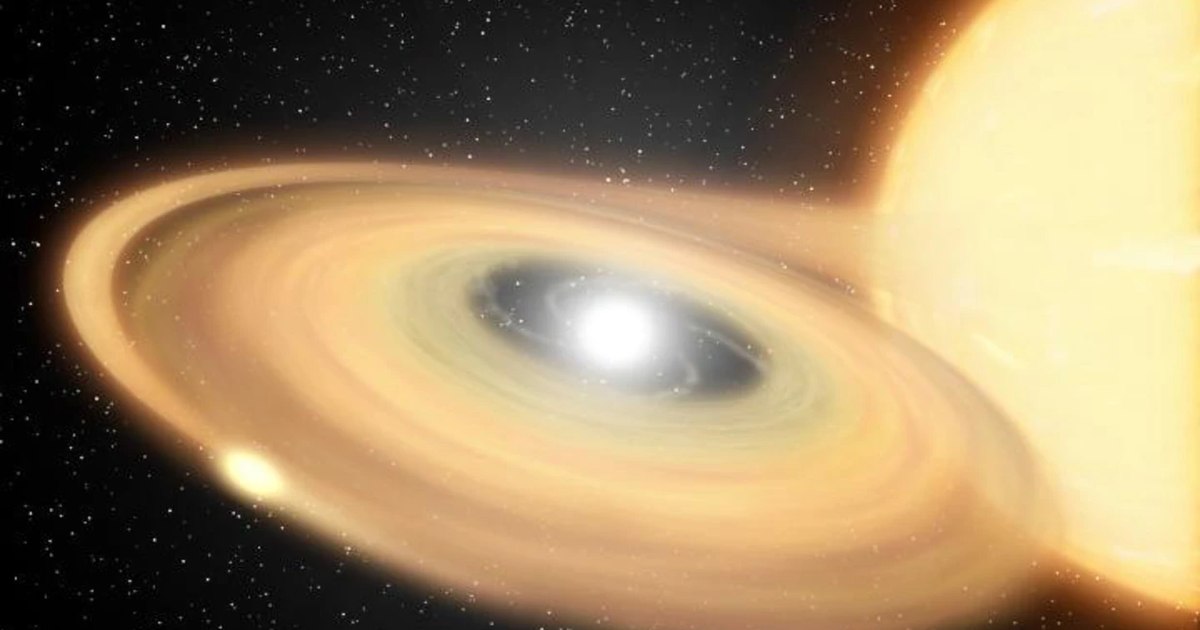
The starburst will occur in a system called T Coronae Borealis, which is 3,000 light-years from Earth. It contains two stars: a dead star, also known as a “white dwarf”, closely orbited by a red giant. Red giants are dying stars that no longer have hydrogen in their cores; The sun in our solar system will eventually become one of them, according to NASA.
In systems like T Coronae Borealis, the two stars are so close together that matter from the red giant is constantly spilling onto the surface of the white dwarf. Over time, this builds up pressure and heat, eventually triggering an eruption.
“As matter accumulates on the surface of the white dwarf, it heats up and builds up more and more pressure until bang – it's a runaway reaction” said Bradley Schaefer, professor emeritus of physics and astronomy at Louisiana State University.
He compared the nova explosion to a hydrogen bomb exploding in space, adding that the resulting fireball is essentially what people will be able to see from Earth. (A nova is different from a supernova explosion, which occurs when a massive star collapses and dies).
At its peak, the eruption should be visible to the naked eye, Schaefer said: “It will be bright in the sky, so it will be easy to see from your yard.
Astronomers predict that the nova explosion could happen anytime between now and September. The last time this particular star system erupted was in 1946, Schaefer said, and another eruption probably won't happen for another 80 years or so.
Astronomers around the world are monitoring activity in the T Coronae Borealis system. Once an eruption is detected, Schaefer said, the best and brightest views will likely be within 24 hours, when it reaches about the same brightness as North Star. The rash may remain visible to the naked eye for several days before it begins to fade.
Even after it fades, sky watchers will likely be able to observe the eruption for about a week using binoculars, according to NASA.
Normally, the T Coronae Borealis system is too faint to see unaided, but observers can find the burst by locating the constellation Corona Borealis, or Northern Crown. The constellation will appear as a small arc of a semicircular circle between the constellations Hercules and Bootes, more easily recognized.
Schaefer, who has done extensive research on the T Coronae Borealis system, said it's worth trying to catch a glimpse.
“This system happens to have a recurrence time scale of under a century, but most have cycles longer than 1,000 years or so“, he said.
In a paper published last year in the Journal for the History of Astronomy, Schaefer discovered two T Coronae Borealis flares “long lost” to the historical record – one documented by German monks in 1217 and another seen by English astronomer Francis Wollaston in 1787.
“These monks near Augsburg, Germany didn't know what it was at the time, but they singled out the eruption as one of the two most important events of the year.” Schaefer said. “They called it 'signum mirabile' in Latin, which translates to 'wonderful sign'. It was believed to be a good omen.”
But determining exactly when sky watchers will have the opportunity to see this “wonderful sign” is a tricky business.
“It could happen maybe even tonightSchaefer said.It will most likely be in the next two months and very likely before the end of the summer.”
