
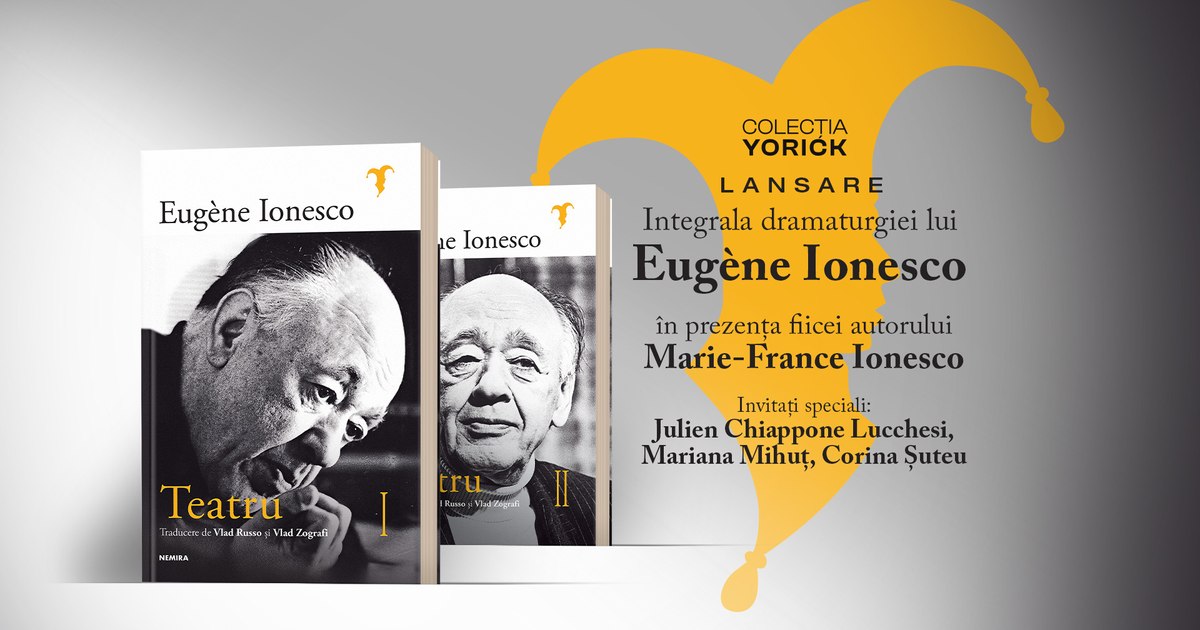
Nemira publishing house announces a very special editorial event, the release in two volumes, in the translation of Vlad Russo and Vlad Zografi, of all the playwright's plays, on May 20, from 19:00, at Cinema Elvire Popesco in within the French Institute in Romania.
The event, organized in collaboration with the French Embassy in Romania, will be held in the presence of the author's daughter, Marie-France Ionesco. Along with this will be Mr. Julien Chiappone Lucchesi, cultural attache and managing director of the French Institute Bucharest, Corina Șuteu, Mariana Mihuț and Victor Rebengiuc, in a discussion moderated by Irina Cerchia, coordinator of the Yorick collection.
The two volumes were published simultaneously, in excellent graphic conditions, in the Yorick collection – the only collection in the country dedicated exclusively to the performing arts – and are available on the publisher's website and in bookstores throughout the country.
Entry is free, based on a reservation on Eventbook: https://eventbook.ro/other/bilete-lansarea-integralei-dramaturgiei-lui-eugene-ionesco
A symbol of both French and Romanian cultures, Eugène Ionesco fundamentally influenced European culture, remaining in the collective memory, alongside William Shakespeare, AP Chekhov or Samuel Beckett, as one of the greatest playwrights in world history. Eugène Ionesco was born on November 26, 1909, in Slatina. When he was two years old, his parents left Romania and he settled in Paris, where his maternal family lived. Returning to Romania after 1922, he learned the Romanian language and enrolled at St. Sava High School, where, a few years later, he became a French language teacher. He debuted as a poet in 1928, in Tudor Arghezi's Bilete de papagal magazine. In 1934, he published his first volume of critical essays, No!, which, with its acid and irreverent style, became one of the most controversial publications of the time. In 1950, he debuted as a playwright with the play The Bald Singer, staged at the Théâtre des Noctambules, directed by Nicolas Bataille, which was followed by The Lesson, The Chairs and other plays that turned him into one of the greatest French playwrights . Once settled in France, he enters the cultural world and opens the “Mihai Eminescu” chair in Nice. To this day, guidebooks about Paris urge tourists to see the Eiffel Tower, the Huchette Theater and Ionesco – it has become a monument, a curiosity, more than the Comédie Française.
Speaking about her father's work, Marie France Ionesco reveals that: “Eugène Ionesco had enrolled at the Sorbonne for a doctoral thesis on the theme of sin and death in French poetry, from Baudelaire onwards. The thesis was never finished, plays were born instead.“
“From failure to failure, Eugène Ionesco's plays succeeded one another and became successes. He couldn't help but write, it was his vocation, his raison d'être, and then he wrote“, adds Marie-France Ionesco.
About the Yorick Collection
The Yorick Collection from Nemira Publishing House is where arts and readers meet. Here are the books that fundamentally changed the way art is understood today. The books that have shaped generations of stage professionals. The books that let you discover the behind-the-scenes of art and the biggest secrets of artists everywhere. The books that take you to new worlds, where value is the main criterion. The books that marked the history of art. The Yorick Collection is made up of big names in theater and film and has a unique presence in the publishing market for over 10 years. This includes books on theater theory, which have fundamentally changed the way theater art is understood today, but also the way it is performed on stage. At the same time, it includes diaries/memoirs of great creators, who inspired generations of actors, directors and other stage professionals (Charles Chaplin, Anthony Quinn, Ingmar Bergman, etc.).
