
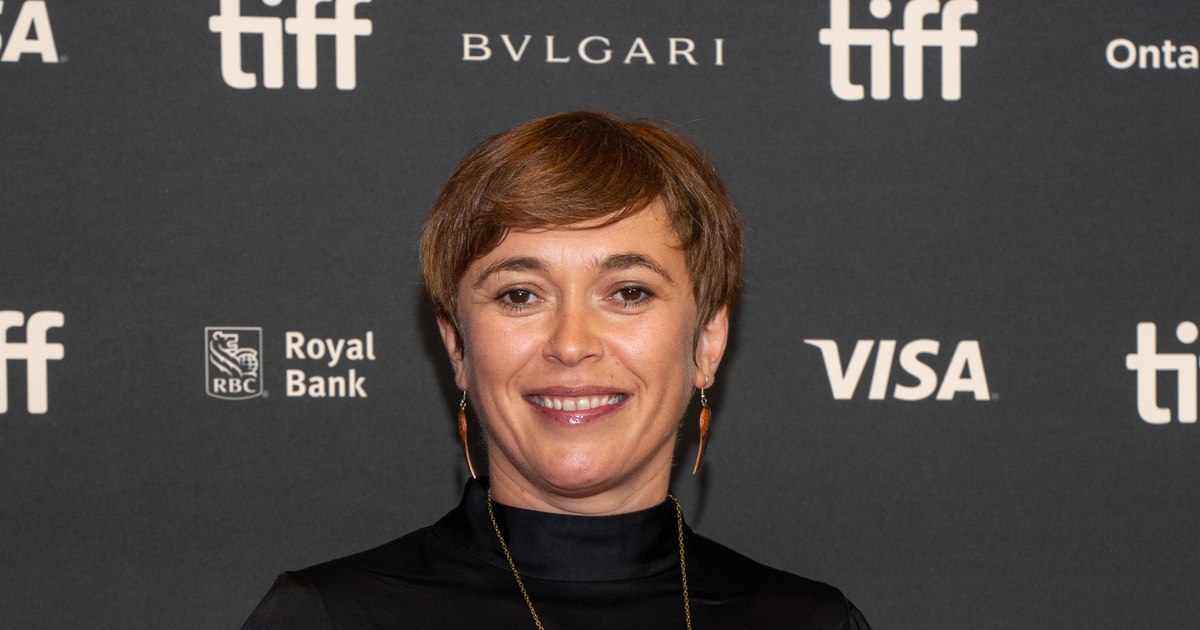
Established in Canada for over 15 years, the actress Cătălina Pop enjoys numerous accolades. At the end of last year, she was nominated at the Québec Cinéma Awards, in the 2023 Revelation category, for the role of a persecuted Romanian journalist.
Cătălina Pop has been away in Canada for over 15 years PHOTO personal archive
The love for the theater began to grow since childhood, when it was indispensable at celebrations. Then, the idea of becoming a professional actress took shape in high school, when she decided to attend the Faculty of Theater and Television at “Babeș-Bolyai” University, which she graduated in 2006.
During 2007-2008 she attended improvisation and Commedia dell'Arte workshops in Milan and Bergamo, and in 2015 she debuted as a cinema actress in Montreal, in the short film “Les vies qui nous restent”, directed by the Romanian-born filmmaker Luiza Cocora.
The talent and value of Catalina Pop are also appreciated by the cultural authorities in Canada, in 2016 and 2018 the actress received two scholarships granted by the Montreal Arts Council. In the film “Le Coyote”, made by Quebec filmmaker Katherine Jerkovic, Cătălina Pop plays the role of a persecuted Romanian journalist.
The film was awarded at numerous festivals, being part of the official selections of the International Film Festivals in Toronto (Canada) and Santa Barbara (United States of America). Along with Cătălina Pop, Virgil Șerban, another Romanian actor settled in Canada, is part of the film's cast.
In an interview for “Weekend Adevărul”, Cătălina Pop spoke with emotion and passion about her career, but also about how difficult it was to follow her vocation in another country. She tells how she received the new vision of the theater across the ocean and how much she was impressed by the openness of the people there to the Balkan culture.
“Weekend Truth“: How was the passion for theater and film born?
Catalina Pop:
The family I grew up in surrounded me with a lot of love. Grandma would put me on the table to sing and clap me with joy. As a child I loved to dance and I was talented. In primary school, at the annual celebrations, it was very easy and natural for me to participate. I wasn't afraid to express myself in public, on the contrary, I loved it. In high school, a subscription to the theater was a natural thing. I participated in a Mihai Eminescu poetry recital competition, organized by Teatrul de Nord, and won the first prize. Then, the following year, I was part of the jury for this competition. The young actors employed by the theater offer Commedia dell Arte workshops. With a group of high school students I went to Sighisoara to the Medieval Art Festival. All these events made me love this art even more.
From dream to professionalism
You graduated in 2006 from the University's Faculty of Theater and Television “Babeș-Bolyai”
of to ClujNapoca.
When did you make the decision to switch from passion to profession?
I was eager to enter the theater faculty since high school. It wasn't the first time, because my parents insisted that acting is not a worthy profession to pursue, as a result I applied and entered Marketing studies. I nailed my dream, but I didn't abandon it. I entered the Theater a year later.
Also in 2006, you debuted at Teatrul Clasic “Ioan Slavici” from Arad, in the show “Iubirea Fedrei” by Sarah Kate, staged by the director Mihai Măniuțiu, a show that had four nominations at the UNITER Awards. Was it a key motivational factor for your later career?
It was a unique chance to work with Mihai Măniuțiu, a man of impressive culture, an exceptional director and a man of typical Transylvanian generosity. An example of professionalism, who is there for his team and which can only instill in you the desire to continue. That year, “Iubirea Fedrei” won the award for the best show of the season, offered by UNITER. It is a period of unforgettable creative effervescence. My colleagues from Arad, like Zoltan Lovas, Ioan Peter, Angela Petran, Andrei Elek, Marian Parfeni, to name just a few, made me feel at home.
A new approach to life and art
You have been in Canada for over 15 years. What made you decide to move across the Ocean and how were your artistic beginnings in Canada?
The decision to emigrate is not mine. I followed my family, being alone with my parents. Debut on the independent scene in 2010 in Calgary with Abortion's Monologues by Jane Cawthrone's Production. The play talks about a woman's right to abortion, a controversial topic worldwide, to this day. We were a team of 18 women of all ages. The rehearsals took place in a family planning center, so not in a theater. We rehearsed for four weeks and then two days in a rented performance hall at Mount Royal University. It was an independent production, Jane being a big activist for women's rights. Jane also took care of the production and getting the funds to pay the actresses, the technical crew and the theater. Then followed, in 2012, the debut on a professional stage with “Attemps on her life or 17 scenarios on her life”, by Martin Krimt. Theater Junction Grant produced the show and Mark Lawes directed. The play is written in English, but it has three scenes where a translation into an Eastern European, South American or African language is required. I invited the Romanian community in Calgary to the show, and my mother made and distributed tricolor flags to the participants. I played scenes with controversial and still current topics, such as ethno-racial discrimination, the cult of right-wing power and the white man, juvenile pornography, the perpetuation of crimes from father to son, racial extermination, suicide between artists, taboos of male infidelity, marginalization of women – what's more, a contemporary bouquet of scandal and mourning. With the troupe of actors, we managed to find a light-hearted approach with a lot of playfulness and self-deprecation, accompanied on stage by a rock band.
How difficult was it to follow your vocation in another country?
The immigration and integration process is not easy. The more you master the language of the province where you are resident, the easier it becomes. Canada is a continental-sized country, each province with its own specifics, and French is spoken in Quebec, where I am now. I had come with good English, but I had to learn French here.
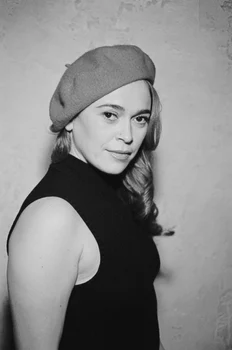
Image 1/4:
Catalina Pop photo Francis A Willey jpg
Do you feel more attracted to the cinema or the theater?
I'm attracted to both. I really enjoy the process of building a character, a performance, the whole collaborative approach of the theatrical experience. Contact with the public becomes an electrifying moment and you feel the energy exchange instantly. It's just ephemeral. The film remains and you can watch it again, only here you build your solitary role and arrive prepared on the set where you do a few rehearsals and then shoot. It's much more discreet playing in front of a camera, and of course, in editing, you can adjust small errors. The impact of a film can be major, so with a larger audience, while the theater has a more isolated and reduced audience. They are two different environments, but both require the same presence and involvement.
“Balkan beauty is appreciated in Canada”
How is the world of theater and film in Canada compared to
the one from
Romania?
The advantage of the companies here is that, as the French-speaking world is more extensive, the international tours become more extensive. The advantage of an actor from Romania is that he has the chance to be employed in a state theater company, and here the actors are on contracts, so the situation can be more precarious. The versatility of actors to act in movies or theater, to do voices for audio books, commercials, etc. it is universal and I am convinced that it is a common denominator specific to the profession wherever you are. When it comes to film, a picture speaks a thousand words. I don't think there is any difference, or if there is, I'm not aware because I don't have much experience on film sets in Romania yet.
What is the perception of Canadians about Romanian actors?
In general, the Romanian is perceived as a hardworking, dedicated and reliable person. The Balkan beauty is appreciated and interculturality is increasingly promoted. The community of Romanian artists in North America is smaller compared to the South American, Italian, Asian ones, which are more numerous and have been installed here for several generations.
Art for the present
I know you also teach at drama schools in Canada. CIt has
estay
feedback from your learners? How often do I ask you questions about Romania?
I chose to teach drama in primary schools, children from 6 to 12 years old, where dramatic art is a course that is part of the public curriculum. I focus on shy children who need encouragement to express themselves and gain confidence. Every day I tell them a sweet or bitter word (when they don't listen) in Romanian and they think it's Italian or Spanish. They are very captivated by this exotic language, and when I count them, it is easiest for me to do it in their mother tongue, they imitate me. I like her and I would really like her to go visit Romania and see how beautiful it is.
At the end of last year you were nominated at the Québec Cinéma Awards, in the 2023 Revelation of the Year category, for CHARACTER
FROM “Le Coyote”, a film in which you play the role of a persecuted Romanian journalist. How was the process of entering the role of a journalist?
I was very happy to have such a role, of a professional journalist, a woman with power, who can participate in changing society for the better. I admit that I don't follow the Romanian press and I am no longer aware of what is happening in the country. I have a friend from Bucharest, also installed abroad, who, on the other hand, is always up to date with the political world and much better informed.
You are among the very few actresses of Romanian origin (along with Brigitte Pogonat) cast in important roles in Canadian feature films. Believeyou that the success of the film “Le Coyote” and the memorable role you play
i can open
doors for other actors of Romanian origin?
I'd like it to be that way, but there are so many factors at play that I have no control over. It is certain that roles can be created for the Eastern European community, the idea is to be dignified and not stereotyped. The interculturality of today's world is becoming more and more present in cinema and television. “Le Coyote” is an exceptional independent film shot on 16mm film, a film d'autheur, a cinéma de repertoire, which currently has seven awards in various prestigious international festivals. It was a production with a technical team where the important roles as director of photography, editing, costumes, etc. were owned by women, and Katherine Jerkovic I tend to believe is a militant of inclusion and uses the power of this art to demolish all the barriers, clichés and restrictions of society, to feel together, in front of the screen, the universality of man and his needs regardless of his affiliation cultural and social. Imagination has no limits and everything is possible, it depends on us what are the values we want to promote.
What do you miss most about Romania?
Spring!
