

While the great European capitals and the established resorts of the Cote d’Azur or Greece are becoming increasingly suffocating under the siege of mass tourism, a handful of fascinating destinations still remain off the radar of the great flows of travelers. From the medieval citadel of Calvi, to the dramatic cliffs of Lagos or the Michelin-starred culinary experiences of San Sebastian, Europe hides places where time seems to have slowed down.
1. Calvi, Corsica (France) – In the footsteps of Columbus
Away from the hustle and bustle of the Côte d’Azur, Calvi is the perfect choice for your summer holiday in 2026. Located in the north-west of the island of Corsica, the town combines Genoese history with French charm. The crystal clear water, which in the middle of summer can reach 30 degrees Celsius, the fine sandy beaches, the medieval citadel and, above all, the authenticity are solid arguments for those who want to spend their holidays in the island of Napoleon and Pasquale Paoli.
Local legends even say that Christopher Columbus was born in Calvi. Moreover, in the citadel are the ruins of the house where the great navigator was said to have been born. That it is true or not is less important to the simple traveller. In any case, an Orangina drunk indecently cold in the shade of the buildings is all you need to admire the entire city and its surroundings from above.

From Calvi you can take a small tourist train (U Trinichellu) to reach other beaches in the Balagne region. And also in the Balagne region, some of the most beautiful villages in France can be visited, by organized tour or by rental car: Sant’Antonino, Pigna, Speloncato, Corbara, Lumio and Algajola.
Corsica is, of course, also an attraction from a culinary point of view. Among the local dishes not to be missed are the famous charcuterie (sausages): Coppa, Salsiccia, Lonzu and Figatelli. There are also many varieties of cheeses, including the famous Brocciu cheese, which is produced only between November and June. Also not to be missed are the Corsican beers (Pietra, Colomba), produced from chestnut flour.
How to get to Calvi:
- Plane (Air France / TAROM / Air Corsica): Bucharest – Paris CDG – Paris Orly – Calvi (one stopover, but need to change airport in Paris)
- Plane (Air France / TAROM / Air Corsica): Bucharest – Paris CDG – Lyon – Calvi (two stops)
- Plane (Ryanair) + ferry (Corsica Linea): Bucharest – Marseille, Marseille – Île-Rousse
- Plane (Lufthansa) + train: Bucharest – Munich – Bastia. Bastia – Calvi.
2. Lagos (Algarve), Portugal – the best beaches in Europe
Unlike the more commercial areas of Portugal, Lagos has managed to retain its bohemian soul. It is where the limestone cliffs meet the blue Atlantic, creating almost unreal landscapes.
Despite the fact that during the summer the town is stormed by European and other tourists, there is always enough space in Lagos on its miles of beaches for tourists to enjoy the sun rays, ocean breeze and fine sand. The most famous beach in Lagos is Praia de Dona Ana, but there are others almost as spectacular: Praia do Camilo, Praia de Porto de Mos or Praia dos Estudantes.
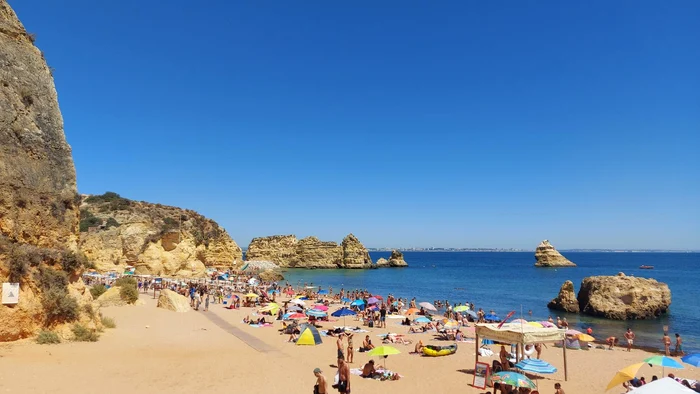
The “pearl in the crown” in Lagos is, without a doubt, Ponta da Piedade, a promontory located a few kilometers from the historic center of the city, considered the most beautiful observation point on the entire Algarve coast. We’re talking rock walls over 20 meters high, arches and grottoes carved by waves over millennia, and isolated cliffs that jut straight out of the water. The ensemble is accessible by wooden bridges and stairs, but the best way to see it would be by boat.

As you probably know, Portugal is not necessarily a culinary attraction. Local dishes are relatively few and do not suit all tastes. The most famous are Cataplana (seafood stew) and Bacalhau com Natas (cod with potatoes). The safest choices are beef steaks, including the famous Picanha, and grilled fish. You can find red wines of very good quality, at very good prices, brought from all areas of Portugal, as well as Vinho Verde (green wine).
How to get to Lagos:
- Plane + bus or taxi (Animawings): Bucharest – Faro (direct flight)
- Plane + bus or taxi (Lufthansa): Bucharest – Munich – Faro (one stopover)
3. Cassis, France – Provence’s best kept secret
Located just a few kilometers from Marseille, Cassis is a small fishing port town that still looks like something out of a Cézanne painting. The road to Cassis is made on the famous Col de la Gineste ascent, which will surely leave you breathless (ed. – advice to those afraid of heights), at the end of which is the most beautiful roundabout in the world.
Cassis is famous for its famous “Calanques”. These geological formations, unique in the world, stretch for about 20 kilometers of coastline between Marseille and Cassis, forming one of the most spectacular national parks in Europe. Relatively walkable from Cassis are the Calanque de Port Miou and the Calanque de Port Pin. However, if you are not in very good physical shape or do not have proper hiking equipment, it would be best to choose a boat tour, especially since they generally include several “Calanques”.
The atmosphere in Cassis is much quieter and more authentic than in other towns in the south of France, and many pétanque players can be seen at noon. At the same time, the town offers several beaches where you can enjoy the Provençal sun and the Mediterranean breeze.

In Cassis, at the Chez Gilbert restaurant, one can eat one of the best bouillabaisse (fish soup originating from Marseille), which goes very well with a white Cassis wine, which must be well chilled.
How to get to Cassis:
- Plane (Ryanair) + bus or taxi: Bucharest – Marseille (direct flight)
- Plane (TAROM / Air France) + bus or taxi: Bucharest – Paris CDG – Marseille
4. Castellammare del Golfo, Sicily – Sicilian authenticity
If you want to feel the real pulse of Sicily, away from the big tourist groups of Taormina, this is the ideal place. It is a picturesque port city, located at the foot of the Inici mountain.
It is the ideal base for exploring western Sicily and the Nature Reserve dello Zingaro. Don’t miss a visit to the Tonnara di Scopello, a historic fishing site, practically transformed into an open-air museum, which in the past served as a setting for the famous film “La Piovra”.

Being in an area with Arab influences from centuries ago, Castellammare del Golfo has Couscous di Pesce as its main dish. Also, travelers with a weakness for sweets can taste a brioche con gelato or a filled cannolo on the spot.
How to get to Castellammare del Golfo:
- Plane + bus or taxi (Ryanair): Bucharest – Palermo (direct flight)
5. San Sebastian, Basque Country (Spain) – The world capital of gastronomy
Located in the Basque Country on the shores of the Atlantic Ocean, “Donostia” (the Basque name) is a destination for the senses. The city has one of the highest densities of Michelin stars per square meter in the world.
San Sebastian is home to the famous La Concha (Shell) beach, one of the most interesting urban beaches in the world. The beauty of the city can be admired from a height from several areas. The most accessible is Monte Igueldo, where you can go up by funicular or even by car.

Parte Vieja, the old center of the city, is not to be missed. Here you can have an extraordinary culinary experience at the famous pintxos bars or at very good quality restaurants. Also in Parte Vieja is Casa Ponsol, the oldest hat and beret shop in Spain.
Very good places, with slightly lower prices, you can also discover outside the central area, where, in general, more locals gather. Much harsher than the cider of Normandy and Brittany, the cider of San Sebastian can be tried with savory dishes, necessarily poured from a height.
How to get to San Sebastian:
- Plane + bus (Lufthansa): Bucharest – Munich – Bilbao (one stopover)
- Plane + bus (Wizz Air): Bucharest – Bilbao (direct flight)
