
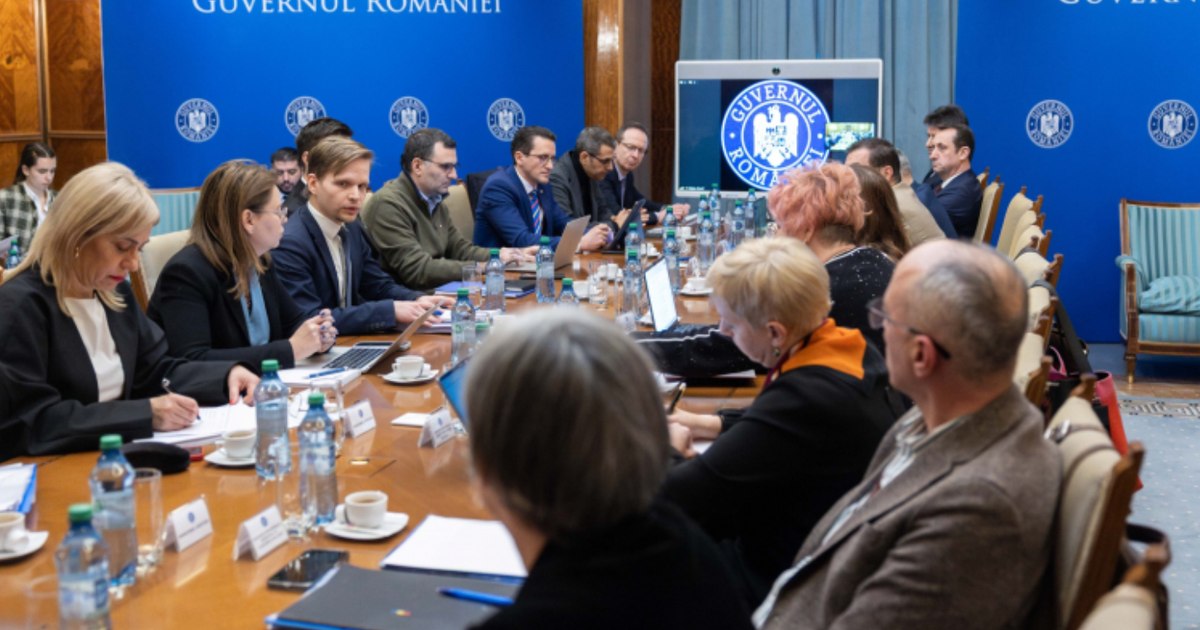
The second meeting of the Committee for the analysis and review of legislation in the field of justice took place on Wednesday, January 14, 2026, at the Victoria Palace. During the meeting, the members of the Committee discussed and agreed several directions of action aimed at reforming the judicial system.
Among the main measures established is the development of a multiannual plan, for a period of five years, to cover the shortage of human resources in the courts and the prosecutor’s offices next to them. The document will be drawn up by the Superior Council of Magistracy (CSM) and the Ministry of Justice and will be subject to the Committee’s analysis until January 30, 2026, according to information published on gov.ro.
Also, a draft law will be drawn up regarding the reorganization of the prosecutor’s offices attached to the judges in a unique structure at the level of each county, a step that will be carried out by the Ministry of Justice, the CSM and the Prosecutor’s Office attached to the High Court of Cassation and Justice, with a deadline of January 30, 2026.
Another important direction is the reconfiguration of the judicial map, by abolishing courts with a reduced degree of workload. The project will be developed by the Superior Council of Magistracy until February 28, 2026.
At the same time, it was decided to initiate an independent audit of the system of random allocation of cases. The procedure for appointing the entity that will carry out the audit will begin by the end of January 2026, and the final report will be made public no later than June 15, 2026.
At the end of the meeting, the chairman of the Committee, state councilor Andrei Lupu, announced that the next meeting will take place on Wednesday, January 21, 2026.
Then will be debated, among other things, the delegation and secondment of magistrates, the procedure for changing the court panels, the return of the magistrates’ criminal investigation competence to the DNA, DIICOT and the ordinary prosecutor’s offices, as well as the method of appointing the governing boards of the courts.
The meeting was attended by representatives of the Chancellery of the Prime Minister, the Presidential Administration, the Superior Council of Magistrates, the Ministry of Justice, professional associations of magistrates, the National Union of Bar Associations in Romania and civil society.
