
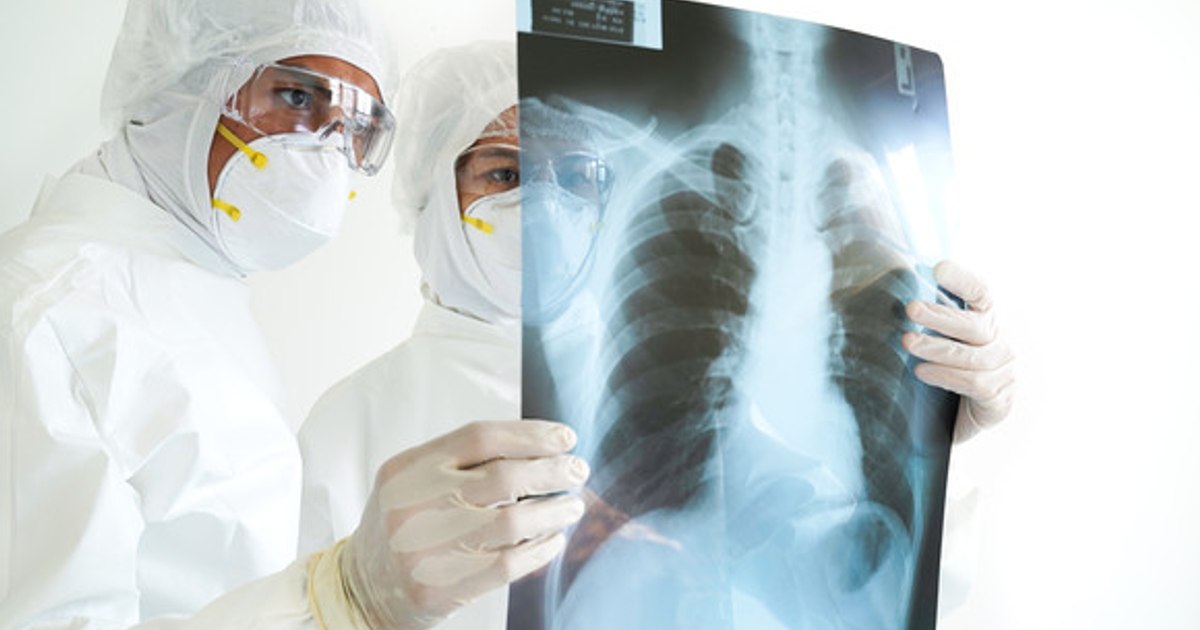
The number of cases of lung cancer in non-smokers has increased, and one reason is exposure to radon, a colorless and odorless radioactive gas that is very dangerous to health if it accumulates in buildings. Researchers from UBB warn that above-average radon levels were recorded in public buildings in 16 counties in Western Romania, including kindergartens and schools.
Lung cancer cases are increasing among non-smokers – Photo Shutterstock
The number of lung cancers in non-smokers is increasing, and the culprit is radiation from radon, an odorless and colorless radioactive gas that is released naturally and is not dangerous unless it accumulates in buildings, experts warn. Compared to other countries in the European Union, Romania is among the states with very high levels of radon in certain regions. Concretely, we are in fourth place in Europe, in this chapter.
What is radon?
Outdoors, radon does not endanger us, but when it accumulates indoors it poses risks to people. Studies show that exposure to high indoor radon concentrations can increase the risk of lung cancer through inhalation. Radon is formed by the breakdown of chemical elements such as uranium, thorium and radium, present in soil, water and building materials. It accounts for half of all radiation exposure for humans, being the second leading cause of lung cancer after smoking and the leading cause among non-smokers. The risk of lung cancer from radon is substantially higher for smokers: they are about 25 times more likely to develop lung cancer than non-smokers.
The International Agency for Research on Cancer (IARC) has classified radon as a proven human carcinogen, along with tobacco smoke, asbestos and benzene.
How radon gets into rooms
The presence of radon in indoor air varies according to geology, construction techniques and types of ventilation. The main source of radon is the soil under buildings. Radon can enter buildings through cracks, windows, and other gaps, especially in temperate and cold regions, where buildings are often under a slight negative pressure. Radon can also dissolve in groundwater and be released into the air during water use, such as showering or washing clothes. However, the risk associated with drinking radon-contaminated water is not considered major compared to exposure to inhaled radon from the air.
“Romania ranks fourth in Europe in terms of radon levels, after the Czech Republic, Estonia and Austria. The soil is the main source of radon. Soil and architectural aspects, such as building foundations, are the main factors influencing the accumulation of radon in indoor air. The level of radon concentration that accumulates in the indoor air depends on the constructive characteristics of each building, the degree of sealing and the situation of the foundations, and if they have not been isolated, as in the case of schools, radon penetrates much more easily from the ground into the indoor air”, explained researcher Alexandra Cucoș, from the Faculty of Environmental Science and Engineering, Babes-Bolyai University (UBB) in Cluj-Napoca.

Radon concentration map – CNCAN photo
In 16 counties in Romania, radon levels exceed the permitted limits, with an average radon concentration almost 3 times higher than the national average. These counties are Alba, Arad, Bihor, Bistrița-Năsăud, Brașov, Caraș-Severin, Cluj, Covasna, Harghita, Hunedoara, Maramureș, Mureș, Sibiu, Sălaj, Satu Mare and Timiș. The Transylvania region and large urban centers such as Bucharest, Iași, Timișoara and Constanța are considered areas with a high risk of radon exposure. Western counties have a higher level of radon exposure “because of the geology of the soil, the whole country has an increased radioactivity of the soil, it is the natural composition of the earth, we live with this and we must learn to take measures”adds the UBB researcher.
What does the law say?
Romania has legislation regarding this gas, and a package of regulations “which completes the Romanian Construction Code entered into force in October 2023 through publication in the Official Gazette“.
“In all public buildings, measures are needed throughout the country, i.e. screening measurements, determination/detection, and where exceedances are found, control measurements and the remedial plan is carried out, after which, in the risk areas, i.e. in the 16 counties , measures must be taken in all buildings, both those to be built and existing buildings. In these high priority areas, measures are mandatory in all types of buildings” says Alexandra Cucoș.
The regulations in our country impose a level of 300 Bq/m3, three times higher than the norm of 100 Bq/m3 considered safe by the WHO. Exposure to a concentration of 300 Bq/m3 of radon is equivalent to 150 x-rays per year or 16 cigarettes per day
The first buildings where measures should be taken, according to the legislation and the public health risk, are school buildings, schools, kindergartens, and then buildings with a high occupancy factor – hospitals, administrative offices or workplaces. More precisely, from 2023, the administrators of public buildings are obliged to take measures to limit the exposure to radon of those in nurseries, kindergartens, schools, public institutions.
The invisible danger in schools and kindergartens
Researchers from Babeș-Bolyai University (UBB) who carry out radon measurements, with over 30 years of experience in the field, drew attention to the increased level of radon in public buildings, including kindergartens and schools.
“There are many schools that don't even have a concrete slab over the foundation, and others are built directly on the ground. Children are exposed because this is the specifics of building educational buildings in Romania. We are talking about buildings erected between 1960 and 2000, when many of the schools were built without the concrete slab. If there are more than 20 students in a classroom, the risk of getting sick increases because the impact is greater, the room is busier and more people are exposed. Radon a heavy gas, with a density about 10 times higher than air, which attaches to aerosols and remains in the indoor air (at a distance of 1-1.5 m above the floor, exactly where children breathe), stinking -accumulates to dangerous values for health“, says the researcher Alexandra Cucoș.
Radon also accumulates inside insulated and energy-efficient buildings, where air circulation is reduced. Practically the building no longer breathes.
“The sick building syndrome also contributes to the accumulation of radon, the building no longer breathes, being heavily insulated, with double glazed carpentry and insulation“, says the expert.
How to reduce the level of radon in the house
Reducing radon levels involves insulating buildings, adjusting air pressure and thermal retrofitting. For values above 400 Bq/m3, specialized solutions such as insulating membranes, centralized ventilation systems and foundation sealing are required. It is essential that the measurements are carried out by laboratories authorized by CNCAN, as there is a risk of errors in the services and equipment available on the market.
To reduce radon levels in the home:
1. Seal cracks in floors and walls.
2. Ventilate the home frequently.
3. Use an air purifier.
4. Install a radon removal system, managed by a certified specialist, that can remove up to 99% of radon.
Alarming increase in lung cancer in non-smokers
Lung cancer accounts for 18.2% of cancer deaths. Despite the association with smoking, 15-20% of new cases occur in non-smokers, most of whom are in their 40s and 50s who have never smoked, according to 360Medical.
“There are several studies being carried out at the moment and in Romania in relation to other factors that could lead to an increase in the number of lung cancer cases and which are the places where we have this higher risk. Fortunately, we can say that the percentage of patients who develop lung cancer in correlation with smoking is decreasing, but the number of lung cancer cases in total is increasing. Unfortunately, polluting factors make their presence felt, and here we are also talking about radon”, pulmonologist Beatrice Mahler explains.
Symptoms of lung cancer include fatigue, frequent coughing, chest pain, wheezing and coughing up blood. Any persistent symptoms should be checked by a doctor, regardless of age. Detected early, the cure rate for lung cancer is 90-95%. However, most cases are detected in advanced stages, when treatments are less effective. Although the survival rate, in Romania, in lung cancer increased from 8% in 2009 to 11% in 2014, it is still well below the EU average of 15%.
“Unfortunately, when our body draws our attention that something is not right and we are talking about lung cancer, it is quite late. This type of cancer is detected through screening methods, of course, at the moment we are talking about screening among smokers, but it is extremely important to diversify the way of screening and to also address families who had someone in the family who died of cancer, especially if you live in a high-risk area“, according to doctor Beatrice Mahler.
It is very important to have screenings for people at risk and exposed to second-hand smoke, radon or occupational exposure.
