
50 years after the implementation of the Expanded Vaccination Plan, there is a sudden resurgence of vaccine-preventable diseases in some parts of Europe. Anti-vaccine propaganda has led to declining vaccination coverage.
During the pandemic, not all children received the necessary doses of vaccine PHOTO: archive
The measles epidemic, which increases every day the number of people affected, and this after a period of “sleep” between the years 2020 and 2022, when we traveled less and were protected by the mask, is just the trial we are currently going through.
However, the same epidemic situation can also be reached in the case of other diseases for which there are vaccines, they have been made for decades, they have saved millions of lives, but today they are inexplicably called into question.
2024 marks the 50th anniversary of the Expanded Program on Vaccination (EPV), the routine immunization program that has saved and improved countless lives.
“Currently the vaccinations recommended by the World Health Organization (WHO) within the EPI are vaccination against: tuberculosis, tetanus, diphtheria, whooping cough, hepatitis B, Haemophilus influenzae type B infections, invasive pneumococcal infections, measles and rubella, rotavirus infections, HPV infections and against COVID-19. There are also vaccines recommended in certain situations, for example against yellow fever, meningococcal meningitis, Japanese encephalitis, cholera”, it is mentioned in the situation analysis carried out by the National Institute of Public Health (INSP) and published on the website of the Olt Public Health Directorate on the occasion of the National Vaccination Information Month.
14.3 million zero-dose children in 2022
The expanded vaccination program was established in 1974 and targeted six diseases. Current vaccination recommendations include a 10-antigen schedule for all countries, with additional antigens for certain regions and some high-risk populations, according to the INSP.
Vaccination has been proven over time to be the most valuable tool for action to maintain global health, helping to eradicate smallpox and limit the spread of polio, diphtheria and measles.
“Thanks to vaccination efforts around the world, children are able to walk, play, dance and learn. Vaccinated children do better in school, with economic benefits that ripple through their communities. Today, vaccines are estimated to be one of the most cost-effective means of promoting global well-being. It acts as a protective shield, keeping families and communities safe. Despite these long-term benefits, vaccine uptake is low”state the INSP specialists.
The pandemic has decreased vaccination coverage
Currently there is a degree of coverage of 85%, a figure far from optimal (over 95%), but which makes vaccination the most effective method of intervention compared to other public health interventions.
Vaccination coverage, on the other hand, is uneven, and we are talking about entire territories subject to real risks of the reappearance of diseases that have been under control for decades.
A turning point regarding vaccination was the pandemic, with specialists currently making efforts to recover the gap recorded in the period 2020-2022, when less was vaccinated due to the restrictions, so that at the end of the period confidence in vaccination decreases.
According to the INSP analysis, the number of zero-dose children (without any dose of vaccine) fell from 18.1 million in 2021 to 14.3 million in 2022, close to the pre-pandemic level.
Coverage with the third dose of diphtheria, tetanus and pertussis (DTP3) vaccine has returned from 81% in 2021 to 84% in 2022, and the proportion of children receiving a first dose of measles vaccine has increased from 81% in 2021 to 83% in 2022, but remains below the 2019 level of 86%.
“During 2022, approximately 84% of infants worldwide (110 million) will have received 3 doses of diphtheria-tetanus-pertussis (DTP3) vaccine, protecting them against infectious diseases that can cause serious illness and disability or be fatal. However, these global figures hide a significant difference between countries according to economic level, with low-income countries lagging behind.” according to the INSP analysis.
Vaccine-preventable diseases and the risks of not vaccinating
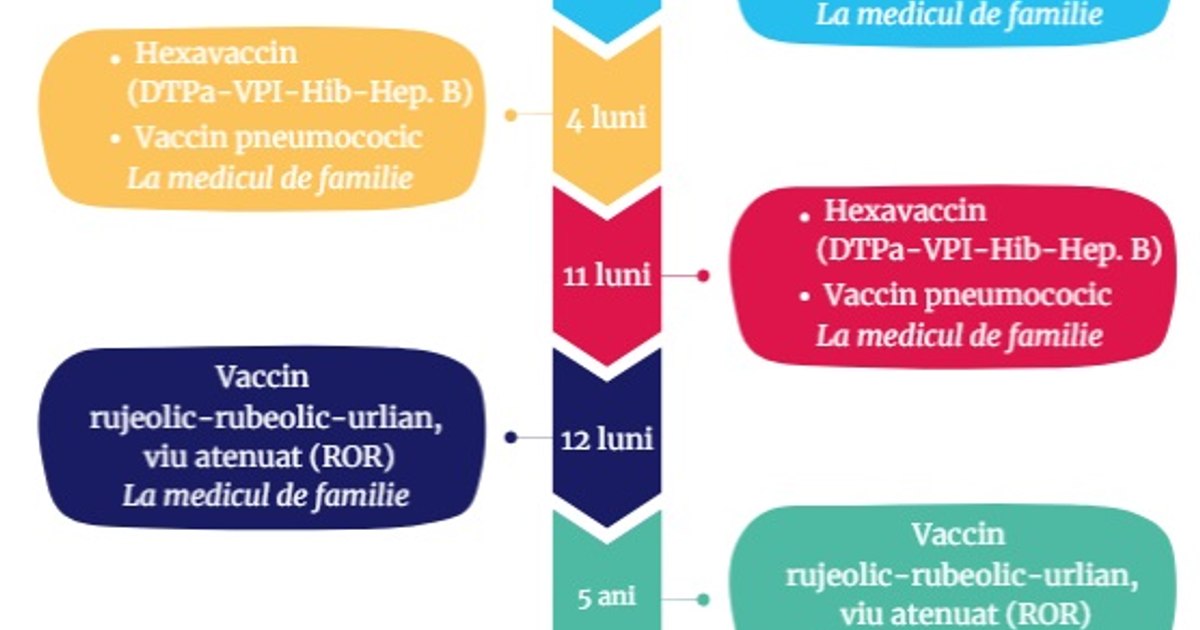
In Romania, the first dose of vaccine (hepatitis B vaccine) is administered, according to the national vaccination calendar, on the very first day of life. A second vaccine is also administered in the maternity ward (BCG) in the first 2-7 days of life. Further vaccine doses follow at 2 months, 4 months, 11 months, 12 months, 5 years, 6 years and 14 years. (SEE PHOTO)
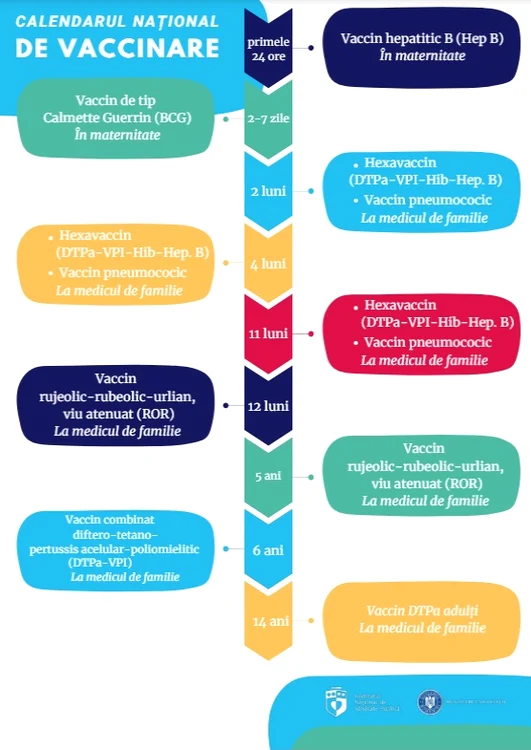
Each is important in preventing serious illness, with certain vaccines causing the body to produce antibodies to defend against many diseases.
Here are the diseases for which vaccine is administered according to the National Vaccination Calendar, according to INSP:
Measles – a highly contagious disease caused by a virus that manifests itself with fever and rashes and can lead to blindness, encephalitis or death. By the end of 2022, 83% of children had received a dose of measles vaccine by age 2, and 188 Member States included a second dose as part of routine immunization. 74% of children received two doses of measles vaccine according to national immunization programs.
The Howling Virus – a highly contagious virus that causes painful enlargement of the parotid glands (the side of the face below the ears), fever, headache and muscle aches. It can lead to viral meningitis. Mumps vaccination has been introduced nationally in 123 Member States by the end of 2022.
RUBELLA – a viral disease that is usually mild in children, but infection during pregnancy can cause fetal death or congenital rubella syndrome, which can lead to brain, heart, eye and ear defects. Rubella vaccination was introduced nationally in 174 Member States by the end of 2022, and global coverage was estimated at 68%.
TETANUS – caused by a bacterium that grows in the absence of oxygen. Bite wounds, contaminated with sand, dung, street dirt, umbilical cord wounds have tetanogenic potential. C. tetani spores are present in the environment, regardless of geographic location. Maternal and neonatal tetanus persist as public health problems in 12 countries, mainly in Africa and Asia.
Poliomyelitis – a highly infectious viral disease that can cause irreversible paralysis. In 2022, 84% of infants worldwide have received 3 doses of polio vaccine. In 2022, 84% of infants in countries still using oral polio vaccine (OPV) had been vaccinated with one dose. Targeted for global eradication, polio has been eliminated in most countries of the world except Afghanistan and Pakistan. Until poliovirus transmission is stopped in these countries, all countries remain at risk of importing poliomyelitis, especially countries with low vaccination coverage, deficient health services, and economic relationships with endemic countries.
yellow fever – an acute viral hemorrhagic disease transmitted by the bite of infected mosquitoes. As of 2022, yellow fever vaccine has been introduced into routine infant immunization programs in 37 of the 40 countries and territories at risk of yellow fever in Africa and the Americas. In these 40 countries and territories, coverage is estimated at 45%.
