
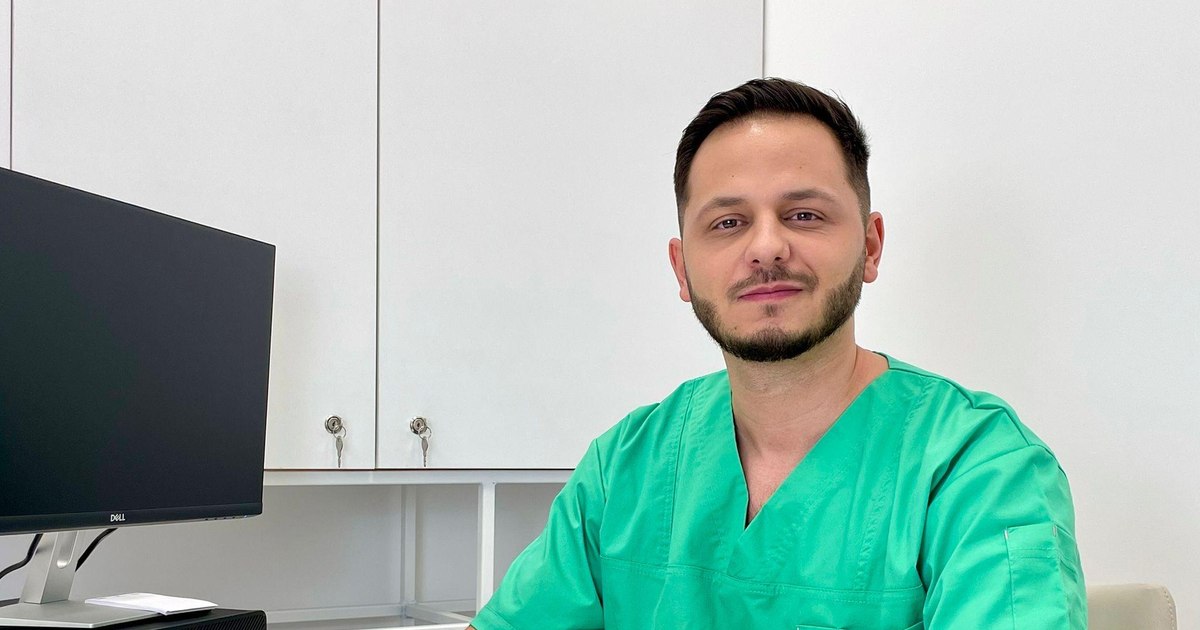
After six years of residency in France and Luxembourg, doctor Raul Doroftei decided to return to the country. ,,I found a changing Romania, with real progress, but also with persistent problems. The medical system often works because of the involvement of people, not because of a solid structure”he says. In an interview for “Adevărul”, the surgeon told why he left, why he came back, but also what he thinks are the main things from the West that Romania should also apply. The doctor now works at the Baia Mare County Emergency Hospital, but also in the private system.
“You are not alone in your decision, that there are clear protocols and a team that works as a unitary whole”
The truth: Where did you go to college and why did you choose Cardiovascular Surgery as a specialty?
Raul Doroftei (cardiovascular surgery specialist): I attended medical school in Târgu Mureș. The choice of cardiovascular surgery took shape over time, with the direct contact with this field during the faculty period. I was attracted by the great responsibility and the fact that, in this specialty, there is no real room for procrastination or half-measures.
It is a field that forces you to be present at every moment and take your decisions to the end. This constant pressure shaped me not only professionally, but also as a person, influencing the way I look at medicine and the relationship with the patient.
When and how did you decide to go abroad?
The decision to leave was a pragmatic one, taken with training in mind. I felt that in order to become the doctor I wanted to be, I needed a very well structured medical system with constant exposure to complex cases. This stage spanned almost six years, during which I was able to train in a rigorous professional setting. It was not a departure out of dissatisfaction, but a natural stage. The experience abroad gave me not only professional knowledge, but also another perspective on how a coherent medical system can work.
Where did you practice? What was life like as a doctor there?
I practiced for almost six years in France and Luxembourg, in different medical systems, but united by the same rigor and clarity. The life of a doctor was demanding, with an intense pace of work, but very well organized. Each day had a clear structure, each team member knew exactly what his role was, and decisions were made within a well-defined framework, not under the pressure of improvisation.
In both systems I felt a deep respect for the medical act and the responsibility it entails. The pressure was high, especially in complex cases, but there was also predictability: you knew you weren’t alone in the decision, that there were clear protocols and a team working as a unified whole. This provides a certain professional peace of mind, even in difficult situations.
At the same time, life as a doctor in the West means a lot of discipline, constant evaluation and high expectations. It’s an environment that forces you to be constantly alert, to improve yourself and to make your own decisions. All these experiences have contributed significantly to my professional training and the way I view medicine today.

“I learned, above all, what a system that works coherently means”
What are the main things that you have learned and that you would like to see implemented in Romania?
In France and Luxembourg I learned, above all, what a system that works coherently means. Teamwork was not just a concept, but a daily reality: the surgeon, cardiologist, anesthetist and family doctor were part of the same patient journey. Communication was constant, decisions were made together, and responsibility was shared.
Another key aspect was adherence to protocols and continuity of care. The patient did not disappear after discharge, but was followed, monitored and guided. I would like to see in Romania more emphasis on prevention and medical education, not just on momentary intervention, when the disease is already advanced.
In which points does the health system in Romania differ the most from the one in Western Europe?
The differences are not related to the professional level of the doctors. Romania has very well trained specialists. The major difference is how the system is organized. In the West, the patient enters a clear and predictable circuit, where each stage is thought out in advance. In Romania, many times, things are solved through individual effort and improvisation.
Another important aspect is prevention. In France and Luxembourg, the patient reaches the doctor much earlier, before the problem becomes an emergency. With us, due to lack of information or access, patients often arrive late, when options are already limited.
“I found a changing Romania, with real progress, but also with persistent problems”
Why did you decide to return to Romania?
The return came naturally. I felt the need to work here as well, to use what I learned in a context that perhaps needs it more. The decision did not come from a lack of proposals or professional options. There were alternatives, but the return was an assumed choice and not an easy one. I chose to come back because I felt that I could contribute concretely, not only through surgical interventions, but also through the way of working, through communication and through the emphasis on prevention.
How did you find things after the years you were away?
I found a changing Romania, with real progress, but also with persistent problems. The medical system often works because of the involvement of people, not because of a solid structure. I have met dedicated colleagues and patients who need, above all, explanations and trust. Often times, this dialogue makes the difference between showing up on time and being late in critical situations.

“Romanian patients need, above all, clear and reliable explanations”
What do you think Romanian patients need?
I think that Romanian patients need, above all, clear and reliable explanations. Many arrive late to the doctor not out of carelessness, but out of fear or lack of information. In the West we have seen how important the doctor-patient dialogue is and how much prevention can change a medical course.
For this reason, in addition to the work in the hospital, I also started speaking online about heart health, warning signs and the importance of seeing a doctor on time. It is, for me, a natural continuation of the relationship with the patient and an attempt to reach people before the disease becomes an emergency.
Under what conditions would you leave again?
I don’t see things in terms of leaving or staying for good. For me, the essential criterion is the meaning of my work and the possibility of being useful to people. As long as I feel like I can contribute and that my work is actually helping real patients, that’s where I choose to be.
