
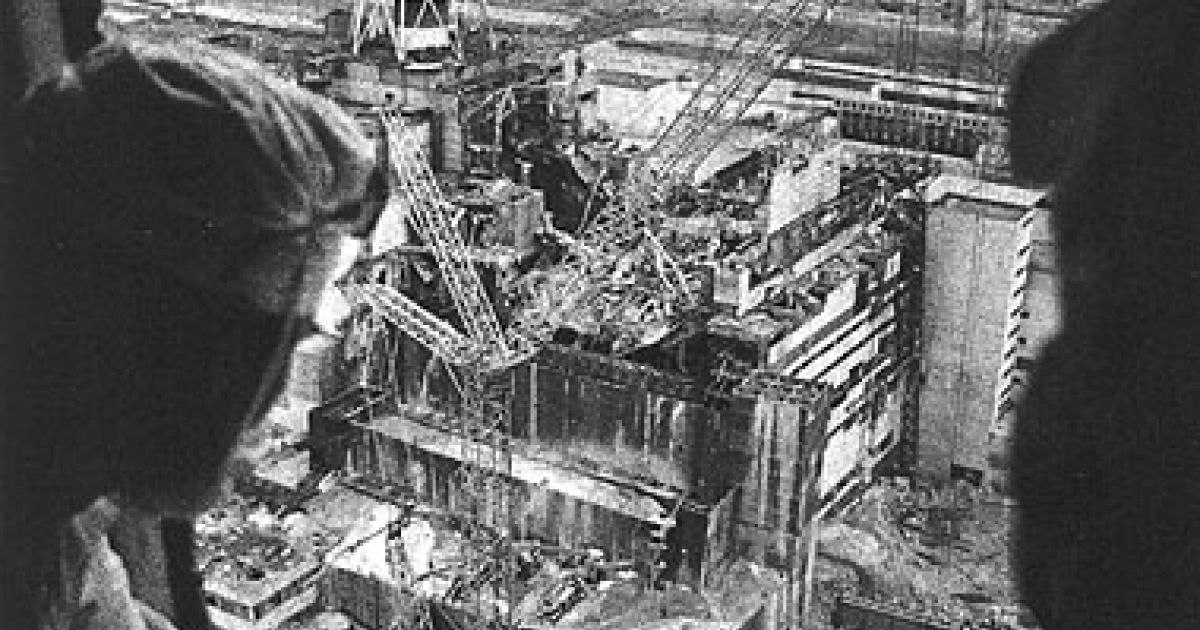
On April 26, 1986, at 01:23 at night, reactor no. 4 of the Chernobyl nuclear power plant explodes, triggering the worst nuclear disaster in human history. Although the plant was approximately 600 kilometers from the Romanian border, the effects of the catastrophe did not bypass our country: neither the radiation, nor the official silence, nor the panic of the population.
The radioactive cloud that reached Romania
In the first days after the Chernobyl explosion, the wind carried the radioactive cloud to the northwest, contaminating Ukraine, Belarus, Russia and later Scandinavia, Poland or Germany. Romania seemed, for a short time, safe from the worst. This illusion was shattered on April 30, when the direction of the wind suddenly changed: the radioactive cloud turned to the south, touching the Romanian territory.
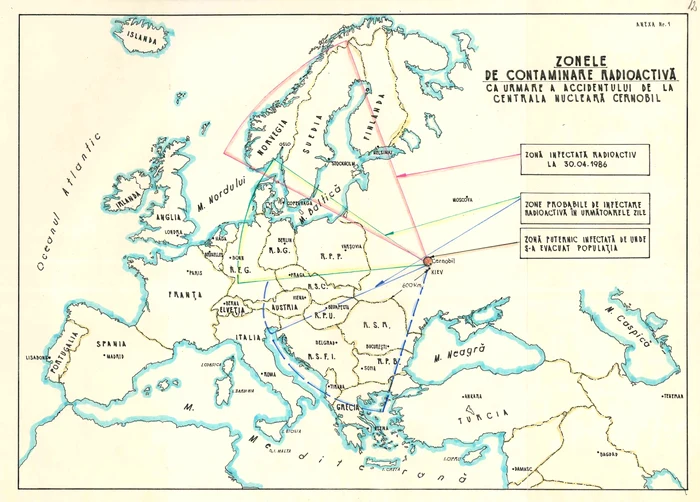
Radioactive deposits affected Romania especially in the first days of May. On the night of May 1, radioactivity measurement stations transmitted alarming values in several areas of the country. The highest level of contamination was recorded in Iași, where the indicators reached the alarm threshold. Worrying situations were also reported in Suceava, Târgu-Mureș, Galați and Tulcea. According to weather reports, in some areas radioactivity exceeded up to 10,000 times normal levels.
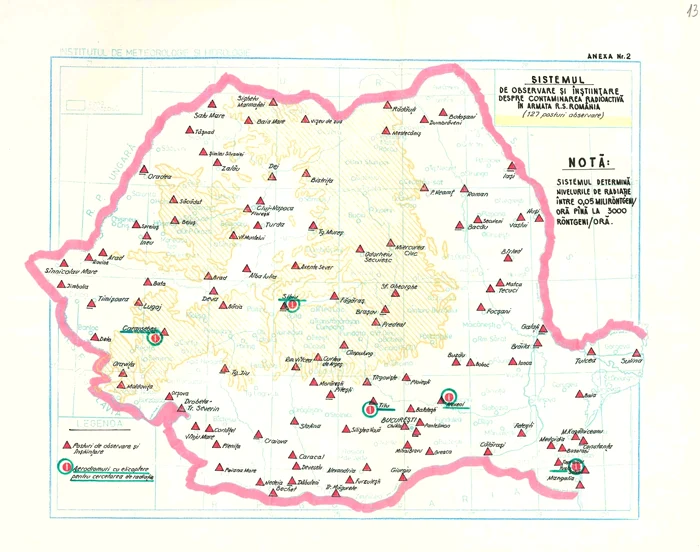
The radioactive cloud remained over Romania for approximately nine days, enough time for thousands of people, especially children, to be exposed to radiation without knowing anything.
How did the communist authorities react? Transcripts of the May 1 PCR meeting
The reaction of the authorities was inadequate, largely due to the way the Soviets tried to cover up the nuclear accident and its effects. A few days after the explosion, those in the USSR were still keeping the Romanian authorities in the dark about the real seriousness of the events. Documents published by the National Archives show that the communist authorities requested information from the Soviet Union (USSR), but the request was not answered.
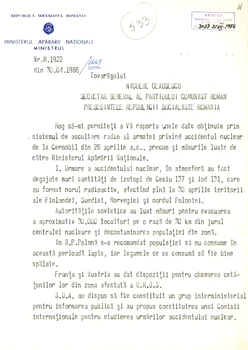
On March 30, General Vasile Milea, the Minister of National Defense, drafted a report addressed to Nicolae Ceaușescu, which contained information,,obtained through the radio listening system” regarding the Chernobyl nuclear accident, as well as the measures taken by the ministry he led. On the front page of the newspaper Scânteia, there was nothing about the nuclear accident, but only announcements about the grandiose May 1st Labor Day ceremonies. “In anticipation of the party’s glorious jubilee and May 1st”the publication captioned.
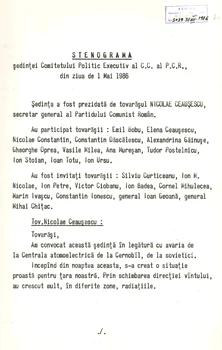
Beyond the facade, concerns were high. On Labor May 1, the Executive Political Committee of the PCR met in an emergency meeting.
“Comrades, I convened this meeting in connection with the accident at the Chernobyl Nuclear Power Plant, from the Soviets. Starting from this night, a bad situation has been created for our country. By changing the direction of the wind, the radiation increased a lot in different areas,” Nicolae Ceaușescu began the meeting.
After the results of the measurements were presented, Elena Ceaușescu asked: “Is this in the air?”
“We called all the garrisons, they are grouped in commandos. We have prepared two planes, with everything necessary, which are made available to the Command for specialists from Iași and Suceava,” said the Minister of Defense, Vasile Milea.
For his part, the Communist Minister of Health, Victor Viobanu, reported:
“The Ministry of Health has 20 surveillance stations and they can start operating immediately. Measurements are taken every half hour. (…) I report to you that, in principle, there is a risk of serious pathology up to 150 km from the place. I also report to you that I have ordered that all people coming to Ungheni be controlled to avoid radioactivity and that any cases be hospitalized in the wards we have.”
Even the food would be controlled, announced the communist officials.
Physicist Ion Ursu, coordinator of Romania’s nuclear program, said, for his part:
“We took measures in Pitesti and Măgurele for the necessary measurements to verify the radioactivity compositions. They do it all the time.”
Nicolae Ceaușescu requested that the mobile stations reach Iasi and Suceava immediately, and then Botoșani and Tulcea. At the same time, ask if help is needed:
“Comrades, in terms of measures, in the areas where the levels of radioactivity values have been exceeded, do we have everything necessary or should we ask for some help from the Soviets, because I know better, have they had accidents before – not only now with this accident – but in general?”
Ion Ursu answered:
“We discussed this issue, comrade general secretary, with the Soviet ambassador here, but we didn’t get an answer. We believe that, for the moment, we have everything that is necessary.”
“In any case, they must answer us, let’s see what the situation is” and “We must have more complete information from them”attracted the attention of Nicolae Constantin, vice-president of the National Council of Workers, and engineer Corneliu Mihulecea, president of the State Committee for Nuclear Energy.
Danger at the Iranian plant in Bushehr, with Russian personnel. “An attack would cause a catastrophe comparable to Chernobyl”
“Let’s know if it’s still burning, what’s the situation”, Elena Ceaușescu also said.
“We asked yesterday, through the Soviet ambassador, to have some specialists available, but we haven’t been answered so far either,” replied Ion Ursu.
Elena Ceaușescu was outraged:
“We have to say that radiation also appeared at our place and we want to know what to do. It can’t be like that!”
Nicolae Ceaușescu also brought up informing the population, but “without creating panic”.
“I think we need to immediately inform the public opinion. Safely, without giving data, but something broader than we have given. Let’s say that: considering the situation created by the accident, some increases in radioactivity have appeared in different areas of our country, especially in the northeast; considering the direction of the wind, the necessary measures have been established and they will be informed about the measures”.
But the May 1 rallies had already taken place, and thousands of people had spent hours in the open air, under the invisible cloud. The France Press agency noted at the time that, according to a Western diplomat in Bucharest, “the population was not given any recommendations to counteract the effects of possible radiation”.
The testimonies of those who lived those days
One of the most vivid testimonies from that period belongs to the physicist Mariana Purice, a researcher at the Nuclear Medicine Unit of the Endocrinology Institute “CI Parhon” in Bucharest, the only unit, at that time, in Romania and in the region where the diagnosis and therapy of thyroid cancer was carried out with radioactive iodine.
“However, I put the film back and ask myself: what memories do I still have from the spring of ’86? The memories of a happy May 1st, on the green grass, on the shore of Lake Cernica with friends, family, my boy Matei, then one and a half years old, and other small children. I had eagerly awaited that day off, one of the few offered by the communist system”
she wrote in 2016, in the Old Dilemma.
When they returned home, they learned from Radio Free Europe what was happening: high levels of radioactivity had been recorded in Poland, Germany, Austria and Romania. The phones started ringing.
“Out of fear, I was talking in code with friends and fellow physicists who worked at the Institute of Atomic Physics. They had the necessary knowledge to gather concrete data. They had already made measurements on their own and knew how serious the situation was.”
The evening of May 1 turned into a race against time for iodine, the only substance that could block the absorption of radioactive iodine in the thyroid:
“A hilarious run started at the pharmacies, but most of them were closed since May 1st. I ran on already empty streets, because informed Bucharesters had barricaded themselves in their houses. On a bicycle, with a gauze mask over my nose and mouth, I rode through the streets of a paralyzed Bucharest that seemed abandoned.”
At the Institute, the team began making their own measurements of radioactivity in the hospital yard, on grass, roofs and food. The initiative was short-lived:
“After a few hours, we were called to the Directorate and we were forbidden to take these measurements again.”
Doctor from Tulcea: “No one knew what to believe”
Dr. Radu Sicinschi, then resident doctor in Iasi, described – in 2022, for Adevărul – the state of generalized confusion:
The Chernobyl mushroom, the mysterious creature that feeds on deadly radiation and thrives where human life is impossible
“In 1986, there was very little information and everyone was panicking because they didn’t know what to believe.”
His colleague, the doctor Vasile Vâlcu, who worked at a fish factory in a Danube town, told in his turn how the precautionary measures appeared suddenly, without any real explanation: athletes were no longer allowed to train outdoors, radioactivity analyzes were carried out at the factories, and at the pioneer camp in Năvodari, food was no longer prepared from the vegetables and fruits harvested that spring, but exclusively from cans. At the same time, several children in the camp developed spots on their skin, attributed to the decrease in immunity.
Long-term effects. What the cloud left behind
Beyond the direct testimony of people, numbers and medical data complete the picture. The radioactive compounds reached the Romanian coast, affecting the beaches and the marine environment. According to a study by Eng. Dr. Vasile Pătrașcu, from the Institute of Marine Research in Constanța, the contamination of the beaches could be detected since May 1986, and the reactive level did not return to pre-Chernobyl values until after 2002. The highest level of the Cs-137 isotope was recorded in the submarine sediments at the mouths of the Danube.
On the medical level, rigorous statistics do not exist, due to the secrecy of the communist regime. However, according to independent sources, thyroid cancer would have affected around 100,000 people from the areas exposed to the radioactive cloud. The increased number of leukemia cases is also blamed on radiation. A 1986–1994 ISP study documented effects on children: growth disorders, decreased immunity, and ossification abnormalities.
Four decades later, Chernobyl remains a reminder of the fragility of nuclear infrastructure and the price of political secrecy.
.
