
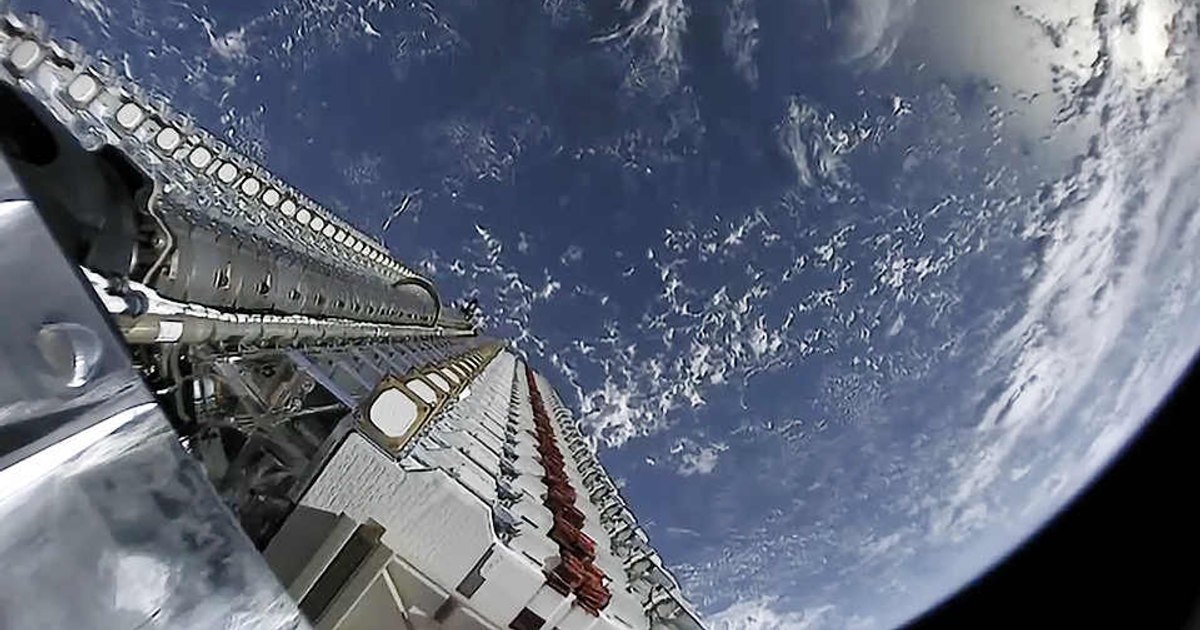
Although the Earth appears perfectly round from space, its actual shape is not. Despite the seemingly smooth and spherical appearance captured in images from space, the reality is that the Earth is an ellipsoid that is always changing its irregular shape.
The Earth seen from space looks like a sphere. Archive photo
What does an irregularly shaped ellipsoid mean? This means that the Earth is slightly flattened at the poles and bulged at the equator, due to centrifugal force. As the Earth rotates, this force pushes outward at the equator, causing it to “bulge”.
The equatorial diameter of the Earth is about 12,756 kilometers, while the polar diameter is about 12,714 kilometers, resulting in a difference of about 42 kilometers. This significant difference is primarily due to the rotation of the Earth and the resulting centrifugal force.
Centrifugal force is the same phenomenon you feel when you spin. This force causes planets and moons to be flattened at the poles and bulge at the equator. Rapidly rotating planets such as Jupiter and Saturn exhibit this effect prominently. An extreme example is the dwarf planet Haumea, which is almost egg-shaped due to its rapid rotation, making one complete rotation in just about four hours, according to DailyGalaxy.
The shape of the Earth is not static, but is constantly changing due to various factors, such as tides, the movement of tectonic plates, natural disasters and, of course, the force of gravity.
tides
The daily movement of the tides affects not only the oceans and seas, but also the earth’s crust. The gravitational pull of the Moon and Sun causes the Earth’s surface to deform slightly, contributing to the dynamic shape of the planet.
The movement of tectonic plates
The slow movement of tectonic plates changes the shape of the Earth over millions of years. This process, known as plate tectonics, can cause significant shifts in the Earth’s crust, resulting in the formation of mountains, valleys, and other geological features.
Natural disasters
Events such as earthquakes and volcanic eruptions can cause sudden and dramatic changes. For example, the 2004 Indian Ocean earthquake and tsunami caused a measurable change in Earth’s mass distribution, slightly altering the shape of the planet.
Gravity
Gravity also plays a crucial role in the shape of the Earth. Slight variations in Earth’s gravitational field lead to the formation of permanent hills and valleys on the ocean floor, further contributing to the irregular shape of the planet. For example, sea level is not uniform because of these gravitational anomalies.
Gravitational anomalies can be caused by density variations in the Earth’s interior. Regions of higher density, such as mountain ranges, exert a stronger gravitational pull, while areas of lower density, such as ocean basins, exert a weaker pull. These variations can cause the Earth’s surface to undulate, creating a more complex shape than a simple ellipsoid.
Understanding the shape of the Earth is more than just an exercise in geometry. It reveals the dynamic and ever-changing nature of our planet, shaped by internal and external forces, but also the uniqueness of the place in the vastness of the cosmos that I call home.
