
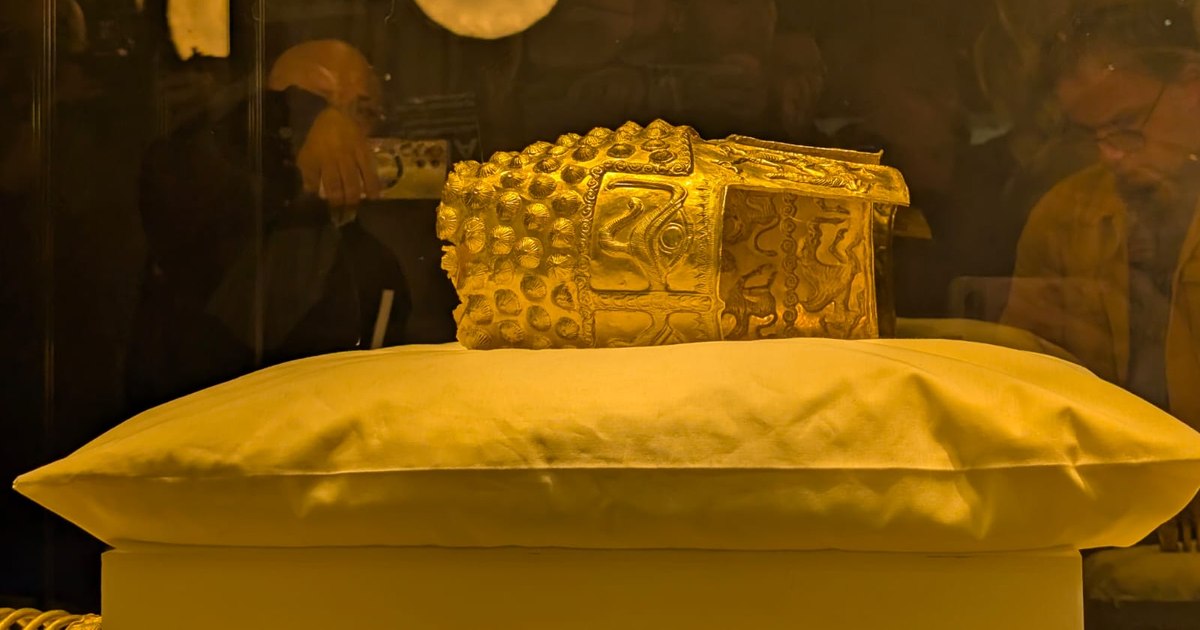
The helmet from Coțofenești and the Dacian bracelets are not simple museum pieces, but real “tools” for building national identity, says sociologist Răzvan Dumitru. With the return of the artifacts to the country, the specialist explains to “Adevărul” that the collective emotion generated by this event goes beyond the passion for history: the theft was felt as a personal loss because these objects are material evidence of our own definition as a people.
More than a passion for history
Schools, museums, ministries and the media present them as material evidence of a historical continuity, and through this very act of presentation, collective identity is strengthened.
“Being part of our collective wealth, we have an emotional connection to it, because collective identity is part of how we construct ourselves”he says.
Therefore, the theft was felt as a personal loss by millions of people who never saw the helmet in reality. And its recovery now functions as a reaffirmation: not of history, but of us as a people.
“It’s not necessarily an interest in history, but in collective identity. It is a signal that we have a collective identity that is present“, adds the sociologist.
A trauma transformed into an opportunity
“Beyond their material recovery, the return of these artefacts home has a symbolic dimension. It means restoring a link between object and memory, between past and present, between heritage and the community that recognizes it as part of itself,” said the Minister of Culture, Demeter Andras Istvan. He emphasized that the heritage must not only be defended, but also “placed more carefully and wisely in public life. Not only preserved but made accessible. Not only admired but understood“.
Referring to the theft in the Netherlands, the minister stated that society cannot ignore the traumatic nature of the robbery, but it must not remain captive to it either. “If trauma is only evoked, everything becomes inert. If it is denied, everything becomes unbelievable. The only fertile formula is to transform trauma into a starting point, for mobilization”, explained Demeter Andras Istvan, pointing out that the huge public and international interest must now be turned into an opportunity for strategic valorization.
The context of the robbery
We remind you that the theft took place at dawn on January 25, 2025, at the Drents Museum in the Dutch city of Assen. Police initially thought it had to do with the detonation of an ATM, but the explosion had been caused by thieves to force an emergency exit. Their target was the exhibition “Dacia – Kingdom of Gold and Silver”, located on the very last weekend of the visit. Once inside, the individuals smashed the windows with hammers and fled with the central pieces of the collection: the Coțofenești Helmet and three Dacian bracelets.
Based on surveillance footage and tips, Dutch police later arrested three suspects, while a fourth – caught on camera in a DIY store – is still being sought. Two of the men under investigation have already struck a deal with prosecutors and admitted their guilt, while the third denies any involvement. The court is due to deliver a verdict in the case on June 5.
In Romania, the robbery had drastic consequences. The former director of the National History Museum, Ernest Oberländer-Târnoveanu, was dismissed on the grounds that he approved the loan of artifacts to an institution that did not have adequate security measures in place. Moreover, the prime minister at the time, Marcel Ciolacu, publicly asked the Dutch state to pay unprecedented compensation.
The first images of the Dacian gold helmet from Coțofenești, recovered after the robbery in Holland
Security breaches and an international debate
Beyond the police investigation, the robbery in the Netherlands exposed serious security gaps at the host institution. Although the loan agreement stipulated 24-hour security, the Drents Museum had no security personnel physically present in the building on the night of the attack.
Ton Cremers, former head of security at the famous Rijksmuseum in Amsterdam, explained to the Dutch press that the robbery could have been prevented. According to the expert, a proper security system for an exhibition of such value had to have several layers of protection, preventing thieves from reaching the main windows within just two minutes of the door being blown open. In addition, risk management specialists pointed out that the choice of a provincial museum, located in a city of 70,000 inhabitants, was unusual for the display of such masterpieces.
The incident reopened a broad international debate about the risks of traveling exhibitions. Experts in international law, such as Mirta Aktaia Fava (who is also an adviser on the acquisition, evaluation and management of works of art), have argued that heritage objects that have exceptional historical and symbolic value should be declared “immovable”. Thus, according to this vision, unique pieces such as the Helmet from Coțofenești should never be loaned abroad, to completely eliminate the risk of destruction or theft.
What does the Coiful de la Coțofenești actually mean?
The helmet from Coțofenești must be understood in the context of the mentality of Antiquity. For the Geta, objects decorated with symbols had both an aesthetic role and functions related to protection and legitimization of power.
The symbols on the helmet – mythological scenes, animal representations and decorative motifs – were associated with the idea of protection from evil and support from higher forces. In a context dominated by war, disease and uncertainty, such objects offered a sense of security. Beyond the spiritual side, the helmet had a clear social and political role: it was a sign of status, reserved exclusively for rulers, marking the difference from the rest of the community. Basically, the Helmet from Coțofenești brings together three major functions: the representation of power, the manifestation of faith and the display of social status.
Millions of people ask AI for medical advice. How ChatGPT can be useful
Dacian gold bracelets
According to information published by the National History Museum of Romania, the Dacian gold bracelets discovered at Sarmizegetusa Regia are considered royal pieces. These are part of the category of ceremonial objects, along with helmets, ritual vessels and elements of harness, being signs of power that belonged to the aristocracy.
In goldsmithing and Gethic art, animal images had a precise symbolic function. They were considered protective, with an apotropaic role, being associated with the idea of defense and strength, especially in the context of fighting or hunting. Zoomorphic motifs include real animals specific to the area – such as snakes, boars, horses or eagles –, exotic animals such as lions, but also fantastical or composite creatures such as griffins.
According to the museum’s specialists, the belief in the magical power of the images contributed to the choice of animals as the central subject of the art, as they were meant to prevent disasters and give strength to the wearer. The presence of these objects indicates the existence of a political hierarchy and a local aristocracy within a stratified society, in which gold functioned as an indicator of status.
The National History Museum also recalls how during the period 1996–2001, the entire Sarmizegetusa Regia area was targeted by organized crime groups that practiced archaeological poaching on a large scale. Of the 24 Dacian gold bracelets stolen and exported illegally initially, some were recovered over time by the Romanian state.
