
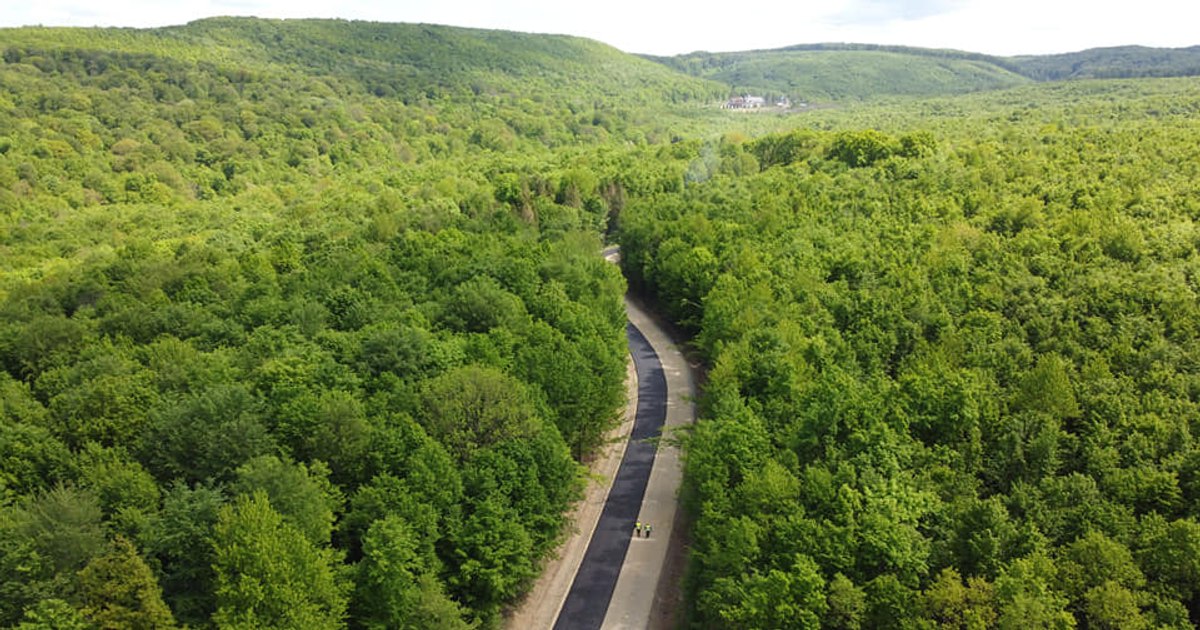
The “Road of the Monasteries” is one of the most fascinating and at the same time little-known ecumenical tourist routes in Romania. It crosses a picturesque area ideal for outdoor escapes and also connects some of the largest spiritual centers in northern Moldova.
The road of the monasteries sinks deep into the Voronei woods PHOTO Botoşani County Council
In Romania there are several well-known ecumenical tourist routes. One of these is the one that connects the medieval monasteries in Suceava County or the one in Neamț County, with medieval monasteries and hermitages well known to pilgrimage enthusiasts. In the extreme north of Romania, there is another fabulous ecumenical route, little known nationally, but with huge tourist potential. It is called the “road of the monasteries” and is addressed both to those looking for special spiritual experiences, but also to those in love with nature, especially since it crosses three old and picturesque groves, plus areas with panoramic points from where nature can be admired in all its splendor. Moreover, this road is being rehabilitated, a joy for any driver.
Through the heart of the secular forests
The “Road of the Monasteries”, as it came to be known after it was fully rehabilitated by the Botoșani County Council in 2023, and included in the national tourist circuit, starts from the Vorona commune, located approximately 20 kilometers from the Botoșani municipality, with multiple variants. The main route starts from the village of Vorona, turning left, based on the tourist sign, towards the Vorona Monastery. From the right of this monastic place, tourists enter a forest paradise, on an asphalted road, on a stretch of more than 12 kilometers. The driver’s experience is incredible, especially since the road crosses the centuries-old forests of Vorona with superb landscapes and a belle vue area, in the higher hill area of the route, from where you can see the forest stretching from Vorona to Tudora in a panoramic way and the Basket. The alveoli intended for stops but also the forest roads that separate from the road offer the opportunity for walks through the forest and even a picnic in the middle of nature. Near the Hermitage of Voronei, a forest road leads to a true “meditation trail”, to the grotto of Saint Onufrio, one of the representative saints of this area. The trail invites you to walk in the relaxing silence of the forest, on hidden paths, which tourists say offers a special inner peace. In the forests of Vorona, there are plenty of mushrooms, berries and an impressed contact with nature.
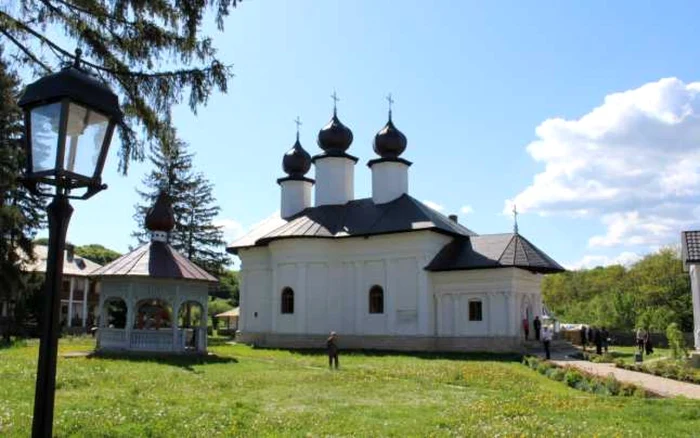
Vorona Monastery PHOTO The truth
The road continues to the Oneaga hermitage, another oasis of peace in the middle of nature, and then descends to the woods of Coșula, with other panoramic areas. Finally, crossing the Botoșani-Iași national road, through the Copălău commune, with other picturesque wooded areas, you reach the Sulița commune, towards the Cozancea monastery, a very special place, especially from the point of view of the beauty of nature, with and possibilities to walk on forest roads through deciduous forests. Those who wish to take an alternative route to the Balș Monastery, located in an absolutely enchanting landscape. Balș can be reached on the Botoșani-Iași road, then turning in the Frumușica commune on country and forest roads to the highest point in the area. Seven kilometers from the town of Flămânzi, hidden deep in the secular woods in the area, the Balș Monastery is a real ecclesiastical pearl. The landscape inspires tranquility and encourages meditation, and from the highest points, on clear days, you can see the crown of the Eastern Carpathians.
Miracle-working saints and icons, places of spiritual elevation
Beyond the beauty of nature, the “Road of the Monasteries” represents an opportunity for those looking for peace of mind and places of prayer. The first stop is at the Vorona Monastery, originally a monastery of monks, founded by the potter Iordache Panaite, on the site of another similar monastery from the 16th century built by Greek, Russian and Romanian monks. Near the place of worship there is also the famous “Gorun of Cuza”. Local stories say that one day, Cuza came to his friend and aide, Nicolae Pisoski, in the Botoșani fair, and made a trip to Vorona, in civilian clothes. He fell asleep under an old gorun. It is said that in those moments the monks would have caught the ruler, without recognizing him, and locked him in the cellar of the monastery. He was saved, in extremis, by his assistant who came to look for him. After this experience, Cuza would have decided to secularize the monastic assets. During the communist years, the monastery became a monastic place for nuns. Continuing on the forest road, you will reach Sihăstria Voronei, an old monastic place of monks. Here are the relics of the Venerable Onufrie, a Russian monk, who suffered in the forests of Voronea.
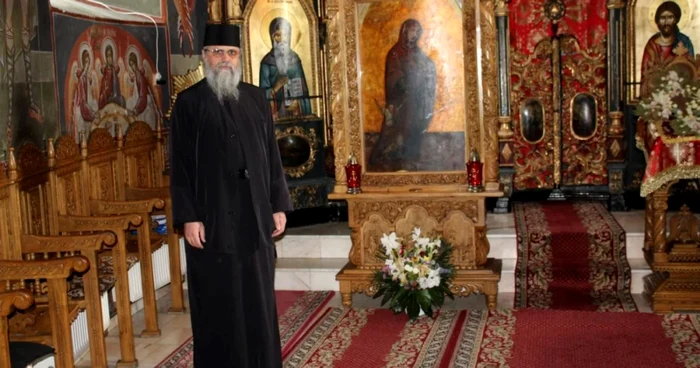
The miracle-working icon from the Voronei Hermitage PHOTO Cosmin Zamfirache
Relics are said to be great miracle workers. As well as a unique icon located in the church of the monastery that shows the Mother of God holding hands with the baby Jesus, at an unusual age for iconographic representations. That is, around the age of 10-11. The icon wants to signify the role of the mother as a guide in the child’s life. A few kilometers from the Hermitage of Voronei is the Oneaga Hermitage, a place of peace and prayer for those who want peaceful spiritual experiences. Passing over the “saddle” of Oneagai, through the forests of Coșula, you will reach a special medieval monastery. It is about the Coșula Monastery, founded in the 16th century, by the treasurer Mateiaș, the trusted man of voivode Petru Rareș. It was the largest monastic center in medieval Eastern Europe, a place of culture and translation of ancient books.
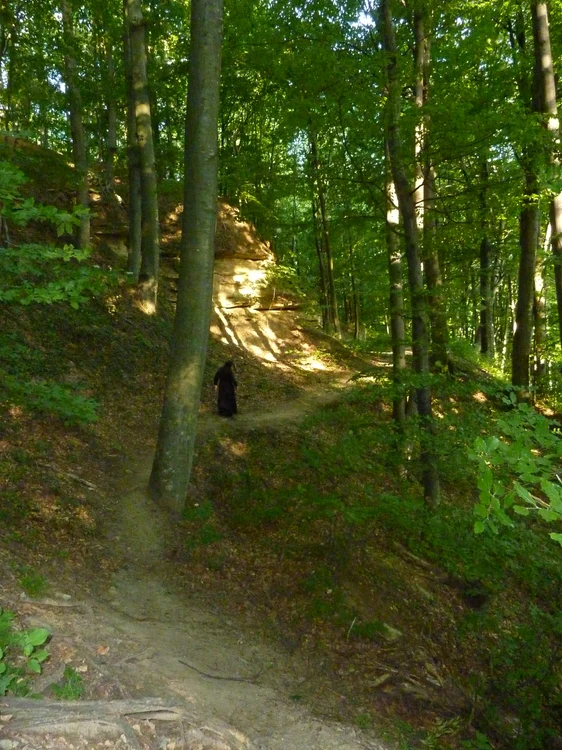
Through the forests of Voronea PHOTO Cosmin Zamfirache
In Coșula in the 18th century, a text by Herodotus was translated into Romanian for the first time, a work submitted by Nicolae Iorga to the Romanian Academy. Moreover, from the Coșula monastery, more than 372 documents of great value were brought to the National Archives for safekeeping. The monastery is famous for its extraordinary frescoes, half a millennium old, but also for the “yellow of Coșula”, which rivals the “blue of Voroneț”. Also, a special place is the Cozancea hermitage. A monastic hearth renowned for important hermits and clergy. Even today it is an oasis of peace and spiritual tranquility. This is where the well-known Romanian clergymen, Ilie Cleopa and Paisie Olaru, recently canonized by the Romanian Orthodox Church, began their journey in hermitage.
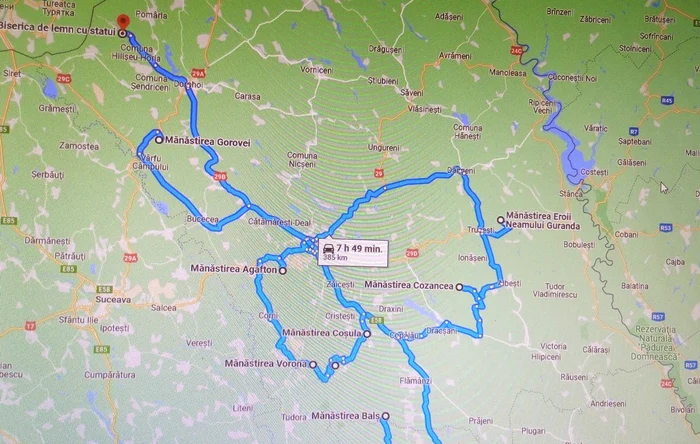
In fact, Paisie Olaru’s cell is still preserved today in the woods near the Cozancea Hermitage. At the same time, from the road to the monasteries, you can easily reach the Guranda Monastery as well as the Agafton Monastery, the place where Mihai Eminescu’s aunts lived as monks. The route, by extension, can be extended to Hilișeu Horia, where there is a unique church in the world, half Catholic, half Orthodox, a symbol of the love of the Curt boyar towards his wife, a Catholic of Bistrita origin.
