
Traveling the Via Transilvanica – the road that unites – is an adventure in itself. But to cross it in one day, from one end to the other, is already a story of courage, community and team spirit. This was the challenge that Orange Romania took on, in a first-of-its-kind project.
Hundreds of Orange Romania employees mobilized to cover, simultaneously, the 78 sections of the route connecting Putna with Drobeta-Turnu Severin – over 1,500 kilometers that cross the heart of Romania. It was a day of rediscovery – of nature, balance and genuine human connection.
Radu Dumitru, from the Strategy, Transformation & Wholesale team at Orange Romania, told us about how this experience felt “down the line”.
What did the challenge of participating in this project mean to you when you received the invitation?
I have to tell you about Via Transilvanica seen through the eyes of a native of Bucharest by birth, a nomad on vacation and a corporatist by occupation. Life at work can be full of plans or hesitations, beautiful results or inabilities, but ORO (as we call Orange Romania) is a company that quickly learned that if it wants to do something beautiful and difficult at the same time, it is enough to propose.
The ambitious people from Asociația țășuleasa Social, who invented Via Transilvanica for several years, with whom Orange has been a partner for quite some time, took care of the beauty. There is a lot of soul put into the Via Transilvanica, and this is visible in all the 1542 km of the route that crosses Romania.
When Orange asked if we couldn’t go through them all in one day, the question felt more like a metaphor. We answered “yes” to the challenge and the metaphor became a plan, and the plan became a reality. Thus, hundreds of colleagues participated both in the teams that started on the routes on the chosen day. Others, many weeks before the feat, set up the necessary (from first aid courses, to participant kits and more).
Among all of them I found myself, in the position of “you will be responsible for one of the 78 sections”, rather chosen because I can quickly raise my hand when we have to do some corporate chat. One could say that this kind of involvement, undertaken before understanding exactly what it entails, functions as a quasi-program of personal development. Because whether you’re skilled or not, when you get to the helm, you still have to bring the ship into port.
How did the route and the experience with the team turn out compared to what you originally imagined?
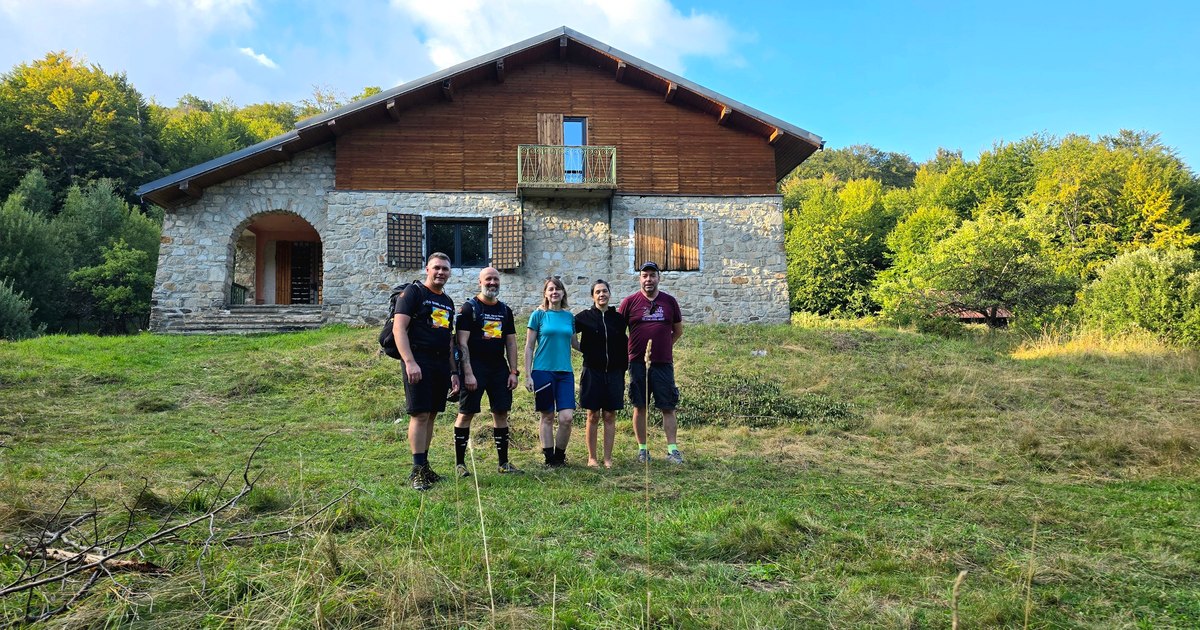
To be honest with myself, I can say that I’m very good at going off on my own – I wondered where in our country I wouldn’t naturally end up as a weekend destination. I made a short list of sections of the Via Transilvanica that are beyond the reach of a Bucharest resident and, with a bit of luck, I managed to convince four other colleagues to join me for the section between Iabalcea and Coșava canton.
I say this, first of all, because the road from Bucharest to Iabalcea, in Caraș-Severin county, is longer than from Budapest, Sofia or Belgrade. Secondly, because we were going to reach the highest point on the Via, at the Coșava canton, traveling just under 30 km from the Via, with a difference in level of 1,100 m.
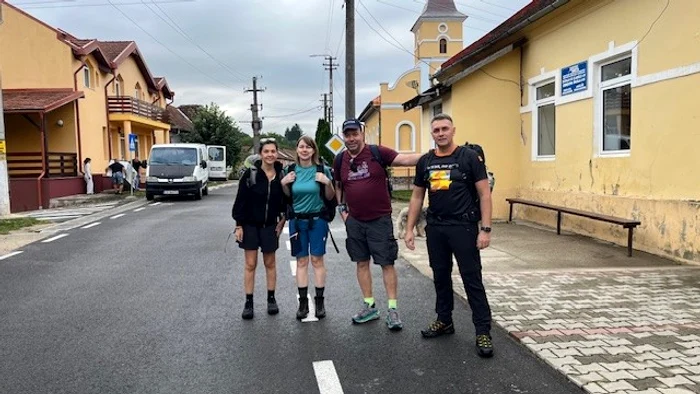
Any mountain man would probably smile condescendingly and see the matter as a walk in the park, so I adopted the same attitude. At the same time, the Via Transilvanica guide says that this section is one of the most beautiful. After the first steps in Iabalcea, I understood. It’s the kind of beauty that makes you curious, makes you forget you’re carrying a heavy backpack, and yet urges you to keep going, even if you suspect some pebbles are hitchhiking in your boots 😊.
What did you learn about Romania that you didn’t know before you left?
The Semenic National Park – Cheile Carașului is a protected area and houses primary beech forests included in the UNESCO world heritage, and the Coșava canton is one of the most isolated places in the country. The atmosphere in these forests is so solemn that a Sequoiadendron giganteum tree has also found a home here.
I didn’t know that we can admire such giants in Romania too. For a long time there were only eight people on dozens of square kilometers: two hikers from Alba Iulia, who were climbing somewhere behind us, the cabin owner who was waiting for us at the canton and our small group of five colleagues who were humming likes and dislikes.
What was the most special moment on the trail?
The mountain has the ability to introduce you in a special way to those you already know, be they colleagues or friends. Nature easily peels off social conventions and doesn’t let you hide anymore, you stay as you are, with all yours. There’s a nuanced difference between being nice and being nice, and we’ve experienced that as a team – a subtle shift from polite collegiality to casual brotherhood.
Authenticity is a hard attribute to pick up in wide social spaces, but the mountain path was rushing up bold enough that it gave us the courage to take courage in our words and thoughts. It couldn’t be otherwise, especially when you share the road and the chocolate, exchange sandwiches and snacks and, as we were to find out later, lie in the same room at night on the mattresses.
We didn’t walk through waist-deep blizzards or jump over lava crevasses. We overcame the more difficult moments as a team: with a helping hand extended to the one who needed it and with a little stubbornness to reach the end of the route, over which we sometimes sprinkled some British humor (keep calm and carry on).
If you were to tell the experience to someone who wasn’t there, what would you tell them from what you experienced with your team?
We walked through this forest like a long, bright church thinking that we had chosen well as a team (or that the mountain had chosen us well). We thought that it is easy for us together, even if we are not in our nest of comfort and that this road, Via Transilvanica, really unites, especially people.
This is what I thought I would take with me on my way back, on my way down from the mountain: the confidence that most of us, freed from social norms and constraints, are just waiting to be of use, to enjoy and to help.
For example, at the canton, the innkeeper awaited us with a campfire, polenta and other dishes designed to ward off fatigue. In the middle of the forest, without electricity, GSM signal, far from any connection with the ordinary world, we had nothing to do and raised our eyes to look at the deepest starry sky. I will definitely remember this and the whole experience on Via in my memory for a long time to come.
